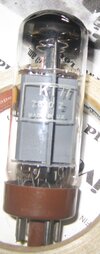
So putting in 6CA7s was a huge improvement over the EL-34s? Interesting.
I don't think I ever had an amp with 6CA7s in it, at least not that I knew of.
Then again, back in the day a number of old Gibsons, Ampegs, Traynors, and Olivers passed through my hands. Even a Hilgen.
When I was just starting out, I had no idea what tubes my amps used.
I never realized using two speaker cables could make a significant difference either.
Can't believe I never heard about that trick before.
Have to try it with my blackfaces. And the old warhorse Boogie amp.
The 6CA7 was something amp guru
@syscokid and
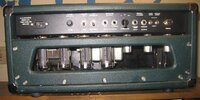
@ivan H suggested when they were both hot rodding my Origin 50 Head and I'm glad they did.
We used the "big bottle" EHX 6CA7.
Here's a description that I found online:
"The 6CA7 and EL34 tubes sound distinctively different. On a sonic scale, the 6CA7 tube is a hybrid between EL34 and 6L6 tube. Like the 6L6 and 6550, 6CA7 tube has a more pronounced low end. People often describe 6CA7 sound as heavier and darker than the EL34 tube."
In my own words, the 6CA7 was bigger and fuller sounding, across the entire sonic spectrum.
The gain structure is cleaner and more defined. Everything is "tighter" and the amp feels much more touch-sensitive at higher volumes, but with far less tendency to squeal/be uncontrollable at those levels.
Keep in mind that I set my master between 7-8 (dial markers not PM) and I "throttle" the amp with a FV30L in the FX loop, so I'm "up there" in terms of working those tubes.
Now, about the one cable - one speaker deal.
Most everyone will say "parallel out makes no difference."
I too though so too.
An old Fender amp guy comes to visit every now and then. He used to work with Leo in Fullerton. I had my 2x12 cabinet at work one day (because I had accidentally left it in the car after a gig and didn't want the heat to affect the glue on the Tolex) so I sat it down at my workstation) and he stopped by.
He looked at the cabinet and said, "Your cabinet? Looks custom. Like an old Bluesbreaker."
We chatted a bit and I showed him the speakers. He pushed his Fender ballcap back and said, "Finally, someone who doesnt do what everyone else does."
I asked him to tell me more. He chuckled and said, "Do you know the history of that speaker?"
I answered by telling him what I knew from the Celestion website.
He answered with a laugh, "That's some marketing guy's story. The real story goes farther back."
"Years ago, when Richie Blackmore was using the Marshall Majors, he kept blowing up everything Celestion had. They tried the G1275's and even bass speakers. So a few of the engineers at Celestion got together to create a speaker that could handle the output dynamics from Richie-Rich's 200 watt amps. That's where your speakers come from. I doubt anybody knows about this because Celestion kept it quiet because they didn't want guitar player's to realize how

ty the Creambacks and Greenbacks where from a reliability standpoint. Guys like Graham Banks would probably remember, maybe Ed Form or maybe Bob Smith, but they are probably long gone now and anyways, everyone involved was told not to discuss the speaker project publicly, so nobody will ever tell you the real story...."
He went on to say that running two cables changed something in the signal path that changed "loop resistance and improved FR numbers" but he went on to say that, "It always made a difference you could hear when you ran each speaker with its own cable. It's even better if you use heavier gauge wire in the cabinet too."
Naturally, we chatted a long time about many other things, but I was scratching down notes while listening without looking, so I took this from my hieroglyphs.
I tried it and it worked. The difference was a more pronounced tone, as if each frequency was brighter. It was a very noticeable difference....