Pine 4x12 with Celestion Blues dimension question[s]

Geeze

Well-Known Member
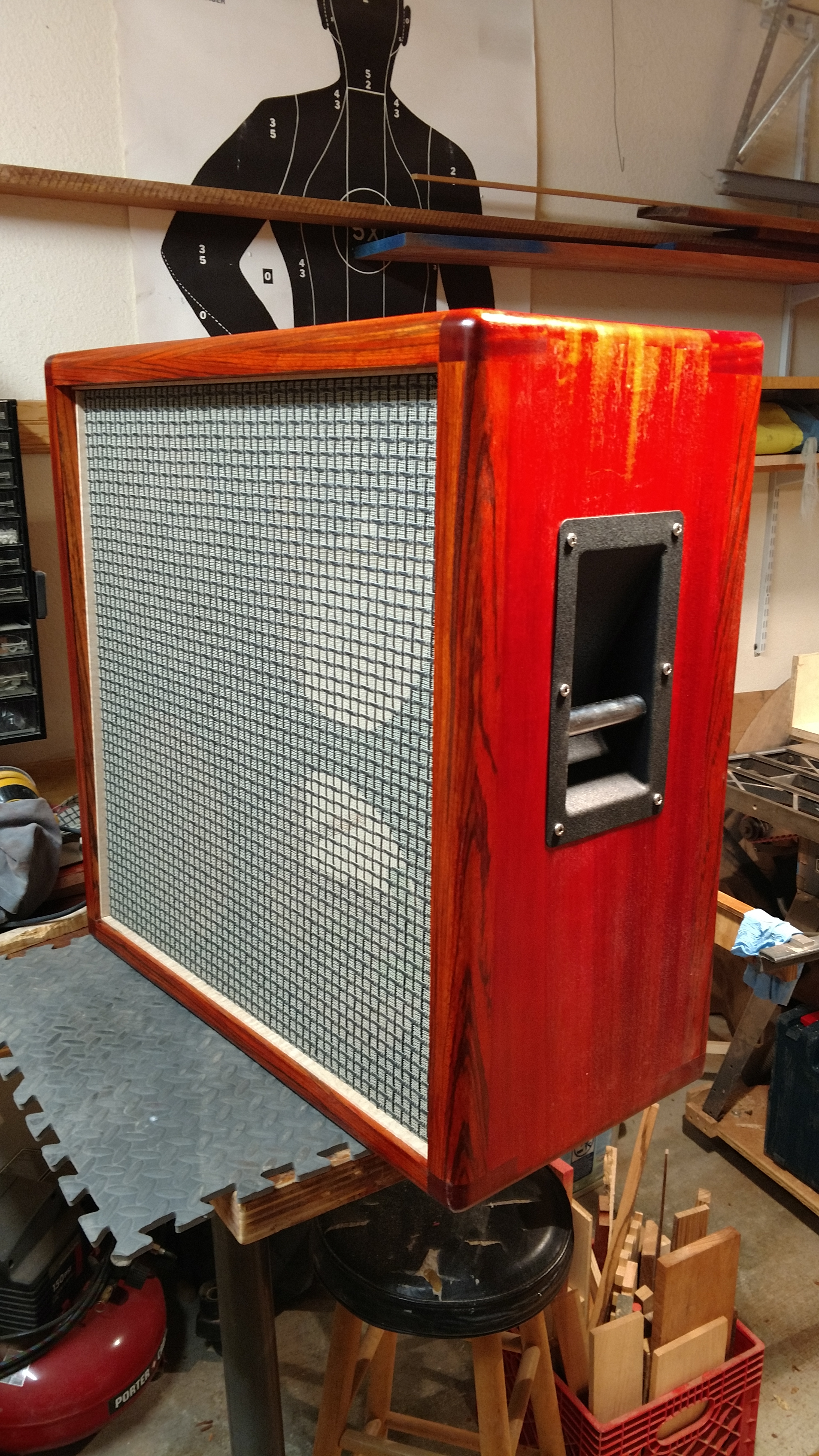
I've been lusting after yet another foolish cab that I suspect zero people are interested in - a B style 4x12 for Celestion Blues made with Radiata pine. Most of my amps are 35 watt and higher and I want the wattage cushion and I want to test the Radiata pine in this form factor as it has yielded several articulate and lively 1x12 cabs. @DirtySteve trolled a 16Ω Blue long enuff that I had to have it and need to collect one more for a quad.

The primary amps will be a Satellite Atom [AC30ish], Satellite Barracuda [JTM45ish] and a JTM45 clone. Possibly a 1987 or a Rockerverb MKIII. The Satellites tend to be voiced for single coil / P90s.

I have a couple of 1960Bs built with African mahogany which is a bit more open or looser grained than pine.

The questions -

  • Anyone have experience with a Blue 4x12?
  • A traditional 1960 cab is 30"x30" and 14" deep - would this be a good fit or would 12" depth be better?
  • Open or closed back? I'm thinking closed back as everything I own - including a combo - is closed back.
Yes this is a foolish quest but it keeps me engaged in my fortress of solitude.

Russ
 
I've been lusting after yet another foolish cab that I suspect zero people are interested in - a B style 4x12 for Celestion Blues made with Radiata pine.

Oh? Sounds like a cool idea to me...!

The primary amps will be a Satellite Atom [AC30ish], Satellite Barracuda [JTM45ish] and a JTM45 clone. Possibly a 1987 or a Rockerverb MKIII. The Satellites tend to be voiced for single coil / P90s.

Be aware that the power handling of the cab would be about 60W on paper. A 1987 will easily exceed that without breaking much of a sweat. Like all Celestion speakers, they're rated fairly conservatively and for continued use so you could get away with it but it would be a bit of a close shave if you really push the speakers in a closed back cab for an hour.

Anyone have experience with a Blue 4x12?

No, but a 2x12 was glorious...

A traditional 1960 cab is 30"x30" and 14" deep - would this be a good fit or would 12" depth be better?

I'd say there are two answers. The simple answer is "it doesn't really matter, try it and find out, you're not going to notice a huge difference". The more complex answer is that it depends on all the other dimensions of the cab as well. Ultimately, even if you do all the maths for the acoustics of the cab, you would need to take the intended space into account where you're going to use it, the character of the amp, your playing, etc. Testing is the sure way to find out.

Open or closed back? I'm thinking closed back as everything I own - including a combo - is closed back.

Another case of try and see, I'd say. Particularly open back or semi-open back cabs sound very different depending on placement in the room. Open gives the speakers more ventilation, so you might get away with more punishment from the 1987, but I tend to prefer closed back cabs for Marshalls overall. It's easy enough to remove the back to see what flips your switch...
 
Interesting project! I'm afraid I can't offer advice, as I don't have any experience with Alnico Blues.
I believe that some Bluesbreaker Combos as well as Vox amps used either Alnico Speakers or Greenbacks, so those should be a solid choice for the Amps you want to use.

Both of those Combos were open Back Cabinets, but of course the JTM45 in Head form is mostly associated with closed back Cabs.
Maybe the Amps could benefit from the stiffer bass response of a 12" deep Cab?

In that situation, it seems to me like everything is possible and could yield great results. Even If I can not offer something constructive (apart from encouragement) I'm really looking forward to what you will find out.
 
I believe that some Bluesbreaker Combos as well as Vox amps used either Alnico Speakers or Greenbacks, so those should be a solid choice for the Amps you want to use.

VOX used the Blue's and much later adopted Greenbacks, too. The original Bluesbreakers (and I think the later re-issues) had Greenbacks exclusively as far as I know.
 
Be aware that the power handling of the cab would be about 60W on paper. A 1987 will easily exceed that without breaking much of a sweat. Like all Celestion speakers, they're rated fairly conservatively and for continued use so you could get away with it but it would be a bit of a close shave if you really push the speakers in a closed back cab for an hour.

I believe the one saving grace here is that the volume pot is logarithmic in function AKA dialed to 'noon' on a 50 watt isn't 25 watts and is quite loud at that point 110dB+ louder than I'm looking for. The last time I dimed a 1959 I didn't care for the mess of overtones, spent time dialing it and finally - heresy I know - turned it down to 2-3 oclock and it sounded better. This was in 18,000 sqft, not in a house.

I'm going to treat the Blues like a vintage GB and not push it or play detuned metal - unless it sounds good.

No, but a 2x12 was glorious...

I have one and it's the reason for the 4x12.

I'd say there are two answers. The simple answer is "it doesn't really matter, try it and find out, you're not going to notice a huge difference".

I remember reading in an old RCA book [early 50's] that has a section on HiFi speaker enclosures. They said the cab can be too small or too big BUT there is a very wide range of volumes that will work fine.

I built a 4x8 bass style cab that the back accordions out to almost double size. In one of my grand wild hair plans - like this one - I was going to get a reference mic and plot frequencies to see what and how much difference it made. Now I'm curious on what the amp would see.

Russ
 
I believe the one saving grace here is that the volume pot is logarithmic in function AKA dialed to 'noon' on a 50 watt isn't 25 watts and is quite loud at that point 110dB+ louder than I'm looking for. The last time I dimed a 1959 I didn't care for the mess of overtones, spent time dialing it and finally - heresy I know - turned it down to 2-3 oclock and it sounded better. This was in 18,000 sqft, not in a house.

On a 1987 (or other similar amps) you actually hit the rated output power - 50W - in this case very quickly, probably with the knob about 10 or 11 o'clock. Remember that it's rated according to *clean* output, so as soon as you're getting any breakup from the amp you're hovering around the rated value or above.

I have one and it's the reason for the 4x12.

I like the way you think...

I remember reading in an old RCA book [early 50's] that has a section on HiFi speaker enclosures. They said the cab can be too small or too big BUT there is a very wide range of volumes that will work fine.

Speaker construction involves quite complex mathematics if you take it to the extremes in hi-fi reproduction. On the other hand, just slapping stuff together can work wonders for instrument amplification because you're not aiming for linear responses. A detrimental quirk in a speaker for hi-fi might be just the ticket for a guitar/amp combination of your choice. There's no real right and wrong either, just taste.

I built a 4x8 bass style cab that the back accordions out to almost double size. In one of my grand wild hair plans - like this one - I was going to get a reference mic and plot frequencies to see what and how much difference it made. Now I'm curious on what the amp would see.

Very cool, please do share! I built an oversized (and I mean OVERsized) 1x12 cab where I can slide the back in and out. It makes a fair amount of difference, but I eventually ended up putting damping wool inside. After that, it made less difference, but was still noticeable. I have a single GB in there now, and it's glorious for certain things.
 
Has anyone edge glued pine to form the baffle and back? I've done some serious edge gluing on amps over the years, this one is end grain glued [supposed to be the weakest joint] and has hauled a 2203 to numerous shows supported by the handle without an issue.

190QH9B.jpg


I have one last sheet of Russian BB ply and I'd love to NOT cut it as I wait at top speed for Pootie to stop being a dumbass...

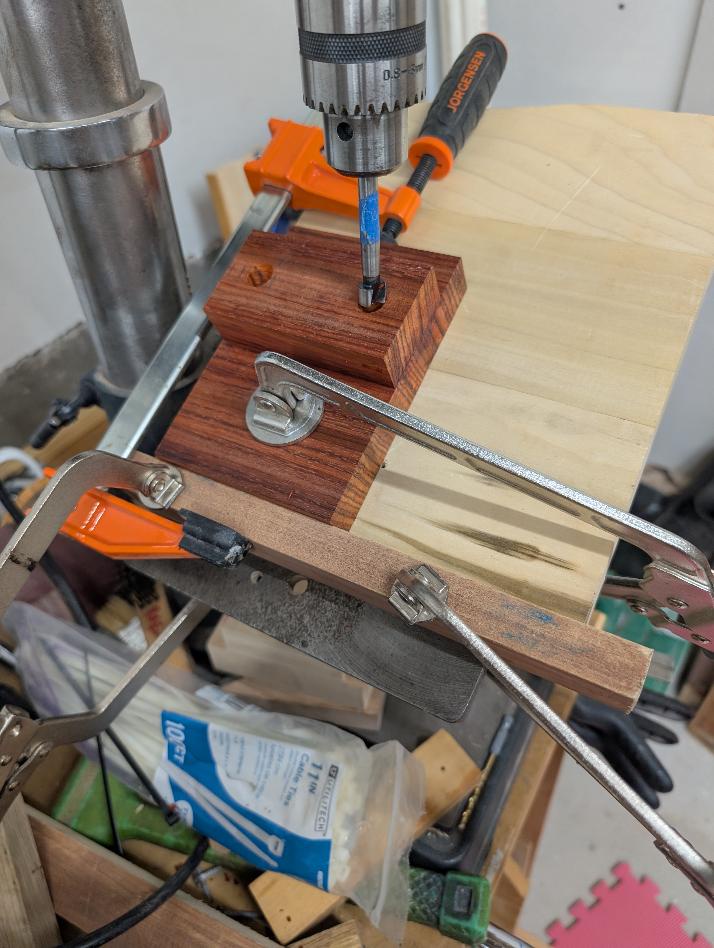
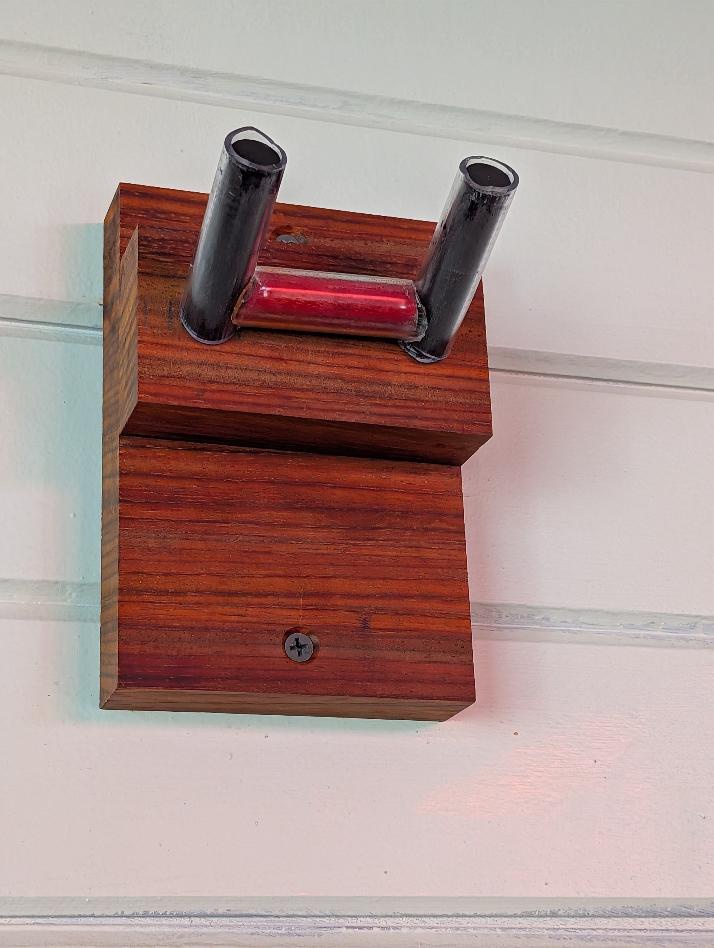
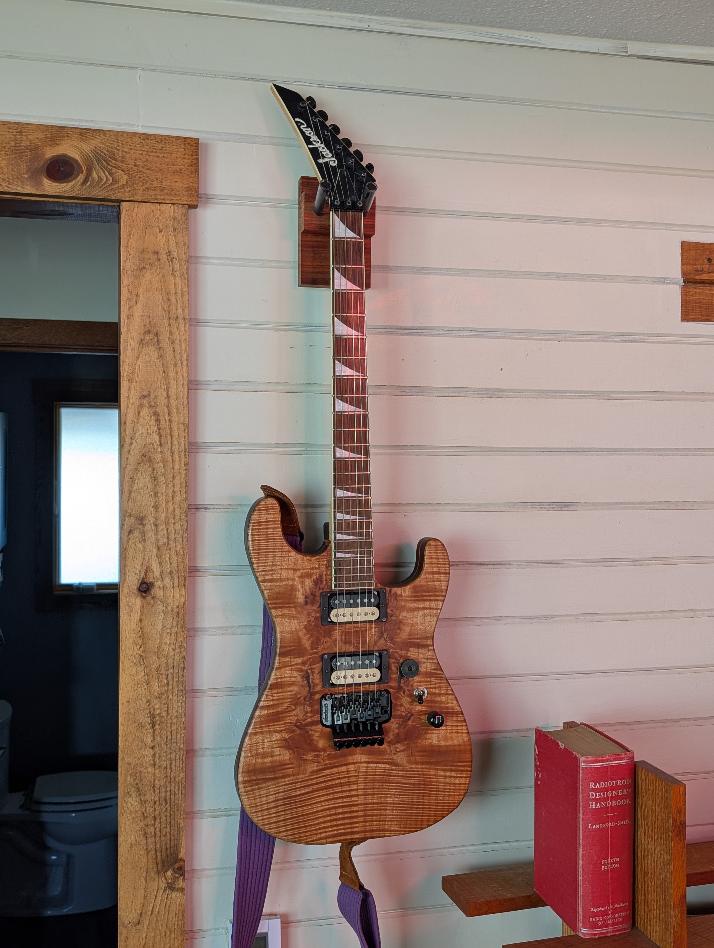
While I've been contemplating the mysteries of edge gluing I built a prototype guitar hanger - what better way to get rid of scraps.

Fun with clamps, tilted bed, and forstner bit.

z2vvmv3.jpg


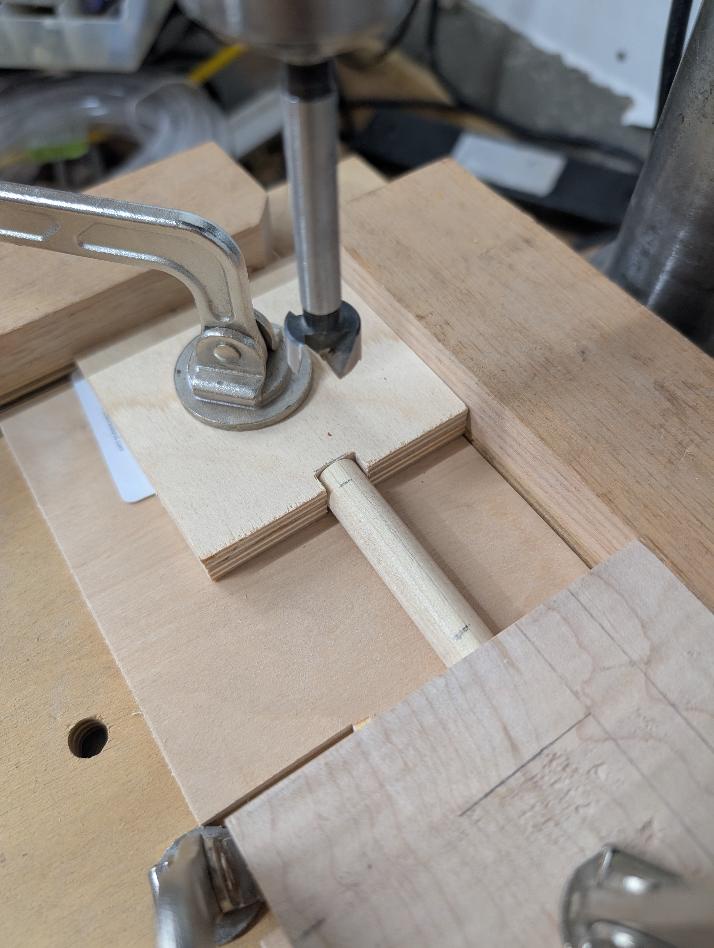
Cutting the center dowel ends with the forstner bit. I later figured out as I needed to shorten this that a oscillating sander will cut in the round notch just fine even with the 1/2" ID tubing.

K8JKnj3.jpg


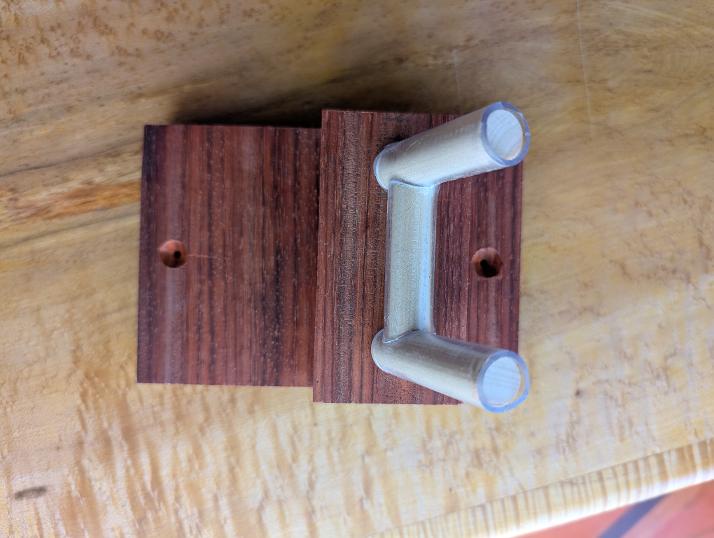
Assembled.

5D6fMpn.jpg


The dowels needed some color - sharpie on the posts and red leather dye on the backer now installed.

44K0b43.jpg


Guitar hung.

NJDKs6E.jpg


I was looking at placing the bookcase on this section of wall and then realized that the wall will hold 6 guitars if I don't.

Russ
 
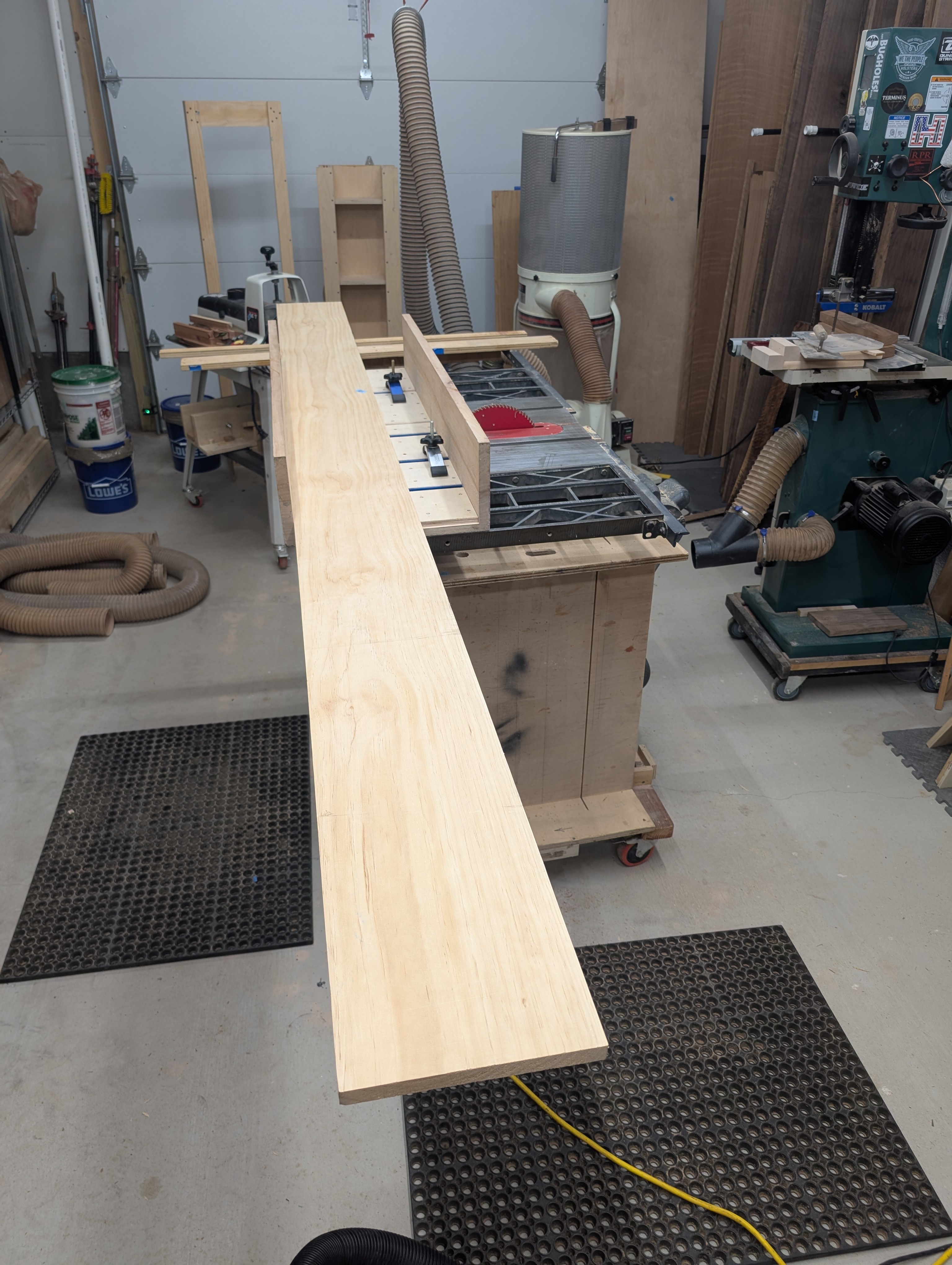
Well got off my dead ass - the first cut is the hardest for me, then it's all about fixing the first cut artfully - and chopped up some radiata. I thoroughly enjoy being able to swing a 120" board around from the rack to the saw and NOT hit anything

QqNp4W9.jpg


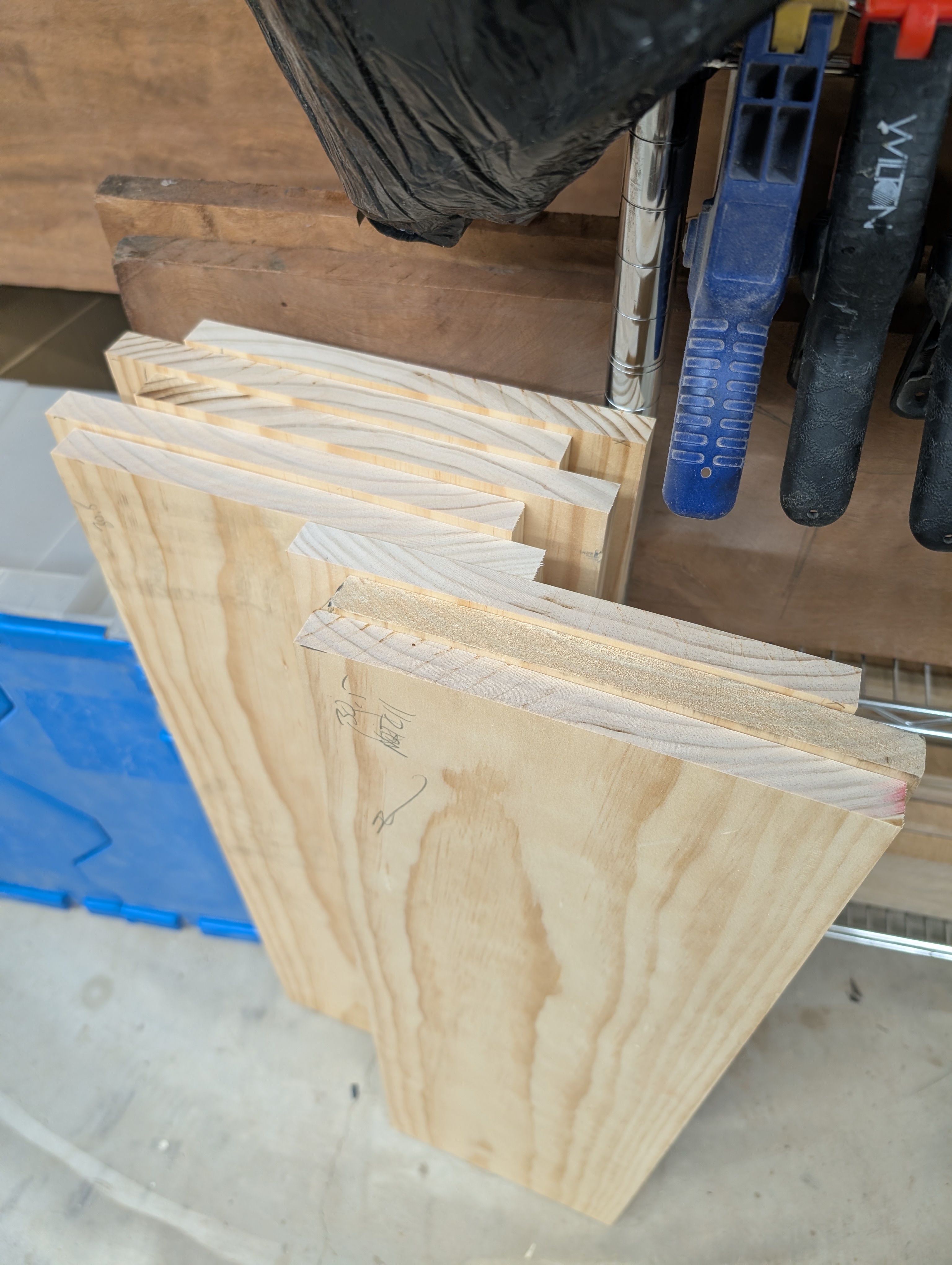
Chopped up. I'll need to split half of these to under 6" wide to form the 14" deep sides.

OdPIwzo.jpg


Russ
 
Well got off my dead ass - the first cut is the hardest for me, then it's all about fixing the first cut artfully - and chopped up some radiata. I thoroughly enjoy being able to swing a 120" board around from the rack to the saw and NOT hit anything
Oh yes, having some space is invaluable.

Seeing how flat- sawn these are, it could be beneficial to split them to prevent warping.

Will you do finger jointed Corners? (Why am I even asking this? Of course he will)
 
Seeing how flat- sawn these are, it could be beneficial to split them to prevent warping.

Will you do finger jointed Corners? (Why am I even asking this? Of course he will)
Each side will consist of two edge glued pieces, coupled with internal bracing and an external baffle ring of the same Radiata. And of course, the previously mentioned finger jointed ends.

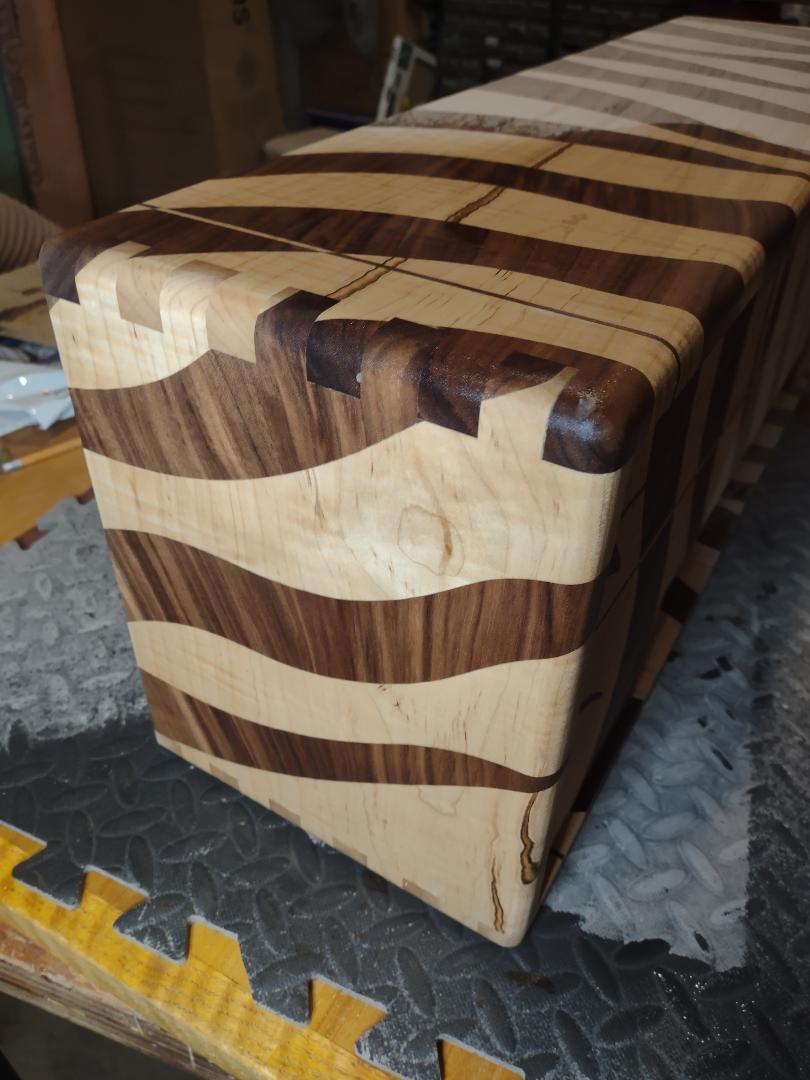
A number of years back in one of a series of discussions with the owner of the TN wood crack house that took all my money he mentioned the more glued pieces in a table top the more stable it is. I was planning two bits per side now I may go three. Or - the brain never stops - looking at the African mahogany 1960B in my living room it hasn't had any issues in 9+ years. Each plank side is at least 12" with a zebrawood edge and baffle ring.

4ugYcLT.jpg


Back to two pieces which I had no plans to evenly split the gap but when three bits entered the discussion that was my first thought. ADHD + OCD [mild] is two of the three mental Stooges.

Russ
 
A number of years back in one of a series of discussions with the owner of the TN wood crack house that took all my money he mentioned the more glued pieces in a table top the more stable it is. I was planning two bits per side now I may go three. Or - the brain never stops - looking at the African mahogany 1960B in my living room it hasn't had any issues in 9+ years. Each plank side is at least 12" with a zebrawood edge and baffle ring.
It is quite complicated, and it depends on so many factors. One of them is thickness in relation to width, and if you go Marshall- Spec, it would be only 16mm or 5/8" (?) thick. Maybe making everything a bit thicker, like 20mm, could be beneficial- and with pine, it wouldn't be overly heavy.

Ultimately you can judge much better of course, as you can look at the actual pieces. Just by looking at the pictures and seeing those long flat growth rings, it was the first thought that came to my mind.
 
Just by looking at the pictures and seeing those long flat growth rings, it was the first thought that came to my mind.
I'm a firm believer in over engineering / building and use 3/4" material. On 1960's I used the 19mm BB and never needed a center post. I expect a bit more flexure with the pine and may need one.

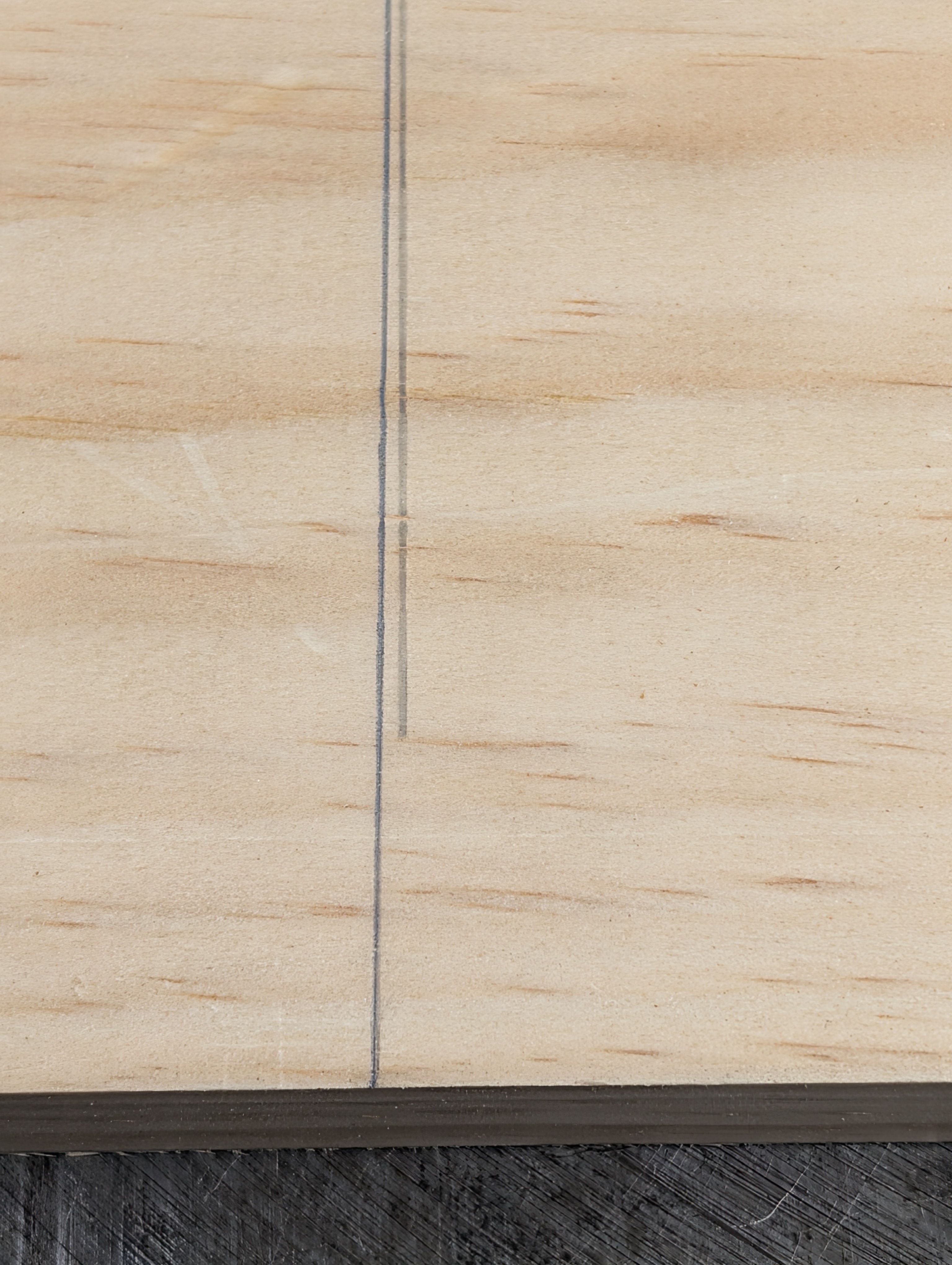
One of the planks had some twist so I ripped them in half on a bandsaw then trimmed the sides parallel on the table saw. While it would be nice to trust that the sides on 4S [sanded on all 4 sides] wood is parallel always best to check to see what kind of remedial work is required to fix it. These are square lines [to each side].

G3WmkSn.jpg


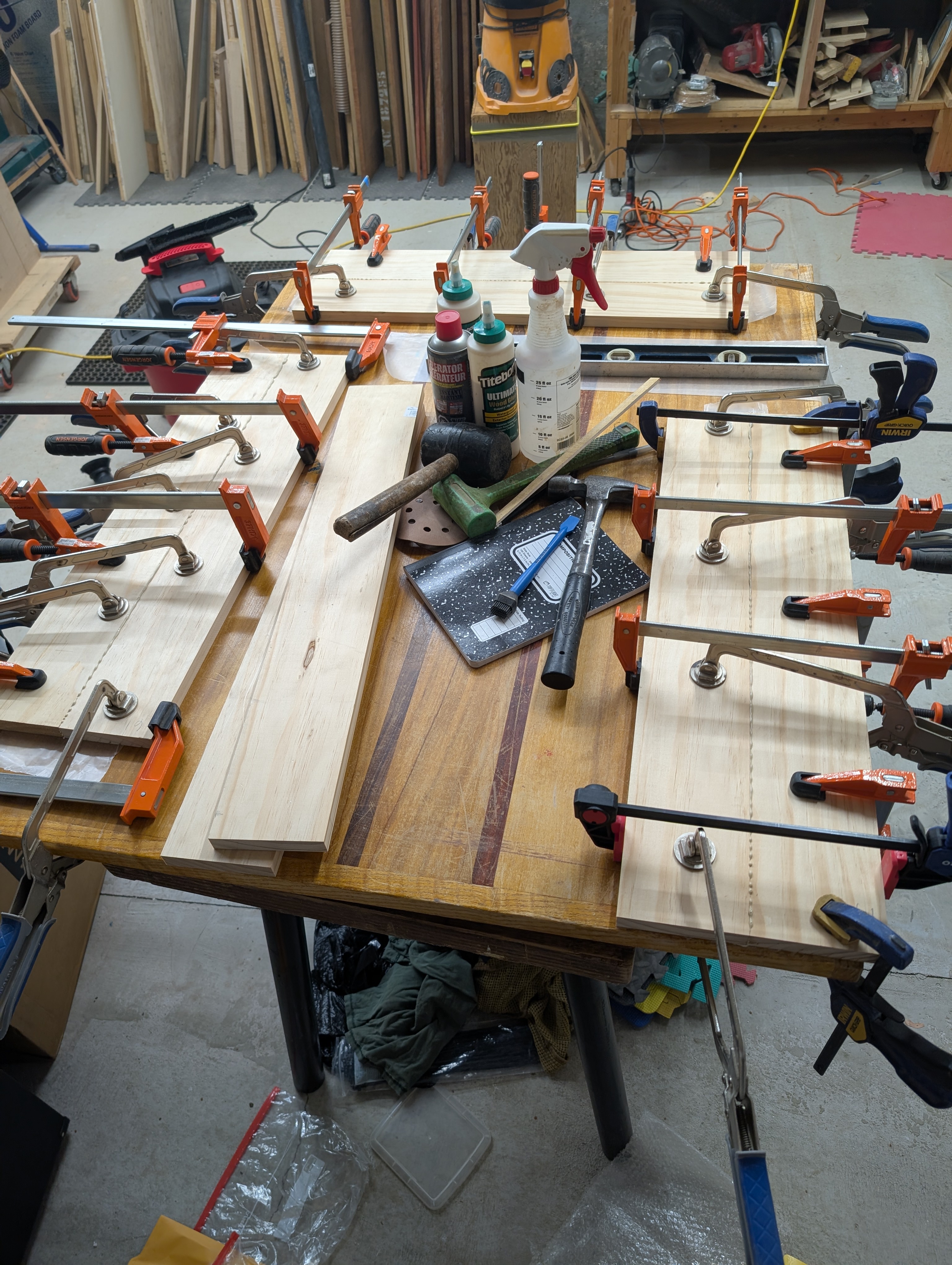
Glue up has commenced on the first two bits for each side.

O4buzdf.jpg


Water break and probably more yard work while its a balmy 84°.

Russ
 
Back
Top