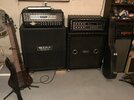
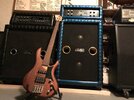
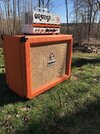
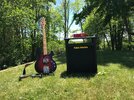
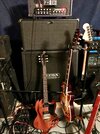
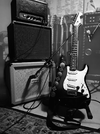
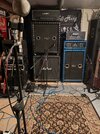
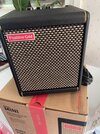
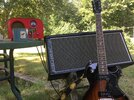
Pictures of AMPS

Wow! Not much room between the magnet, choke, and tubes.
I'm pretty sure it's a Valco.
Valco made amps for several different name brands....but you can tell a Valco by the chassis form factor.
Primarily sold for use with a lap steel guitar (Hawaiian Slide Guitar).

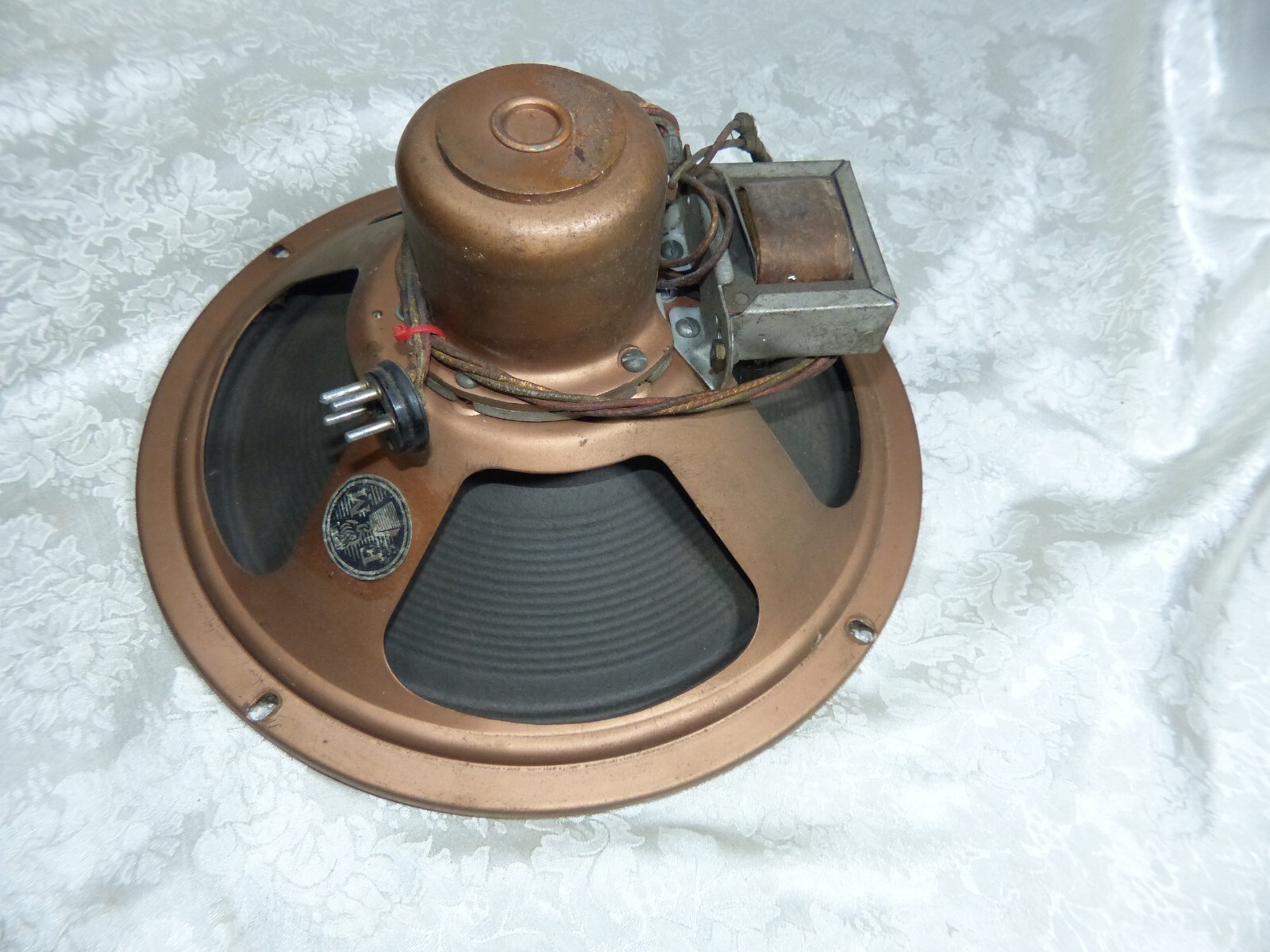
Originally this amp had a field coil speaker...
That is, the speaker magnet was an electromagnet. Not a permanent magnet.
This made the speaker lighter weight compared to an iron magnet of the 1930s-40s.
The speaker electro- magnet was powered by the B+ amp voltage....

Something like this:
the output transformer is part of the speaker...

s-l1600.jpg


mgwovkpii1evprpqodeh.jpg
similar to this arrangement.

However, this amp in the Magna picture is now modified for a modern permanent magnet speaker.
The high voltage no longer powers the magnet.

 
Last edited:
And here’s what the Pete Cornish camp had to say about Jimmy Page’s gear:

JIMMY PAGE’S GUITAR/EFFECTS/AMPS FLOOR SYSTEM


After extensive testing and comparisons of various effects pedals and amplifiers by Jimmy and his technician we were asked to build an effects system that would operate with equal efficiency in every country in the world and incorporate all Jimmy’s chosen effects and route the signal to several amplifiers.​

Most of the effects had so called “true bypass” footswitches and we decided to investigate whether we could use this system with the entire collection of effects and amps as so many manufacturers offer the “true bypass” as the ultimate type of switching.

Our findings were that the “true bypass” did NOT create unified signal level or tone from the guitar for the following reason:
Take for instance a 5m guitar cable linked to six pedals, each linked by a 1m cable, and then on to the amp by say a 15m cable. If all pedals have “true bypass”, and are off, then the total cable length hanging on the guitar output will be 25m. This will cause a huge loss of tone and signal level particularly if the guitar is a vintage type with low output. The amp volume is then turned up and the treble control increased to compensate for the losses. The inherent background noise now increases by the amount of the gain and treble increase and is usually, in my experience, too bad for serious work. If one of the pedals is now switched on, then it’s high input impedance (and usually low output impedance) will buffer the output cables from the guitar; the signal level and treble content will rise due to the removal of some of the load on the pickups (i.e. 6m instead of 25m of cable). If that pedal was for example a chorus or delay, devices which are usually unity gain, then the overall signal level and tone will vary each time an effect is added…not a very good idea.

The “Pete Cornish System”, which we devised in the early 70’s, is to feed the guitar into a fixed high impedance load, which is identical to the amp input, and then distribute the signal to the various effects and amps by low impedance buffered feeds. This gives a constant signal level and tonal characteristics from the guitar, which do not change at all when effects are added. The proof that this works are in the recordings of our clients: Roxy Music; The Police; Queen; Pink Floyd; Bryan Adams; Lou Reed; Dire Straits; Paul McCartney; Sting; Judas Priest; Black Sabbath….

For Jimmy’s stage system, we fitted additional high impedance pre-amps between each effect to further isolate each one from the next in line. We also provided two send/return circuits so that new effects could be added at a later date and another send/return to Jimmy’s Echoplex. The four isolated outputs to the stage amplifiers each had a line driver fitted to overcome the very long across-stage cables (total length 64m).

To ensure that the sound of the guitar and effects would remain constant at each venue across the world we designed “super regulated” dc power supplies to suit both the effects and the audio frequency pre-amps. Each effect and pre-amp had it’s own isolated dc feed which we know helps to prevent cross-leakage of effect signals: for example upper harmonic distortion products can leak into clean chorus circuits through a common power supply if this precaution is not taken.

Jimmy was very pleased with his “Pete Cornish Guitar/Effects/Amps System” and it has proved most reliable and convenient to set up, as all the effects and routing are permanently in the correct
order and it is so simple to “just plug in and play…”

GUITAR SYSTEM S/No: 257
DESIGNED AND BUILT BY PETE AND LYNDA CORNISH
OCTOBER 1993

Signal Routing:

Guitars connected to Pete Cornish Input Selector and Line Driver (off stage) via Pete Cornish HD Guitar Cables
Selected Guitar Signal to Effects / Amps Pedalboard via Pete Cornish Custom
Signal Cable Loom (Loom includes Amp Feeds and Remote Mute Control)
Pedalboard Input – Unity Gain
Emergency Automatic Mechanical Bypass to Output #1 in case of Power Failure
Send / Return to Spare FX #1 with Bypass Switch
Roger Meyer Voodoo Fuzz – Removed in January 1996 – Replaced by Amp Lead switch for 2 off Fender Tone Master
MXR Phase 90 with Bypass Switch
Yamaha CH-10Mk II Chorus with Bypass Switch
Send / Return to Spare FX #2 with Bypass Switch
Boss CE-2 Chorus with Bypass Switch
Jen Cry-Baby Wah with Bypass Switch
Digitec WH-1 Whammy + Pete Cornish Linear Boost 0/+20dB with Bypass Switch
Send / Return to Echoplex EP3 (modified by Pete Cornish) with Adjustable Gain and Bypass Switch
Linear Boost all Outputs 0/+20dB with Bypass Switch
Master Volume
Local and Remote Mute All Outputs
3 off Outputs to Amps – Output #4 added January 1995
115V Output to Echoplex

AMPS:

2 off Fender Tone-Master S/Nos: 0869/0864
2 off Vox AC30 (Original T.Boost Model)​


corn1.jpg
 
My first amp was one of these
16716053134733358240850114861161.jpg
Very early 60's Aussie made (Vadis 601), really regret having let it go. Of all the amps that I could post pics of, I'll just show the important one.
16111859701404709200760034480149.jpg
'67/'68 JMP50. While only a "player" grade amp, aside from the filters & bias supply filters that I replaced, all iron & electronic components are original. Fitted with 163 series Mullard CV4004's & a matching date code duet of double halo getter xf2 Mullard EL34's. It's never had screen grid or grid stopper resistors fitted & sound frikkin awesome. Now I need to find a matching cabinet for it. Cheers
 
Last edited:
And here’s what the Pete Cornish camp had to say about Jimmy Page’s gear:

JIMMY PAGE’S GUITAR/EFFECTS/AMPS FLOOR SYSTEM


After extensive testing and comparisons of various effects pedals and amplifiers by Jimmy and his technician we were asked to build an effects system that would operate with equal efficiency in every country in the world and incorporate all Jimmy’s chosen effects and route the signal to several amplifiers.​

Most of the effects had so called “true bypass” footswitches and we decided to investigate whether we could use this system with the entire collection of effects and amps as so many manufacturers offer the “true bypass” as the ultimate type of switching.

Our findings were that the “true bypass” did NOT create unified signal level or tone from the guitar for the following reason:
Take for instance a 5m guitar cable linked to six pedals, each linked by a 1m cable, and then on to the amp by say a 15m cable. If all pedals have “true bypass”, and are off, then the total cable length hanging on the guitar output will be 25m. This will cause a huge loss of tone and signal level particularly if the guitar is a vintage type with low output. The amp volume is then turned up and the treble control increased to compensate for the losses. The inherent background noise now increases by the amount of the gain and treble increase and is usually, in my experience, too bad for serious work. If one of the pedals is now switched on, then it’s high input impedance (and usually low output impedance) will buffer the output cables from the guitar; the signal level and treble content will rise due to the removal of some of the load on the pickups (i.e. 6m instead of 25m of cable). If that pedal was for example a chorus or delay, devices which are usually unity gain, then the overall signal level and tone will vary each time an effect is added…not a very good idea.

The “Pete Cornish System”, which we devised in the early 70’s, is to feed the guitar into a fixed high impedance load, which is identical to the amp input, and then distribute the signal to the various effects and amps by low impedance buffered feeds. This gives a constant signal level and tonal characteristics from the guitar, which do not change at all when effects are added. The proof that this works are in the recordings of our clients: Roxy Music; The Police; Queen; Pink Floyd; Bryan Adams; Lou Reed; Dire Straits; Paul McCartney; Sting; Judas Priest; Black Sabbath….

For Jimmy’s stage system, we fitted additional high impedance pre-amps between each effect to further isolate each one from the next in line. We also provided two send/return circuits so that new effects could be added at a later date and another send/return to Jimmy’s Echoplex. The four isolated outputs to the stage amplifiers each had a line driver fitted to overcome the very long across-stage cables (total length 64m).

To ensure that the sound of the guitar and effects would remain constant at each venue across the world we designed “super regulated” dc power supplies to suit both the effects and the audio frequency pre-amps. Each effect and pre-amp had it’s own isolated dc feed which we know helps to prevent cross-leakage of effect signals: for example upper harmonic distortion products can leak into clean chorus circuits through a common power supply if this precaution is not taken.

Jimmy was very pleased with his “Pete Cornish Guitar/Effects/Amps System” and it has proved most reliable and convenient to set up, as all the effects and routing are permanently in the correct
order and it is so simple to “just plug in and play…”

GUITAR SYSTEM S/No: 257
DESIGNED AND BUILT BY PETE AND LYNDA CORNISH
OCTOBER 1993

Signal Routing:

Guitars connected to Pete Cornish Input Selector and Line Driver (off stage) via Pete Cornish HD Guitar Cables
Selected Guitar Signal to Effects / Amps Pedalboard via Pete Cornish Custom
Signal Cable Loom (Loom includes Amp Feeds and Remote Mute Control)
Pedalboard Input – Unity Gain
Emergency Automatic Mechanical Bypass to Output #1 in case of Power Failure
Send / Return to Spare FX #1 with Bypass Switch
Roger Meyer Voodoo Fuzz – Removed in January 1996 – Replaced by Amp Lead switch for 2 off Fender Tone Master
MXR Phase 90 with Bypass Switch
Yamaha CH-10Mk II Chorus with Bypass Switch
Send / Return to Spare FX #2 with Bypass Switch
Boss CE-2 Chorus with Bypass Switch
Jen Cry-Baby Wah with Bypass Switch
Digitec WH-1 Whammy + Pete Cornish Linear Boost 0/+20dB with Bypass Switch
Send / Return to Echoplex EP3 (modified by Pete Cornish) with Adjustable Gain and Bypass Switch
Linear Boost all Outputs 0/+20dB with Bypass Switch
Master Volume
Local and Remote Mute All Outputs
3 off Outputs to Amps – Output #4 added January 1995
115V Output to Echoplex

AMPS:

2 off Fender Tone-Master S/Nos: 0869/0864
2 off Vox AC30 (Original T.Boost Model)​


corn1.jpg
That's a lot of gear , of course in their early recordings there are studio pictures of a supro. My point is that studio recordings are mysterious and magic happens.
 
Last edited:
Back
Top