Peavey Beantown Boom Stick

What I’m thinking might have occurred with a previous owner:

Do you think it’s possible that they adjusted a bit of neck tilt, but cranked the neck screws tight enough to force the metal disk up, causing a rise in the frets/fretboard above?
 
What I’m thinking might have occurred with a previous owner:

Do you think it’s possible that they adjusted a bit of neck tilt, but cranked the neck screws tight enough to force the metal disk up, causing a rise in the frets/fretboard above?
I do not think so. Frankly, I think that very few production guitars and basses come with solid fretwork. Then, over time, wood warps and causes anomalies, fretboards wear downward making frets proud, etc. This bass has been played which is nice to see. Since it is still in good shape, I think the owner must have liked it very much. However, like so many people, they do not want to spring for a fretjob, etc. It is possible that this bass has never had fretwork. One way or the other, with your permission, we will do what it takes to make this play nicely
 
I do not think so. Frankly, I think that very few production guitars and basses come with solid fretwork. Then, over time, wood warps and causes anomalies, fretboards wear downward making frets proud, etc. This bass has been played which is nice to see. Since it is still in good shape, I think the owner must have liked it very much. However, like so many people, they do not want to spring for a fretjob, etc. It is possible that this bass has never had fretwork. One way or the other, with your permission, we will do what it takes to make this play nicely
Indeed. Granted.
 
  • Like
Reactions: RVA
So the good news is that the TR works. It seems to have plenty if travel. I am not sure exactly how much because I do not think there is any point in cranking it any further. This FB is all over the place, and I do not think it will ever be right without being planed.

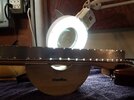
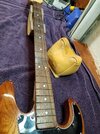
You can see here that the problem is not just a high fret, but rather a high fretboard at the body end.

20190201_192736.jpg

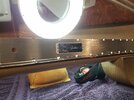
The middle gaps are variable

20190201_192744.jpg

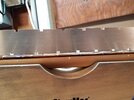
In fact the middle only touches down in a few spots.

20190201_193058.jpg

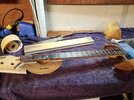
I think it is time to pull these frets and fix this board.
 
Last edited:
:shock:would it be a bad time to suggest-----------going FRETLESS!!!!!!!!!!!!!!!!!!!!!!!!!!!

seriously -- its like going TOPLESS -- well sorta -- I
LOVE my fretless EB "P"
just a thought......
Those fret slots would need some filling...probably as much work, or maybe more, than a re-fret.
Nice try though:D
 
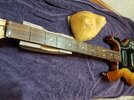
love that color burst dude--------love it
20190201_204923-jpg.21864
 
I am dying to find out, but conventional wisdom says not too crank too much at one time, and to give the wood time to rest between big moves. The smart move is to find out tomorrow. If not, a refret and FB plane will bring this to a new level, but it will visibly "altered"

I cranked the TR a bit more this morning and it was darn close to flat. I will see if I can take it the rest of the way tonight.

When I read discussions about neck relief and truss rod adjustments, I feel I should bring something up I feel might save some major headaches from either stripped TRod nuts,, T rod breaks, and all manner of potential OOPs moments when attempting to make a neck good and flat.

I believe the real function of a truss rod is to keep the neck stable and straight rather than to take out large bows in them. So, if one has a fairly large bow in their neck to a point such as it seems Ray's Peavey is, I hear it is better to put your neck in a jig and basically use clamps to take out the bow and then adjust the nut on the T rod to hold the neck straight. If the neck is close and just needs a smidge of adjustment to make it straight, then small turns of the T rod nut should be fine to bring it into spec.

If anyone else has tips and hints regarding neck stability before/during/ after adjustment please feel free to enlighten me. I kind of always saw mention of making small adjustments, then give the neck time to settle in. Then if still need be, make another small adjustment and let sit. Basically don't over do it and force a neck straight, using the T rod.
 
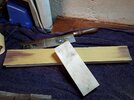
I use the small block to target the high ends and periodically check with the long beam. As the gap in the middle closes so that I am hitting wood most of the way through, I will switch to the long beam exclusively until it is flat. The fret slot saw is to chase down the slots as they try to dissaepear on me

20190201_235656.jpg
 
Last edited:
Back
Top