OK Admittedly clueless, School me on Preamps, Mixers, Sound Software

chilipeppermaniac

Ambassador of Decibels
Country flag
Ok I admit I know what a mixing board is, I know pro's have sound men, studios have engineers, there are things called protools etc. BUT, I am totally tech clueless as to how people put all the pieces together.

Here is an example I accidentally came across while trying to hear good examples of my Laney AOR Pro Tube Lead 50.

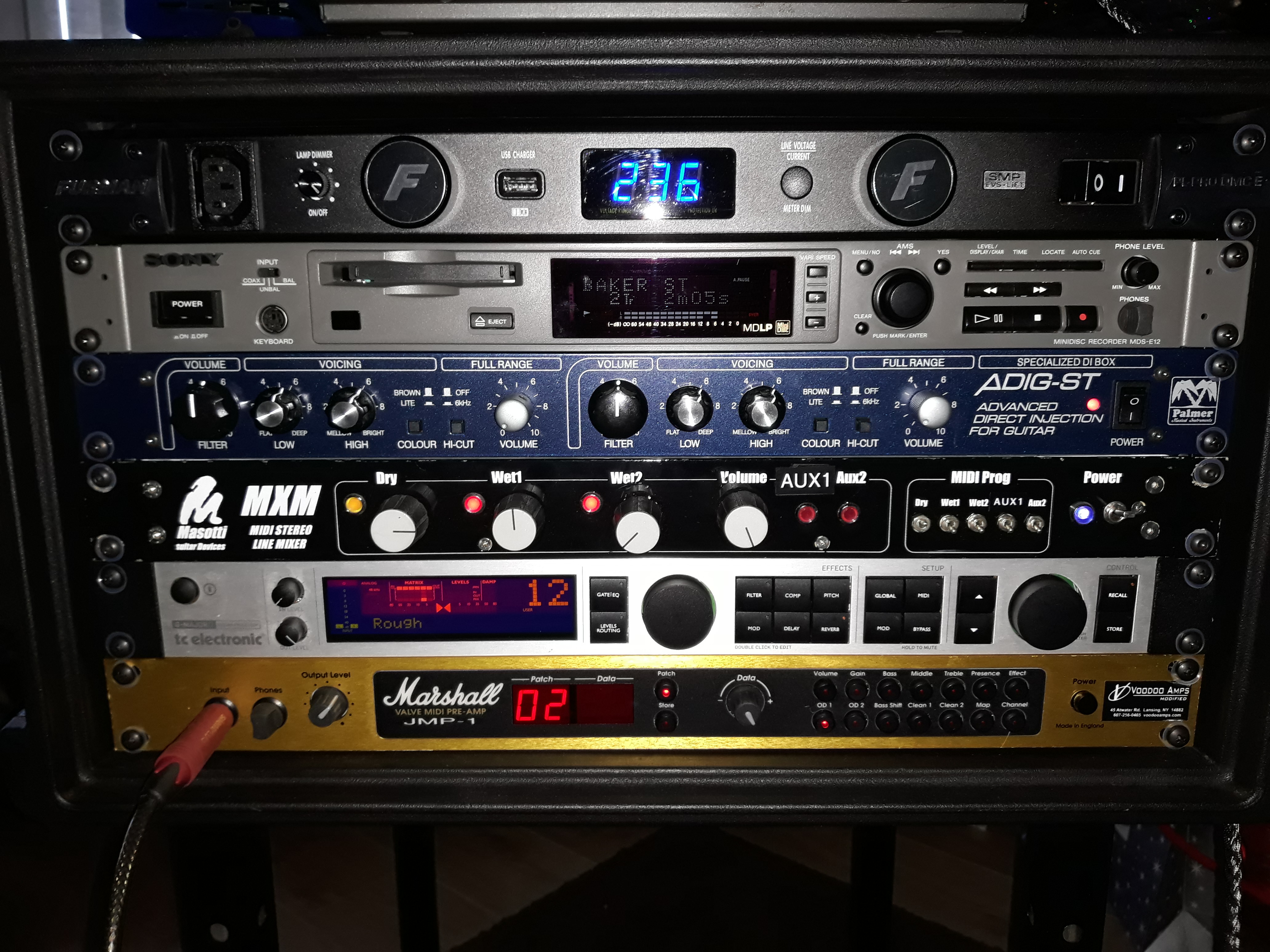
This guy uses software but is also a fine player it seems. Now, to me his sound reproduces really well as I hear it through my headphones. But can someone tell me the secret to this JMP-1 Preamp, and how would it color amps I have? Which drives which? Does it plug into the amp and color the amp, or does the amp used color the preamp? Explain how these work please.

Also, a few weeks ago, RVA was recording some chops through a mixer type thing and was getting hum. With 1 second of using a mixer experience, I managed to find the solution to his hum. He since bought a different unit to attain the goal he wanted from his setup.

So, what is the SHiz,,, the secret mojo making setup for home recording? Do we buy the good stuff-- combo of hardware and software for that unit, or do we buy mic's and basically download software to do the recording and replay of our performances? What is the secret formula? Thanks


 
Hahahahaha Chili!
Adrian is right...it’s a deep hole, indeed.
The preamp in the first video was a rack mount guitar preamp. It’s meant to be plugged in to a power amp. You would plug your guitar in to the preamp, the preamp in to a power amp, and the power amp in to a speaker cab.

He had a mic in front of the speaker cab...that would be plugged into a different type of preamp...geared towards microphone use...perhaps part of a DAW interface of some kind. That interface would be an analog to digital converter, and likely a digital to analog converter as well. But a different animal than the preamp in the first video.
 
Last edited:
Ok I admit I know what a mixing board is, I know pro's have sound men, studios have engineers, there are things called protools etc. BUT, I am totally tech clueless as to how people put all the pieces together.

Here is an example I accidentally came across while trying to hear good examples of my Laney AOR Pro Tube Lead 50.

This guy uses software but is also a fine player it seems. Now, to me his sound reproduces really well as I hear it through my headphones. But can someone tell me the secret to this JMP-1 Preamp, and how would it color amps I have? Which drives which? Does it plug into the amp and color the amp, or does the amp used color the preamp? Explain how these work please.

Also, a few weeks ago, RVA was recording some chops through a mixer type thing and was getting hum. With 1 second of using a mixer experience, I managed to find the solution to his hum. He since bought a different unit to attain the goal he wanted from his setup.

So, what is the SHiz,,, the secret mojo making setup for home recording? Do we buy the good stuff-- combo of hardware and software for that unit, or do we buy mic's and basically download software to do the recording and replay of our performances? What is the secret formula? Thanks


Chili,

I'm not in the same league with a lot of our home recording guru's here, but I will share what I have experienced with you.

I use a super basic, super simple setup. It's a Focusrite/Scarlett pre-amp/USB interface (which provides phantom power for a Focusrite microphone) and I have a fully licensed version of Audacity. I record with my amp going direct out into the USB interface and I have laid down tracks for hire here at home with a room full of noisy people nearby.

I know there are better, more costly equipment out there, but I routinely share files with a colleague who uses Pro-Tools and he has remarked on how good my sound quality is with a $249.00 studio setup.

Many will say that mic-ing a speaker cabinet is the only way to go. However, without a dedicated and soundproofed room, that's hard to do.

When I recorded Ace Of Spades, all the guitars and bass were recorded here in my home 'studio' direct out. If you listen to it on a good system, the guitars and bass are very dynamic and I seriously doubt that mic-ing the speakers would have made the finished recording any better.

Here's the equipment used and where the guitars and bass tracks were laid down:

20181107_231603.jpg

And here's the finished product:

VON - HERNDON ACE - OF - SPADES MIX2A 07192018 REMIXED

This is just an example of what I was able to get out of my simple setup and considering the investment, the tone is very good. The drums and vocals were recorded in a legitimate recording studio and everything seems to blend together seamlessly.

I would suggest starting out slow (cheap) and moving up from there...

Happy Holidays!!!
 
Last edited:
Heck I would just be happy knowing how to play respectfully, instead a of being a hack player. I do love having nice gear though.

I am with you there, ChasFred. Although, like I always wanted to understand electronics but felt it was too hard for me to ever learn. I put it off from childhood till 53 years old. Then, I got encouragement from a former member here, plus had great and patient mentors in DonP and IvanH and advice from 67plexi, Smitty and a few others. They aided me in learning the components, circuit theory, amp design and the general principles of electronics. My investment paid off greatly. In learning bit by bit over many hours of PMing, books and video research, I pored over the actual boards on amps to try to figure out what component aligned with the symbols on schematics that denote each bit. Then I set about assembling in my mind, the signal paths, the logic of why certain resistors and caps were installed where, and how it all was supposed to function to produce the intended sound palette the designers engineered to occur. All this led to fixing a few valve amps of mine and a friend's. At least one was Point to Point, the other PCB type. Having said all this, I would have been happy just going to a store or buying any amp I desired at a pawn shop, ebay, craigslist or wherever and call it a day. But in reality, eventually one or all of them would need work and I am way better figuring out how to fix things myself. Having said all this, by being pro active I am now able to fix my own stuff instead of picking and locating a reliable, trustworthy, and diligent tech not mess up my good stuff type of tech anywhere close to home.

Having said all this, I still remember watching fellas run sound for bands and wanting to figure out how to do that too.
Now in helping RVA figure out his troubles one morning, I learned a little about that Audacity and other type software which is now adding to my curiousity to figure out what all this stuff really is capable of doing.
 
If nothing he'll get you started in the right direction, well, probably more correct to say in a direction some consider right - you'll quickly find that not all agree what is better or correct in the world of recording, mixing, and mastering.

That’s the difficult part...it’s so subjective. One persons comfort zone does not fit all, and there are many good choices out there.
Finding the right fit for you is going to be up to you.
I have a few different choices at my disposal. But lately, if I’m not recording a full band, or drum kit, I like using an ART USB Dual Pre in to an old iPad 2. Quiet, portable, and flexible. I can record 2 sources at once. It all runs off the iPad power...unless I have a condenser mic, and need phantom power...then I use a 9volt battery. Again, pretty easy for me. I think I bought the app for the iPad(and/or iPhone) for less than $20, including the upgrade from 8-24 track capability. The ART that I mentioned works fine on a computer as well...much like Robert’s interface, mentioned above.
 
That’s the difficult part...it’s so subjective. One persons comfort zone does not fit all, and there are many good choices out there.
Finding the right fit for you is going to be up to you.
I have a few different choices at my disposal. But lately, if I’m not recording a full band, or drum kit, I like using an ART USB Dual Pre in to an old iPad 2. Quiet, portable, and flexible. I can record 2 sources at once. It all runs off the iPad power...unless I have a condenser mic, and need phantom power...then I use a 9volt battery. Again, pretty easy for me. I think I bought the app for the iPad(and/or iPhone) for less than $20, including the upgrade from 8-24 track capability. The ART that I mentioned works fine on a computer as well...much like Robert’s interface, mentioned above.

I've found driving the piss out of a board incorrectly can produce some great sounds - but, that is a general big no, no - lol. But, the people listening would never know it's what you did ;)

I've found in the world of music that there are rules, but one of the rules is you can brake the rules up to a certain point and it sounds great, but the trick is to learn/know when, where, and how much those rules can be broke. Music is a science that is artfully manipulated...
 
I've found driving the piss out of a board incorrectly can produce some great sounds - but, that is a general big no, no - lol. But, the people listening would never know it's what you did ;)

I've found in the world of music that there are rules, but one of the rules is you can brake the rules up to a certain point and it sounds great, but the trick is to learn/know when, where, and how much those rules can be broke. Music is a science that is artfully manipulated...

I hear ya there, drumoid. Now does anyone have explanations of what a preamp unit like the Marshall JMP-1 does and how it is best used? That whole rack mounted thing, if ya know what I mean.

One guy in another forum uses one and is happy with his setup.
FNi0OoK.jpg


Tell me about the Marshall JMP-1 preamp
 
Last edited:
Now does anyone have explanations of what a preamp unit like the Marshall JMP-1 does and how it is best used? That whole rack mounted thing, if ya know what I mean.
Hahahahaha Chili!
Adrian is right...it’s a deep hole, indeed.
The preamp in the first video was a rack mount guitar preamp. It’s meant to be plugged in to a power amp. You would plug your guitar in to the preamp, the preamp in to a power amp, and the power amp in to a speaker cab

See my other quote above.
In short, it does what the gain, and eq controls would normally do on a guitar amp. It just won’t power a speaker. It puts out a line level signal.
 
I've found driving the piss out of a board incorrectly can produce some great sounds - but, that is a general big no, no - lol. But, the people listening would never know it's what you did ;)

I've found in the world of music that there are rules, but one of the rules is you can brake the rules up to a certain point and it sounds great, but the trick is to learn/know when, where, and how much those rules can be broke. Music is a science that is artfully manipulated...

Yep! Driving the piss out of an analog pre can be quite cool, and is the technique responsible for many classic tracks.(amongst others)
Driving a digital signal in the digital domain doesn’t yield the same results though.
 
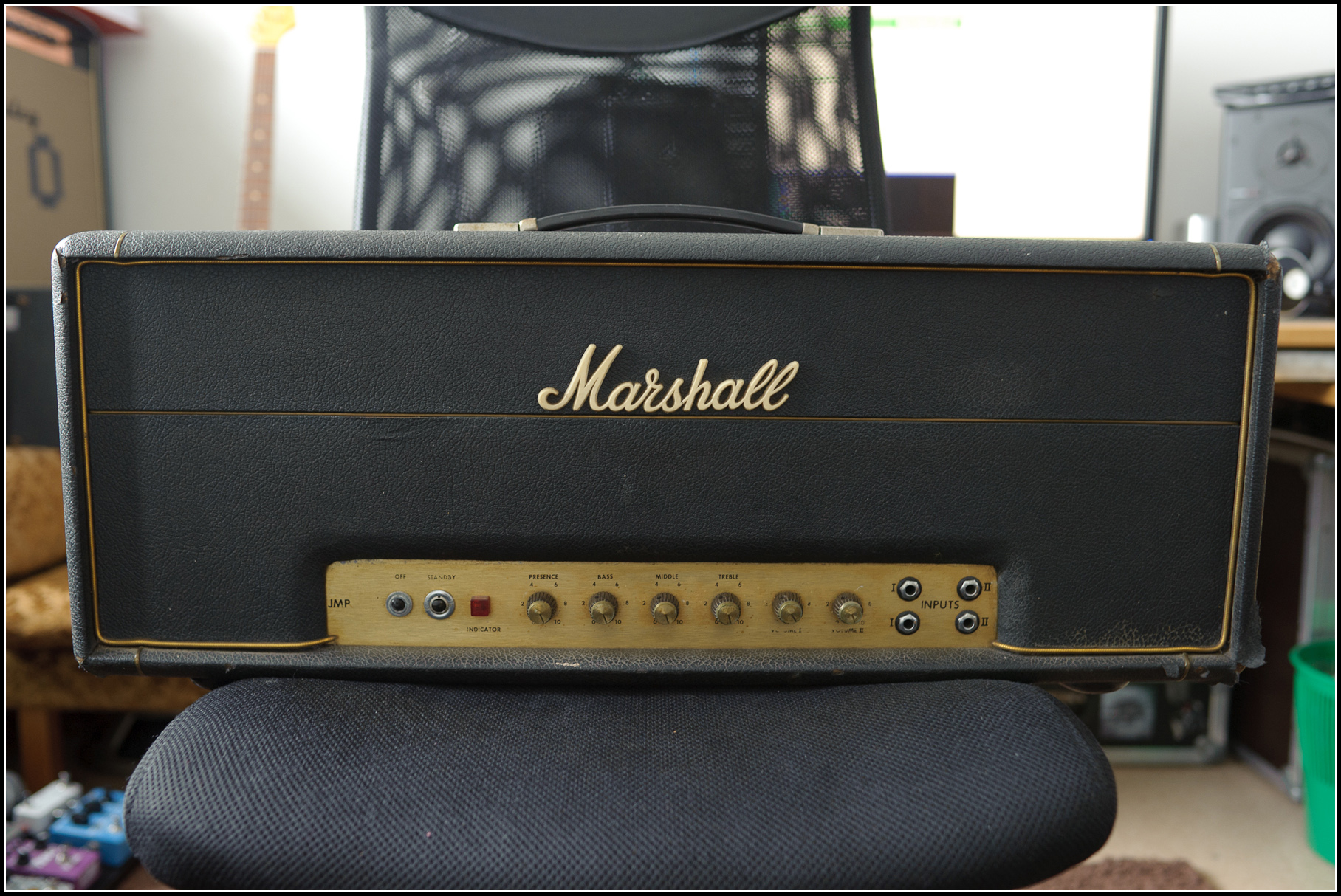
The JMP 1987 50 watt amp obviously does not have an effects loop, etc, so my only guess as to how to run anything with it is thru the hi and low inputs. Here is where I begin to stretch my experiences and understanding of how to dial in sound. Stuff like where to put the various pedals, accessories and components like a preamp in a signal chain.

I know there is no line in line out type thing for running straight into a mixing board etc. In essence, I need to understand all the little possibilities from the bare bones amps to more complicated ones such as my Red Knob The Twin, which has effects loop ( Preamp out, Power Amp iN jacks) A Power Amp THRU Jack, and various speaker arrangement hookup jacks and selector switches.

Fender Twin Red Knob (The Twin) – Ampwares

pesag022n2gbwj8dnphxdehz1g.jpg


Knobs: Red or Black (90-94) Unnumbered
Faceplate
  • Front: Vol, Treb/Boost, Mid/Cut, Bass – Ch 1 In, Ch 1 In – Ch 2 In, Ch 2 In – Gain, Treb/Boost, Mid/Boost, Bass/Boost, Presense/Notch, Vol/Channel, Reverb Select Sw, Reverb – Hi-Lo Power Sw, Standby Sw, Power Sw, Pilot Lamp
  • Rear: Fuse (4A), Effect Out, Effect In, Power Amp Thru, Loop Level Sw, Output Bias Adj, Output Balance Adj, Foot Sw, XLR Line Out, Ex Speaker Series, Ex Speaker Parallel, Impedance Sw
 
Last edited:
Back
Top