Ohm setting question

LiveeviL2000

Ambassador of Pentagonal Pentatonics
Country flag
Guys.
As you know. I bought a Carvin 212 with a 5150iii 50w from a friend of mine. He had a vague idea of what speakers were in the cab.
So he set the amp at 8ohms and that’s where I have it now.

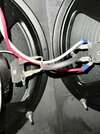
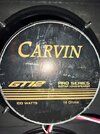
I opened it up and found these speakers inside.
My question is, since they are both 16ohm should I set my amp to 16 or keep it at 8?
2E24EEE8-7FB8-486E-9763-36E67DB56219.jpeg
 
8 ohm.
2x16 ohms wired in parallel is an 8 ohm load.
Would be very unusual to have them wired in series for a 32 ohm load.
Plus if cab says 8 ohm amd speakers haven't been changed...
The weird thing about the cab is it doesn’t have a tag or info plate anywhere.

Since I am an annoyingly inquisitive kid, what makes it series or parallel?
I’m sure it’s as you say and it’s wired parallel.
The way it’s wired it has a 2 lead wire coming off the input to 1 speaker and a 2 lead wire jumping the 2 speakers. See below.
817E0D2D-90EF-4796-A264-B687EE086A1A.jpeg
 
1. You are right to be cautious...
if a cabinet is labeled 8 ohms, it may not be 8 ohms. It could have been rewired.
The surest way to check is with an ohm meter.
Plug a speaker cable into the cabinet and connect the ohm meter to the free end of the cable.

An 8 ohm speaker should read 6.8 ohms about.
A 16 ohm speaker should read 12.6 ohms, approximately.
A 4 ohm speaker will read about 3.2 ohms.

2. Take the speakers out of the cabinet.
Move the speaker cone in and out by hand, like a piston.
The cone must move in /out freely....no interference.
If the cone (voice coil) scrapes and rubs when it moves in out, the speaker is blown.

Never play an amp through a blown speaker.

Whenever you buy speakers, test this. Don't assume speakers are good until you test them.

When people sell speaker cabinets: it's really common to find blown speakers.
 
The weird thing about the cab is it doesn’t have a tag or info plate anywhere.

Since I am an annoyingly inquisitive kid, what makes it series or parallel?
I’m sure it’s as you say and it’s wired parallel.
The way it’s wired it has a 2 lead wire coming off the input to 1 speaker and a 2 lead wire jumping the 2 speakers. See below.
View attachment 88264
By the wiring, it appears to be parallel indeed, where as each of the two leads from the amp hit the first speaker plate and then jump to the second and end. In a series configuration, you would have one lead from the amp hitting the right speaker and the other lead hitting the left, with a small jumper crossing from the negative of the right over to the positive of the left.

By that logic, it would be 8ohm parallel like @Jethro Rocker mentioned. As @Amp Mad Scientist mentioned, it's always a good idea to check your speakers too beforehand especially when buying used. Sometimes it's not just a blown speaker but a failed or broken speaker magnet. Either issue means the impedance would break down and cause too much current to flow back to the amplifier and damage screen resistors on the best day but blow transformers and other components on the worst day.
 
It's really funny...
musicians avoid testing speaker cabinets, like the plague.

They don't realize that wrong impedance will destroy their tubes, and bad speakers will cause all types of damage.
Blown output transformer...burned tube sockets......blown fuses.....
They just don't get it.

They plug the amp in and play first without any caution.....
Then they whine and cry when the fuse blows.
Then you try to check the speakers...and they won't listen to a word of it.

"Why is there NEVER time to do it right? But ALWAYS time to do it over again?"
---Gene Berg
 
1. You are right to be cautious...
if a cabinet is labeled 8 ohms, it may not be 8 ohms. It could have been rewired.
The surest way to check is with an ohm meter.
Plug a speaker cable into the cabinet and connect the ohm meter to the free end of the cable.

An 8 ohm speaker should read 6.8 ohms about.
A 16 ohm speaker should read 12.6 ohms, approximately.
A 4 ohm speaker will read about 3.2 ohms.

2. Take the speakers out of the cabinet.
Move the speaker cone in and out by hand, like a piston.
The cone must move in /out freely....no interference.
If the cone (voice coil) scrapes and rubs when it moves in out, the speaker is blown.

Never play an amp through a blown speaker.

Whenever you buy speakers, test this. Don't assume speakers are good until you test them.

When people sell speaker cabinets: it's really common to find blown speakers.
Ampmad, I was going to say the exact things you did.

I educated myself on these things because of buying used amps and speakers and not wanting to cause any destruction,
 
They are stock speakers labelled 16 ohms.
They are 16s.
Wired parallel so indeed an 8 ohm cab.
As long as each speaker works, carry on.
Except like Ampmad said, it is always best to verify the ohms with a meter.

NEVER trust hooking up your amp to an unknown cabinet such as your buddy's, an ebay, pawn shop, newspaper, etc cab.
Plug in the speaker cord in the speaker, hook up your meter and in a few seconds time, you will KNOW what Ohm speakers you are hooking up the amp to. Then make sure your amp is rated and set for that same setting.
 
Last edited:
It's really funny...
musicians avoid testing speaker cabinets, like the plague.

They don't realize that wrong impedance will destroy their tubes, and bad speakers will cause all types of damage.
Blown output transformer...burned tube sockets......blown fuses.....
They just don't get it.

They plug the amp in and play first without any caution.....
Then they whine and cry when the fuse blows.
Then you try to check the speakers...and they won't listen to a word of it.

"Why is there NEVER time to do it right? But ALWAYS time to do it over again?"
---Gene Berg
^^^^^^^^^^ This
 
Ampmad, I was going to say the exact things you did.

I educated myself on these things because of buying used amps and speakers and not wanting to cause any destruction,
I'm sure that most major repair bills $$$ go right back to the speaker or speaker cable.

People repair the amps and don't check the speakers or the cables.
Seems to me that any major amp repair should include testing the speakers....or the job isn't done all the way.
 
Though it isn't always perfect, I always went with the over impedance rule whenever in doubt: if you aren't sure what you should be running or what you have, use the lowest impedance setting in an amp.

If you have 4 ohm outputs, you are mostly fine with anything else if in doubt. Worst case, is the amp won't push the speakers as hard and you get a "safe-mismatch". But going 16ohm on the output and you're asking for trouble unless you got the proper load. Goes back to the inverse-proportion rule of electricity ( aka Ohms law):
At constant resistance, current increases as voltage increases and vice versa. At constant voltage, current decreases as resistance increases and vice versa.

In other words, if you have a high resistive load, the amperage will be low and thus safer going back to the amplifier.
 
Except like Ampmad said, it is always best to verify the ohms with an meter.

NEVER trust hooking up your amp to an unknown cabinet such as your buddy's, an ebay, pawn shop, newspaper, etc cab.
Plug in the speaker cord in the speaker, hook up your meter and in a few seconds time, you will KNOW what Ohm speakers you are hooking up the amp to. Then make sure your amp is rated and set for that same setting.
If they are labelled as 16 with stock label?
I never do.
EDIT if the individual drivers are labelled that is, not the cabinet
 
Last edited:
I have never seen a "speaker test" video,
where the video shows the REAL pro method of testing speakers.

They always show part of it, and never follow through with ALL of it.

"check speakers for scraping voice coils"
They will not do it.

check cabinet input jack, with a flex test.....for solid continuity.
they will not do it....

Test speaker cable with a flex test.....nope.

Test amp speaker jack for solid continuity...........no.

It's just a fact.
Not even the tech who repairs the blown up amp will test the speakers.
 
I have never seen a "speaker test" video,
where the video shows the REAL pro method of testing speakers.

They always show part of it, and never follow through with ALL of it.

"check speakers for scraping voice coils"
They will not do it.

check cabinet input jack, with a flex test.....for solid continuity.
they will not do it....

Test speaker cable with a flex test.....nope.

Test amp speaker jack for solid continuity...........no.

It's just a fact.
Not even the tech who repairs the blown up amp will test the speakers.
I think this is an opportunity for somebody who knows proper methodology to make a video. Someone who is … oh I don’t know, let’s just say, a mad scientist of amps perhaps?
Now, if we only knew somebody like that ….hmmmmm…:unsure:
 
I have never seen a "speaker test" video,
where the video shows the REAL pro method of testing speakers.

They always show part of it, and never follow through with ALL of it.

"check speakers for scraping voice coils"
They will not do it.

check cabinet input jack, with a flex test.....for solid continuity.
they will not do it....

Test speaker cable with a flex test.....nope.

Test amp speaker jack for solid continuity...........no.

It's just a fact.
Not even the tech who repairs the blown up amp will test the speakers.

Interesting!!!

Why do you think that is???

When i stopped using Creambacks and Greenbacks, i quit blowing up speakers.

Electro-Harmonix 12VR75 i found to be indestructible.

WGS Reaper 55Hz also was impervious to damage from high volume and high resonance settings. I still have one here somewhere...

Italian-Made Jensen Stealth 80 and Jensen 100 Watt Tornado Neodymium models also never failed.
 
It doesn't matter if i tell them to do it. they won't
I would. I don’t know if that makes me weird or not, but I would.
It’s why I started this thread in the first place, it’s to be informed by people who know what they are doing.
I feel if a person has useful knowledge, it should be shared and handed down so the community can better themselves.
 
Back
Top