Nut repair

Ghostman

Ambassador of the SuperNatural
Country flag
I've had some issues with tuning on my Jackson Soloist on the high "E" string. If I tune it to open E, the fretted notes are all sharp, from fret 1 to 24. If I tune it to the fretted notes being in tune, then the open string is flat. I've messed with intonation countless times.

Recently I bought a headset magnifier and I am able to now see that the nut slot is not right. If I move the string I can tell that the string moves in the nut slot, which tells me that the slot is not cut right.

I have slot files, but what else am I missing about working the slot so that the string end point is not a quarter of the way into the nut?
 
Usually high nut slot only pulls the first few frets sharp, unless the action is really high.
If you file the slot, do a few strokes at a time, maintain the break over angle, and check it with the string under tension.
I'm no luthier; others may have more better info.

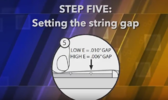
I use the instructions that come with the Tusq nuts:

1611858740295.png
 
I've had some issues with tuning on my Jackson Soloist on the high "E" string. If I tune it to open E, the fretted notes are all sharp, from fret 1 to 24. If I tune it to the fretted notes being in tune, then the open string is flat. I've messed with intonation countless times.

Recently I bought a headset magnifier and I am able to now see that the nut slot is not right. If I move the string I can tell that the string moves in the nut slot, which tells me that the slot is not cut right.

I have slot files, but what else am I missing about working the slot so that the string end point is not a quarter of the way into the nut?

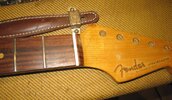
The slot can be filled with baking soda / super glue and re-cut.
Baking soda makes the super glue much stronger...

1611859442254.png

1611859618045.png

Only use gauged files.
do not use "general purpose" files.
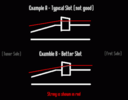
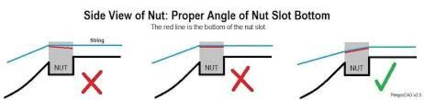
Cut the slot like this / not like this ----

Even stew mac cuts the slots incorrectly.

There are only a few who actually do it the right way....

But cutting the slot correctly makes the intonation quite a bit better. Big difference here.

1611859683838.png
 
Ill second the TUSQ nut. I changed my Tele to a TUSQ XL Black graphite and followed their instructions. Had to sand down the bottom of the nut just a touch with fine grit sandpaper because it was raised very high. But literally, rubbed it in a circular pattern on a sheet of sandpaper and would check it periodically until it fit right. The string slots were already filed very closely to a perfect fit and didnt take much adjusting
 
I have a set of Nut files, so this will be good use. I don't know the term of the point which is the last edge of the Nut that the string touches, but it's not the fret-board edge of the nut. It's like the nut slot is rounded from headstock to fretboard. Hard to describe.
 
@Ghostman -

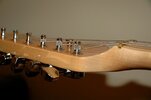
I look at the strings passing through the nut from the tuning key side. I will then mimic the angle the strings are traveling at - through the nut - when I file my slots, so each string slot may have a different profile, but all will follow the string path as dictated by the position of the strings as they rise from the tuning keys to the nut.

BLOGIMG+-+Staggered-Height+Tuners+Angles.png


Strat String Winds.jpg
 
Last edited:
I knew I asked the right group.

Q1gEeX4.gif
 
@Ghostman - To take this a step further....

With a non- locking tremolo, 100% of your tuning stability is in the nut. I can dive bomb my stock Stratocaster 11 semitones - almost a full octave - and pull the 'g' up to b-flat - and remain in perfect tune.

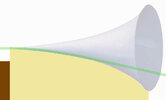
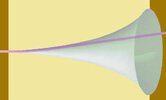
I tend to make the nut profile like a bell.

picard.horn.3.jpg

And a view looking down from above:

picard.horn.4.jpg

On the wound strings, I use a bell profile on BOTH sides.

90% of Stratocaster tremolo problems are the result of a totally flat nut floor profile.

The leading edge of the nut slot is what determines your string's intonation length. It should make solid contact with the string.

If this area is not cut square and if the string doesn't break across the front edge of the nut slot, you will often hear this as a sitar-like tone on the open strings.
 
Update:

Just finished up on refiling the nut. Luckily, it didn't drop the High E string in the saddle enough to notice. I still have good clearance on the first couple of frets. I took a little time to do the "Bell" type of filing on the nut for the other slots.

Readjusted the Truss Rod, and it's back to good baby!

Thanks all for the help in this!
 
Back
Top