NPPFCD!!!!!!

syscokid

Ambassador of War & Peace
Country flag
New PolyPropylene Film Capacitor's Day:
30144

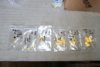
Just got these from Mojotone, and I'm going to try them in my Allen Chihuahua amp. The Mojo polypropylene/film caps are going to replace the Mallory 150 polyester/film caps that are being used as signal and coupling caps. I also plan to record and post the results of this experiment.

This is the video that inspired me to try this for myself:
 
Be interesting to hear the results. Aside from the dielectric (polypropylene vs polyester), the two types are constructed differently, Mallory 150's being "metalized" polyester film, the Mojotone's being (polypropylene) film/foil types. Be interesting to hear which you prefer. Cheers
Yes.

Common polyester film caps are the old Mustards and Astrons, SOZOs, Synergy Royals, Jupiters, Mallory 150s.

Common polypropylene film caps are the Orange Drop 715P & 716P series, Solen, IC (Illinois Capacitors), Mojo Dijon, and TAD. I think the TADs and Mojo Dijons are the same.

Another motivating factor for this experiment comes from an article from Randall Aiken's Aiken Amplification website. He shares his opinion on polypropylene caps at the fifth question at the following link:
 
Update.... I went and replaced the polyester caps with the new polypropylenes. But I forgot to record the amp while it still had the polyesters. No biggie... I'll plan on recording the new polypropylenes first, then reinstall and record the amp with polyesters in there.

I'm also taking the time to break in the new caps. I'm leaving the amp on for at least 20 hours to try to accomplish this. Hopefully this technique will be sufficient for proper results. If I have to actually play the amp for 20 hours, then that might take about 2 years at my rate of playing with my arsenal of amps. If anybody has any info on breaking in caps, please let me know.
 
Update.... I went and replaced the polyester caps with the new polypropylenes. But I forgot to record the amp while it still had the polyesters. No biggie... I'll plan on recording the new polypropylenes first, then reinstall and record the amp with polyesters in there.

I'm also taking the time to break in the new caps. I'm leaving the amp on for at least 20 hours to try to accomplish this. Hopefully this technique will be sufficient for proper results. If I have to actually play the amp for 20 hours, then that might take about 2 years at my rate of playing with my arsenal of amps. If anybody has any info on breaking in caps, please let me know.

If the caps are not electrolytic they do not need to be broken in.
 
If the caps are not electrolytic they do not need to be broken in.
Not all coupling caps need breaking in, but some definitely exhibit an audible difference after some use. The Sozo film/foil caps for example seem to open up after 40 or 50 hours use. The NOS Mullard Mustard caps I've been using in my builds also do, though admittedly one amp had new iron in it also. Sysco, you need a signal passing through them to break them in. Cheers
 
Sysco, you need a signal passing through them to break them in.
I was afraid somebody was going to say that... :BH:. At least a couple of hours is on the book now. Wish I had a dummy load to plug into the amp. I guess I can use my Rivera attenuator at max attenuation and a looper pedal like my BOSS RC-3 and let it do its thing for a few hours at a time... :unsure:
 
I guess I can use my Rivera attenuator at max attenuation and a looper pedal like my BOSS RC-3 and let it do its thing for a few hours at a time... :unsure:

Yes, that would do it. When I was first getting into valve amp electronics (30 yrs ago), the old guy teaching me had me make up a few dummy loads by winding reasonably thick "nichrome resistance wire" around ceramic rods, up to the desired resistance. They worked well & were used often. Cheers
 
I just stuck a bunch of the Mojo caps in an old amp - they sound good to me, although I can't really say I heard a big difference or anything. They seem like a nice enough cap, especially for the money.
 
At first blush, with earbuds on a mobile device, I like them both in certain spots.
The first clean was classic chime tube tone. I liked that.
The second clean, and second dirty, were really nice though.
I’m going to revisit this on a better system.
Thanks for sharing this! I had been looking forward to it! :cool: (y)
 
of course it all boils down to . . . what do YOU think sounds the best.
I like brown mustard, wife like yellow mustard, daughter likes Dijon mustard. There all mustard all taste good.
this is an interesting comparison though. Thanks
 
The first clean was classic chime tube tone.
Yes, the difference is subtle when listening to the recording, but it also confirms what is happening in the video that I posted in the beginning. It didn't help much that I couldn't exactly duplicate the phrases for better control of the experiment. I was going to use a looper pedal for that reason, but I got too impatient.

I like brown mustard
I prefer brown mustard, too!

Only see a change in tone with a change in capacitor value....
You must have pretty good vision if you can see tone changes... :p. But the point here was to show how caps with different dielectric can sound different even if the capacitance values are the same. One of the more obvious examples is the original ceramic bright caps (1000pF) across the volume pot on older Marshall circuits. Replace a 1000pF ceramic with a 1000pF silver mica at that position, and you will hear a difference. Ceramic = grainier; silver mica = smoother!
 
Yes, the difference is subtle when listening to the recording, but it also confirms what is happening in the video that I posted in the beginning. It didn't help much that I couldn't exactly duplicate the phrases for better control of the experiment. I was going to use a looper pedal for that reason, but I got too impatient.

Oh, I didn't find it subtle at first listen. I hear more higher order harmonics in the first one, and more mid focus on the 2nd and 4th passages.
That's what i meant by chime. The third passage is not doing anything for me though, compared to the fourth. The looper would have been a good call, but we get excited about these things sometimes.:)
I just gave a listen in the studio, and I'm going to stick by my initial observations after listening on a couple of sets of speakers. over all, I like the Polypropylene caps. Especially on the driven tones.
They're both good sounding, and have a place though....but I hear a distinct difference, especially in high end content.
 
Just completed the polyester caps versus polypropylene caps soundclip demo:


Phrase 1: Clean with polyester caps
Phrase 2: Clean with polypropylene caps
Phrase 3: Dirty with polyester caps
Phrase 4: Dirty with polypropylene caps
While I do not believe caps contribute to sound, that was nice playing!! I went back and forth and did not hear a difference, but your playing stayed good each time!
 
Back
Top