NPMAD

HOLY CRAP MAN --- to get that must feel like a MILLION BUCS!
I am jealous as HELL -- but also VERY VERY happy for you Brother !!!
Congrats!!!!
:2Thumbs:
It does feel like a million bucks, & thanks, appreciated.
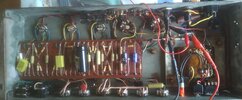
With family gone & no risk of kids coming to see what's going on, & possibly getting electrocuted by doing what nosey kids do, I've got to it conditioning the new filter caps. First, with the amp on standby I checked for proper operation & range of the bias circuit. All good. To condition the filter capacitors I first removed the HT fuse, then, with two alligator clips I jumpered a 100k 1 watt (current limiting) resistor across the two terminals of the HT fuse holder & powered up. It's been on for about 1/2 hour or so now, voltage drop across the 100k resistor is down to 18.2Volts. Anything below 5V & we can consider the filters properly conditioned, but really, the lower it's left to get the better. Here's a pic with new filter caps in & being conditionedIMG_20210130_160221.jpg
The alligator clips, 100k resistor & meter leads attached to the resistor (monitoring voltage & voltage drop across resistor) can be seen attached to the HT fuse. Cheers
 
Do you have to warn the local town authorities before you turn it on for the first time?
Nah, they're pretty used to that sort of thing by now. So long as I don't krank them up late at night it's usually no problem. I usually don't play them after about 4pm, though occasionally the neighbours do ask me to turn it down. Cheers
 
Ok, all unloaded (no valves installed) voltages check out,
Heaters 3.24-0-3.24VAC.
B+ = 443VDC.
Bias supply ranges from 0V to -50VDC.
All coupling caps check out, no DC leakage, though I expected this, the C296 mustard & RS silver mica capacitors are pretty good in that regard.
So, after some lunch I'll re-tension the valve sockets, give it a few shots of contact cleaner, then install valves, bias the output valves, find the best valve for the V3 (PI) position & then,,, plug a guitar through it.
While I think of it, something else that is in line with @67plexi thinking it may be a '67 rather than a '68, the board's inter-turret wiring is all done on the board underside as was done in '67 & earlier amps. In '68 Marshall started doing this wiring on the upper side of the board to make troubleshooting/repairs easier. Cheers
 
Ok, so I got everything done except finding the valve best suited to the phase inverter (V3) position. The bias adjustment slider makes biasing more time consuming than with a trimpot due to the slider making coarser adjustments. Getting the negative bias voltage in the ballpark is relatively easy using a non-conductive implement (nylon screwdriver) to move the sliding contact, but fine adjustment requires shutting the amp off & draining it to make small adjustments by hand. Only VERY small movements of the sliding contact are needed. Ended up plate voltage 416V, bias V4 at 39.9mA (66.5%) & V5 at 40mA (68.2%). Having the cooler biasing valve in V4 is ideal as it gets driven the hardest by the PI.
With it still out of the headcab (so I could keep an eye on the output valves) I plugged an SG into the bright channel, controls set presence 2, bass 4, middle 7, treble 5 1/2, bright volume 3 1/2, normal volume 0. That the noise floor was a little high was expected seeing as the electronics weren't shielded (chassis not in headcab) & the amp was in close proximity to the 4x12 cabinet.
And it sound good, damn good, clear, punchy & ballsy with that aggressive upper mids & high end sizzle that Marshalls do so well. And loud, did I mention that at 3 1/2 on the dial it's getting loud,,, & starting to break up a little. Good sustain too. Chords could be coaxed into feedback by manoeuvring the guitar toward the speaker cab, likewise single notes with some vibrato.
I knew at the time (about 5-20pm) that it was a bit late in the arvo to be playing a 50 Watter at home & after a little more than 5 minutes the young Barby doll next door let me know that it was too loud. I'm very much looking forward to taking it out to the farmhouse (rehearsal space) for a decent workout at a more sensible setting of 6, 7 or 8 on the volume. Cheers
 
Last edited:
To condition the filter capacitors I first removed the HT fuse, then, with two alligator clips I jumpered a 100k 1 watt (current limiting) resistor across the two terminals of the HT fuse holder & powered up.
Nice method. This is much simpler than the method of disconnecting the B+ lead into the first filter cap and then clipping on the current limiting resistor to the cap and to the B+ lead.


That the noise floor was a little high was expected seeing as the electronics weren't shielded (chassis not in headcab) & the amp was in close proximity to the 4x12 cabinet.
What works for me if I want to get a good idea of the noise floor of the amp when it's on the bench opened up and unshielded, is to lay a sheet of aluminum big enough to overlap the open chassis and secure that sheet with a couple of magnets. Obviously the magnets won't hold if the chassis is made of aluminum.
 
What works for me if I want to get a good idea of the noise floor of the amp when it's on the bench opened up and unshielded, is to lay a sheet of aluminum big enough to overlap the open chassis and secure that sheet with a couple of magnets.
I had a sheet of aluminium alloy that I used for the same thing, for years, but now its shielding my 1 watt JCM800 micro amp (was just the right size). Cheers
 
Back
Top