NGPD!

One other thing, I modified the Ernie Ball volume pedal for use with the Helix. In stock form, the pedal has a 250 K Ohm audio-taper pot and is intended to be used in the audio path, usually between guitar and amp.

However, the Line 6 is looking for a 10 K Ohm linear pot. What's more, unlike many expression pedals, which use a TRS (tip-ring-sleeve) 1/4" plug, the Line 6 is looking for a simple TS (tip-sleeve) connection, like a standard guitar pedal patch cord.

So, I hunted around on the Mouser website until I found a suitable and heavy duty 10 K Ohm linear pot and I wired the pot according to this schematic:

th


Of course, that would mean that I'd have blank holes in the front of the Ernie Ball pedal due to the unused jacks I removed. So, I made a new faceplate from pick guard material and affixed it to the original mounting plate with a few dots of hot-melt glue.

Here it is all in place:

VolPedal_Modded_sm.jpg

This works flawlessly with the Helix.

One really cool thing about the Helix is that you can tell the Helix what kind of behavior you want the pedal to have. So, even though this physically has a linear pot, within the Helix you can tell it to use either linear behavior or logarithmic (audio taper) behavior for the pedal. You can do this on a patch-by-patch basis.

It's quite cool.

Another nice touch is that as soon as the Helix detects that you've plugged an expression pedal into the EXP 2 jack on the Helix, it automatically assigns that pedal as the volume pedal and it assigns the built-in pedal (EXP1) as a wah pedal (or whatever else you may have previously set EXP1 to control). You can change this if you want to, but this default setup is exactly what I want, so that's a nice thing, as well.
 
Yes. That's one of the things I'm wanting to achieve.

Yep, very clean.
One other thing, I modified the Ernie Ball volume pedal for use with the Helix. In stock form, the pedal has a 250 K Ohm audio-taper pot and is intended to be used in the audio path, usually between guitar and amp.

However, the Line 6 is looking for a 10 K Ohm linear pot. What's more, unlike many expression pedals, which use a TRS (tip-ring-sleeve) 1/4" plug, the Line 6 is looking for a simple TS (tip-sleeve) connection, like a standard guitar pedal patch cord.

So, I hunted around until I found a suitable and heavy duty 10 K Ohm linear pot and I wired the pot according to this schematic:

th


Of course, that would mean that I'd have unused holes in the front of the Ernie Ball pedal due to the unused jacks I removed. So, I made a new faceplate from pick guard material and affixed it to the original mounting plate with a few dots of hot-melt glue.

Here it is all in place:

View attachment 93292

This works flawlessly with the Helix.

One really cool thing about the Helix is that you can tell the Helix what kind of behavior you want the pedal to have. So, even though this physically has a linear pot, within the Helix you can tell it to use either linear behavior or logarithmic (audio taper) behavior for the pedal. You can do this on a patch-by-patch basis.

It's quite cool.

I would suggest anchoring any cables that are near a volume pedal to keep the cable from impeding pedal movement.

20230520_090829.jpg

Note the cables on my wah...ask me how i know this....
 
Last edited:
Well…I’m gonna be using the Helix in a full-up, four-hour gig tonight. So, whereas I have used it in a shorter set already, this is its first regular gig.

I used it at rehearsal earlier this week. As expected, it worked very nicely and a couple band members commented on how much better a couple patches sounded, so that’s good.

Any hoo…the gig is from 5-9 EDT, so we’ll be going into the nighttime hours, which I like. I think I’d prefer a 6 -10 slot, though. But, it is what it is.

I leave in a few minutes to start loading the trailer with the rest of the band.

Looking forward to a good set tonight.

Wish me luck!
 
Yay!! Enjoy the new rig at the gig!!

She actually appreciated our more compact setup and the fact that we have more control over our sound, since we don't have amps blasting away on stage.
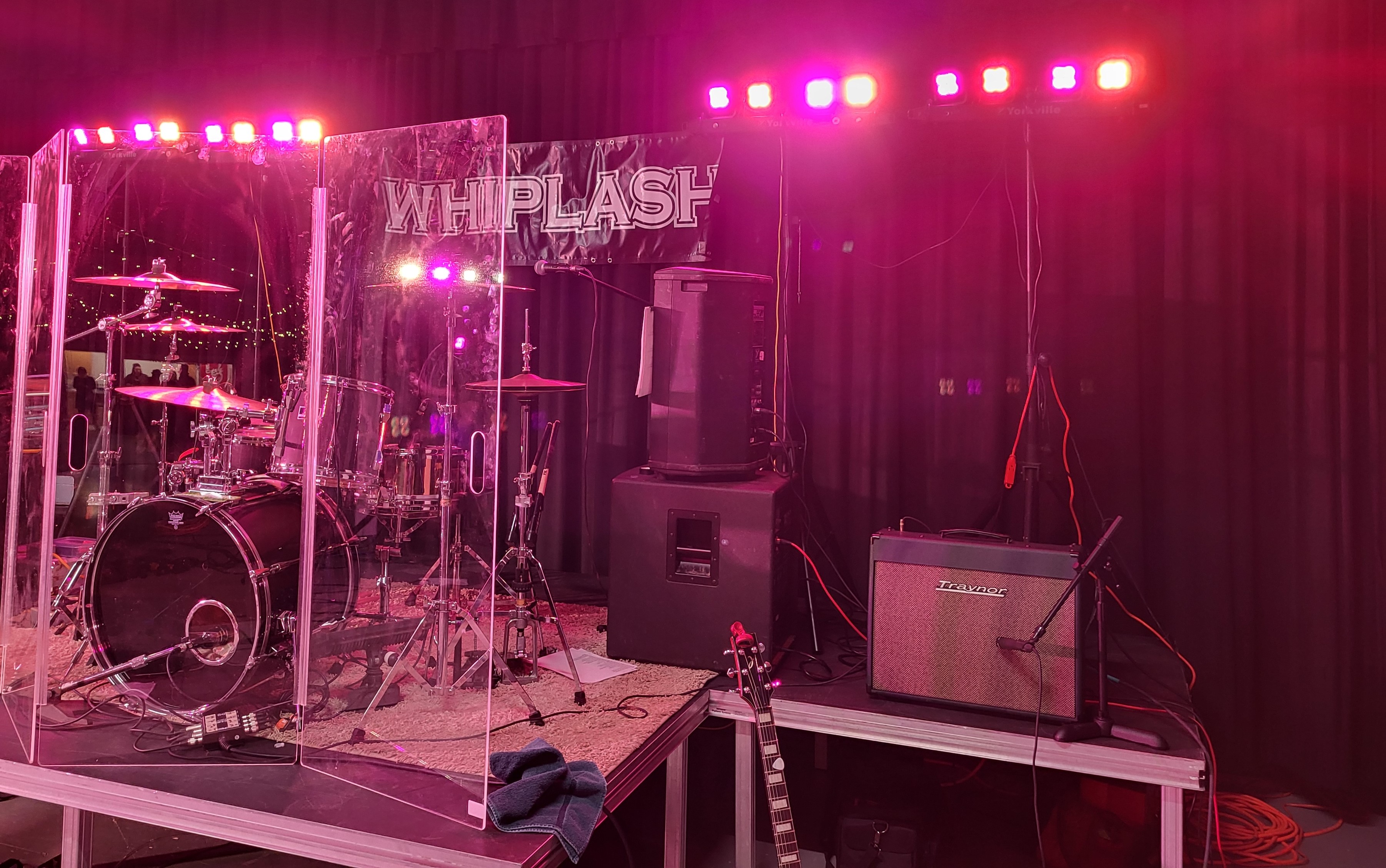
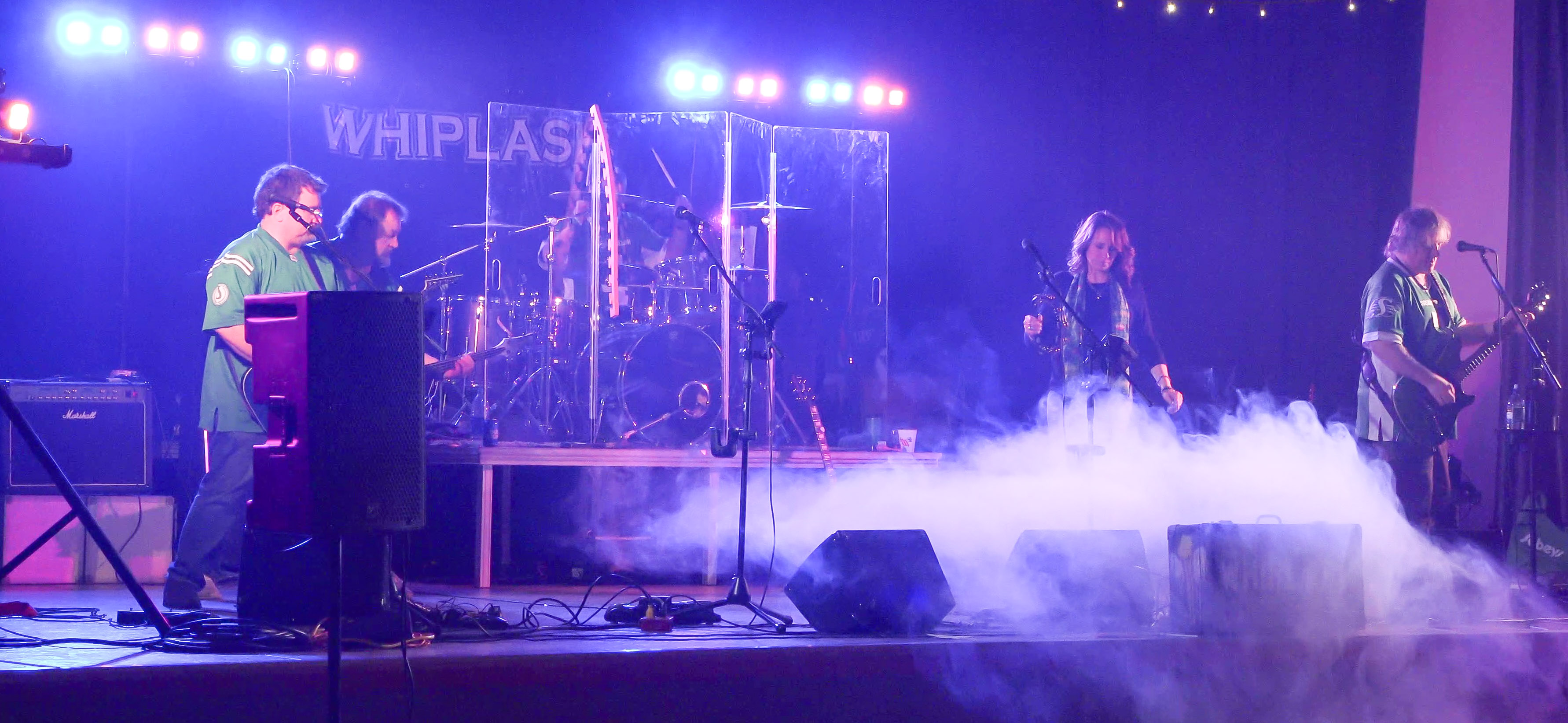
I get that for sure. Our problem all along is the drummer. An acoustic set really can't go much quieter. Thus we have rented the Shield of Shame ( with thanks to @SG John for this term!) the last few shows and likely will even for the big show under the tent. We use wedges so for the singer this is a nice addition.

mefUi3W.jpg


QY2gNcA.jpg
 
Okay, so the gig last night went great and the Helix worked perfectly.

But, I did encounter a “weak spot”, of sorts. Specifically, the display is not bright enough to be seen in bright outdoor light. Fortunately, it got really cloudy prior to the gig, so I didn‘t have too much of a problem.

I’ll have to fashion some sort of a sun shield for it.
 
Yay!! Enjoy the new rig at the gig!!


I get that for sure. Our problem all along is the drummer. An acoustic set really can't go much quieter. Thus we have rented the Shield of Shame ( with thanks to @SG John for this term!) the last few shows and likely will even for the big show under the tent. We use wedges so for the singer this is a nice addition.

We use electronic drums. Electronic sets are getting better and better. Our drummer’s set actually sounds pretty decent and is perfectly adequate for live gigging use. I don’t know the exact model, but it definitely is not an entry-level set! Like all music technology, they’ve come a long way from how they sounded and behaved years ago.

I‘ve also seen some Roland sets that are made to look similar to acoustic drums, with the larger shells, but they use electronic triggers.
 
We use electronic drums. Electronic sets are getting better and better. Our drummer’s set actually sounds pretty decent and is perfectly adequate for live gigging use. I don’t know the exact model, but it definitely is not an entry-level set! Like all music technology, they’ve come a long way from how they sounded and behaved years ago.

I‘ve also seen some Roland sets that are made to look similar to acoustic drums, with the larger shells, but they use electronic triggers.

Rat's Nest Studios was one of the first (down here) to go with fully electronic drums.

The use the Roland V-Drums VAD706 kit.

 
Okay, so the gig last night went great and the Helix worked perfectly.

But, I did encounter a “weak spot”, of sorts. Specifically, the display is not bright enough to be seen in bright outdoor light. Fortunately, it got really cloudy prior to the gig, so I didn‘t have too much of a problem.

I’ll have to fashion some sort of a sun shield for it.
 
Are these affected by direct sunlight???

When we played Mojave Wasteland Weekend in September 2018, a bunch of guy's equipment shut down in direct sunlight....tube amps blew fuses too.
 
We use electronic drums. Electronic sets are getting better and better. Our drummer’s set actually sounds pretty decent and is perfectly adequate for live gigging use. I don’t know the exact model, but it definitely is not an entry-level set! Like all music technology, they’ve come a long way from how they sounded and behaved years ago.

I‘ve also seen some Roland sets that are made to look similar to acoustic drums, with the larger shells, but they use electronic triggers.
Yeah that would work. That's lots of mixer inputs tho. Every cymbal etc. Our guy like his acoustic set!!
 
Are these affected by direct sunlight???

When we played Mojave Wasteland Weekend in September 2018, a bunch of guy's equipment shut down in direct sunlight....tube amps blew fuses too.

I wouldn’t say it’s a problem of the unit, itself, being affected by sunlight, as much as it is a problem of simply not being able to see the display.

But, I have an idea for sunscreen.
 
Yeah that would work. That's lots of mixer inputs tho. Every cymbal etc. Our guy like his acoustic set!!

Our drummer only uses two inputs at our FOH mixer. Everything goes to the “brain” for the drum kit where you can set the balance. Then, that mixed output from the brain goes to the main mixer. I think our drummer uses two “brain” units - one for the drum elements and one for the cymbals and hi-hat. So, those are the two feeds going to the mixer.

All told, we use use only eleven inputs to our mixer: three vocals, two keyboard channels, one guitar channel, one bass channel, two drum channels, and two channels (a stereo pair) for background music between sets. Our mixer also has a dedicated talkback mic which we use, but that is not considered part of the channel capacity. We have more open channels. I’m actually thinking about running my system in stereo.
 
Our drummer only uses two inputs at our FOH mixer. Everything goes to the “brain” for the drum kit where you can set the balance. Then, that mixed output from the brain goes to the main mixer. I think our drummer uses two “brain” units - one for the drum elements and one for the cymbals and hi-hat. So, those are the two feeds going to the mixer.

All told, we use use only eleven inputs to our mixer: three vocals, two keyboard channels, one guitar channel, one bass channel, two drum channels, and two channels (a stereo pair) for background music between sets. Our mixer also has a dedicated talkback mic which we use, but that is not considered part of the channel capacity. We have more open channels. I’m actually thinking about running my system in stereo.
Ah I see. Makes sense.

We use 14 total plus music input.
It's the Aux that are so cool with a digital board.
5 mon mixes, 1 kick for drummer, 1 FOH sub and still some left.
I doubt drummer would ever do an electronic kit.
Shield of Shame works though.
 
Digital cymbals sound like A$$ way to complex I have a Roland TD 50 sound module with triggers
own 6 complete cymbal sets all cherry picked Roland is the Bud Light of cymbal sounds

I would respectfully disagree.

We've had a number of people who couldn't tell that drum passages were played on an electronic kit.

The technological advances are otherworldly, not to mention the production teams.
 
Last edited:
Back
Top