New Family Build - Amp Cab

I was just gonna write years and years ago i went into Portland Music in Portland Oregon and they had a Purple Marshall half stack and a White Marshall half stack in the store.I thought they were the most beautiful thing id ever seen.
 
not sure what those routes are for in post #169, but if your cut a dado or other joint like that dont free hand it; clamp a straight guide board or other straight edge behind the edge of the router base and run along it.
 
not sure what those routes are for in post #169, but if your cut a dado or other joint like that dont free hand it; clamp a straight guide board or other straight edge behind the edge of the router base and run along it.
Good info. Next time I will do that!!

The dado is to slot the baffle
 
I learned to do dado joints and such on a table saw when I was in school. Is the router better for this?

I still do them at times with a circular saw...
 
Ray, you are learning quite practically. Here are a few good tips. When trying to make straight dado's without a dado blade in a table saw, use a combination of table saw and router. Set the blade of the saw at the depth you want the dado and set the fence to line up the blade with 1 side of the dado. Pass it thru the saw then move fence to position to cut the other edge. Then rabbet out between the lines with router. Nice clean dado's.

I have other ways too like clamping a guide fence to the piece at the distance from edge of router base to the bit where it fits to cut the one side of the dado, then move fence to cut the other side, then rabbet out the middle like above.
 
  • Like
Reactions: RVA
Ray, you are learning quite practically. Here are a few good tips. When trying to make straight dado's without a dado blade in a table saw, use a combination of table saw and router. Set the blade of the saw at the depth you want the dado and set the fence to line up the blade with 1 side of the dado. Pass it thru the saw then move fence to position to cut the other edge. Then rabbet out between the lines with router. Nice clean dado's.

I have other ways too like clamping a guide fence to the piece at the distance from edge of router base to the bit where it fits to cut the one side of the dado, then move fence to cut the other side, then rabbet out the middle like above.
Great advice, that you. It seems to be close enough to work. Hey, I can only get better
20170616_224309_zpsbdnhnlr2.JPG
 
Last edited:
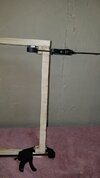
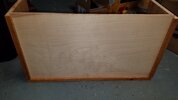
The grill frame is meant to fit in the space in front. I think I should have left more room. I am currently reinforcing the frame.

20170616_221131_zpseirtlasz.JPG
 
Last edited:
a proper dado blade on a good sized table saw is the preferred method for cutting dados, the other ways are work arounds when you dont have the optimal equipment.
I have cut dados, rabbets, etc. joints for building decks and mailbox posts, etc. free hand with a circular saw by making the edge passes like Chili says and then making parallel passes 1/4" apart or so within the joint. knock the pieces out with a hammer and clean the joint up with a chisel. That is for rough work, not cabinet work though.
 
When trying to make straight dado's without a dado blade in a table saw, use a combination of table saw and router. Set the blade of the saw at the depth you want the dado and set the fence to line up the blade with 1 side of the dado. Pass it thru the saw then move fence to position to cut the other edge. Then rabbet out between the lines with router. Nice clean dado's.
Hey Chili, why wouldn't you run the table saw all the way through for this technique. Also, if you do not go all the way through, how far in from he edges should you cut?
 
That thin frame may be tough to get structural strength. I prefer to put a framing strip around the perimeter of the front of the baffle board, put T-nuts through the front so the speaker mounts from the back and then put the grill cover over that.
 
All I can say is Ray is a balls to the walls kind of doer. Nothing like a guy learning new things and doing them himself even if it is not perfect, it is an effort and move in the right direction.
I am a big proponent and often quote the term "learn by doing".
There is no substitute for experience and I find I learn more from my failures than my successes.
 
That thin frame may be tough to get structural strength. I prefer to put a framing strip around the perimeter of the front of the baffle board, put T-nuts through the front so the speaker mounts from the back and then put the grill cover over that.
Any chance you can explain that so that a lawyer can understand?
 
I did the Uncle Doug method, counselor, see exhibit # lol, youtube. It is a simple and maybe somewhat crude method, but it works well.

I 'm not saying its the best way but it worked well for me and I have adopted that method.
The baffle board and grill frame are one unit, and get screwed into blocking / framing strips at the correct depth in the cab from the front.
The T-nuts are threaded nuts with a wide face and barbs on the back. they get pressed into the the face of the baffle, say with just the chuck on a drill press. Use the speaker to layout and drill the holes first.
The speaker is mounted on the rear of the baffle with machine screws matching the the thread size an pitch of the T-nuts, with a flat washer and a lock washer. But the speaker doesnt get mounted until after the grill cloth is applied.

Around the edge of the front edge of the baffle you cut and glue / staple 1" wide by 1/4" thick trips to raise that plane off the baffle surface. the grill cloth is then applied over that.

I'm not sure even I understand my textual explanation; watch the Uncle Doug videos. Do what feels right to you, but that thin grille frame looks kinda flimsy and may be prone to rack out of plum and square. Remember, your grillle cloth needs to pull tight.
 
  • Like
Reactions: RVA
Back
Top