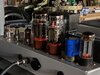
New amp build finally started. JTM45 with KT66.

Finally got my bags of resistors today. Switched the 220K voltage dropping resistor to a 180K as Plexi pointed out. Had to redo my math, as it actually brought my B+ voltage up to 440 volts. The Gold Lion KT66s are very, very close to my numbers. I also managed to finally get 7.67 volts difference between pins 1 and 6 of V3. Needs a bit more breaking in and tuning. I’m happy with the current sounds I’m hearing.


View attachment 51604
Got that ol classic grit!
 
Finally got my bags of resistors today. Switched the 220K voltage dropping resistor to a 180K as Plexi pointed out. Had to redo my math, as it actually brought my B+ voltage up to 440 volts. The Gold Lion KT66s are very, very close to my numbers. I also managed to finally get 7.67 volts difference between pins 1 and 6 of V3 after checking ten 12ax7s.
Sounds deliciously vintage-gee. Did the switching to the 180k improve the amps bias range?
 
Sounds deliciously vintage-gee. Did the switching to the 180k improve the amps bias range?


Yeah, improved it greatly. I'm sitting right in the middle of the bias pot now. I'm still going to try to tweek it a bit more. By changing to 180K, it also brought the B+ up to 441. That gave me a 1 volt drop when checking the plate voltage. After doing the math, I needed 1.6784 mV on V4 and 1.6942mV at V5. I got 1.699 mV on V4 and 1.592 mV on V5. I'd like to swap the tubes and see what I get, then maybe try the other Gold Lions I have to tighten those numbers up. Couldn't find a fuse for my Extech meter today, so I'll have to get my work meter out of the truck to see what my mA reading are. Now that I now the numbers are reasonably good, I hope it's all fine tuning now.
 
Great job SG John, well done, you should be proud. Sounding good too.
I never "dime" amps, I prefer to find it's sweet spot.
Good idea to try swapping the position of the KT66's, it may get them closer. They will settle in with a bit of use, so it's worth checking the bias setting down the track a bit.
The plate voltage coming up with a cooler bias setting is normal. Current flows in the tubes in the form of electrons & electrons carry a negative charge. The more electrons strike the plate, the more the plates positive potential falls. Alternately, the less electrons strike the plate, the more it's positive potential rises (up to a point). This is what causes voltage swings at the plate when a signal is applied to the control grid. Same with pre-amp tubes too.
Regarding the 7.67V difference between the PI plates, you see just how much difference plugging different 12AX7's in can make. You can use this same method of trying different tubes to fine tune ALL the pre-amp tube voltages to get as close as possible to the voltages called for in the original Marshall JTM45 voltage chart. This is worth doing if you can.
A tip regarding pre-amp tube socket lead dress, keep the blue plate leads & yellow cathode leads down flat against the chassis, while keeping the green control grid leads up off & away from the chassis & distanced as much as possible from the blue & yellow plate & cathode leads.
Again, well done. Cheers
 
Great job SG John, well done, you should be proud. Sounding good too.
I never "dime" amps, I prefer to find it's sweet spot.
Good idea to try swapping the position of the KT66's, it may get them closer. They will settle in with a bit of use, so it's worth checking the bias setting down the track a bit.
The plate voltage coming up with a cooler bias setting is normal. Current flows in the tubes in the form of electrons & electrons carry a negative charge. The more electrons strike the plate, the more the plates positive potential falls. Alternately, the less electrons strike the plate, the more it's positive potential rises (up to a point). This is what causes voltage swings at the plate when a signal is applied to the control grid. Same with pre-amp tubes too.
Regarding the 7.67V difference between the PI plates, you see just how much difference plugging different 12AX7's in can make. You can use this same method of trying different tubes to fine tune ALL the pre-amp tube voltages to get as close as possible to the voltages called for in the original Marshall JTM45 voltage chart. This is worth doing if you can.
A tip regarding pre-amp tube socket lead dress, keep the blue plate leads & yellow cathode leads down flat against the chassis, while keeping the green control grid leads up off & away from the chassis & distanced as much as possible from the blue & yellow plate & cathode leads.
Again, well done. Cheers

Thanks Ivan. If it wasn’t for all the help that you, Plexi, and Sysco gave me, I may not have pulled it off. I have the guys in Cambridge, but we’ve only gotten together twice since March. I do truly appreciate all the help and encouragement you guys have given me.

Now, to swap out a troublesome capacitor and try to fine tune this baby.
 
Last edited:
After enjoying several days of no internet due to the cable company accidentally knocking out our connection while working on the neighbors cable, I'm back. I hate using the phone for logging in. The Martin sounds nice, and I really like it. This amp does too. I've been using my '62 Reissue Strat and Cipollina SG.

Anyway, I'm probably way overthinking this because I'm a machinist by trade. All of my voltages look great by the sheets I'm using, and B+ being about 430VDC. By the math, I'm supposed to get about 1.737-1.758 VDC when biasing the power tubes. I get 1.845 and 1.690. the difference is between .06 and .11 VDC. They are well below 10% and should be ok, no? If my scanner/printer didn't die, I'd scan my latest voltage chart.

Keep in mind, the way my brain works is anything between .0002 and .005 is way off, so I'm trying to adjust and not overthink stuff.
 
By the math, I'm supposed to get about 1.737-1.758 VDC when biasing the power tubes. I get 1.845 and 1.690. the difference is between .06 and .11 VDC. They are well below 10% and should be ok, no?
I forgot, and I'm too lazy to research your thread, but...: What biasing technique are you using?
 
I forgot, and I'm too lazy to research your thread, but...: What biasing technique are you using?

I believe I'm using "Shunt" method. Would like to double check with using my Eurotubes adapter and Milliamps, but blew the fuse in my meter. Haven't been able to find any locally, and don't need the fused part of my meter for volts. It's just one extra bit of math.

[Plate Dissipation divide by B+] times [CT to pin 3 Ohms] = VDC of B+ and pin 3
 
I believe I'm using "Shunt" method. Would like to double check with using my Eurotubes adapter and Milliamps, but blew the fuse in my meter. Haven't been able to find any locally, and don't need the fused part of my meter for volts. It's just one extra bit of math.

[Plate Dissipation divide by B+] times [CT to pin 3 Ohms] = VDC of B+ and pin 3
Shunt method works fine as long as you are a bit careful and got your math right. Seems like you definitely got of all that under control!
 
I believe I'm using "Shunt" method.

[Plate Dissipation divide by B+] times [CT to pin 3 Ohms] = VDC of B+ and pin 3
There are two "shunt" methods, one where a milliamp meter is placed directly across half of the OT primary to read the current flow directly.
This isn't applicable to all amps though. Electricity is lazy & will take the path of least resistance, so if the OT primary has a low DC resistance (Marshall OT's), current will prefer to flow through the primary half rather than the meter shunting it, giving a wrong reading.

The second "shunt" method is the one SG John is using where we first read & note the DC resistance of each half of the OT primary, (Edit) then, after powered up amp has stabilised, read & note the plate voltages (end edit), then do the math before shunting the primary halves with a volt metre to read the voltage drop across it. This is very accurate so long as we get good connections & thus good readings. I use this method.

The first part of the equation should read

[Maximum Plate dissipation divided by plate voltage (pin 3)]

The B+ voltage will be slightly higher than the plate voltage. Taking the B+ voltage instead of the plate voltage will throw the equation off a little. Cheers
 
Last edited:
Sounds really good SG John, great job.
Are you planning on buying, or building a headcab? Cheers


Was playing it earlier plugged into the Normal channel. It sounds much better, although I do like how clangy the Bright channel is.

I'm probably going to by a box from Mojo, then make a front panel like Cadorman's. Seen some of the reproduction silver and red Marshall block panels on evilbay, but it's not really a Marshall.
 
Was playing it earlier plugged into the Normal channel. It sounds much better, although I do like how clangy the Bright channel is.

I'm probably going to by a box from Mojo, then make a front panel like Cadorman's. Seen some of the reproduction silver and red Marshall block panels on evilbay, but it's not really a Marshall.
I like to jumper the channels when playing my Strat or tele through 4 holers, Les Paul or SG go straight into Hi bright channel.
The headcabs offered by Valvestorm are made by guitar cabinets direct & are excellent repro's.
If your interested in one send me a message & I'll let you know the headcab type & options to select on their site for an exact replica of the original smallbox JTM45 headcab. Cheers
Edit:
I tried to link the guitar cabinets direct site/page but couldn't get the link to work. They do cost a tiny bit less than the similar Mojotone headcab. Cheers
 
Last edited:
Back
Top