New amp build finally started. JTM45 with KT66.

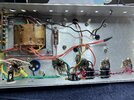
Like I mentioned, I have several layouts and other things like the Metro Amp instruction guide for a JTM45. They all contradict each other. Finally settled on the Mojo layout sheet after Steve sent it to me last night. Ripped out some wires tonight. Then I mounted the posts for the turret board to see that it would fit. Then, changed the 6.3 volt heater wires between the transformer and V5. Also tidied up a couple of grounds and added the 470 Ohm 7 watt resistors to the power tube sockets. Also ordered a few things that I discovered were not in my box of goodies.

Tomorrow after work, I'll probably set up the transformer taps and rail, along with the face and rear panels. Maybe start mounting the pots, switches, etc. Right now, I'm pretty knackered, and it's only Monday.


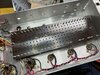
The turret board fits nicely.

IMG_3437.JPG


Resistors and some other stuff.

IMG_3439.JPG
 
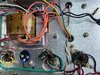
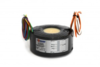
Finally got a chance to speak with Chris Merren tonight after he sent me a cheat sheet for the output transformer. Now that the color codes don’t confuse me, and I know that he does not put a 4 Ohm wire to the selector, I’m good to go. Did some rewiring, and added a few small things like the selector switch and speaker jacks. This weekend I’ll try to get the potentiometers and Switches installed, and then start wiring the turret board.

Oh, the two orange wires with the shrink tubing on the ends are 280 volts, if I ever want to convert the amp to Class A. I told Chris that I still have a lot to learn first.

0B6C0A32-F8F5-48CC-8B40-460DB7E0904B.jpeg
 
What advantage does a KT66 have over an EL34???
A KT66 is a British 6L6. The 2 are basically the same tube, and so is a 5881 which is the military version built to withstand more shock and vibration.
The 6L6 is known for more bottom end and lower midrange...but it's really the circuit (whatever circuit is attached) that makes it sound that way.
The 6L6 is more of a general purpose audio amplifier.
The EL34 was specifically designed for Hi Fi.
The fact that different manufacturers used different tubes was more a factor of which tube was more easily available, cheaper, etc than anything else.

The different sound comes mainly when the tube is pushed into overdrive.
If the tube is never pushed that hard, it's more difficult to hear a major difference between them...they sound more similar at lower loudness.

But when the EL34 is pushed, it's noticeably crispier in the top end. Less muddy in the bottom.
When the 6L6 is pushed it's more midrange and bass; "rounder."

I am a fan of power amp distortion as opposed to preamp distortion, and I never use any distortion pedals. I always go for the sound of the tube and I dislike the fizzy sound of transistors.

The JTM45 is a clean preamp which overdrives the output tubes. Like a Bassman or Plexi.
The Preamp distortion came after those amps, with 2203 and 2204 that has the extra gain stage in the preamp and master volume.

But I really prefer the extra gain stage like 220X, and use that to overdrive the output tubes. The extra gain stage increases the sensitivity of the amplifier, which is what the guitar player really wants.
You keep hearing "more gain," but that's not really what a guitar player wants.
A guitar player wants more input sensitivity, not more gain at all really.
But the 2 terms are frequently confused and misunderstood.
 
What advantage does a KT66 have over an EL34???
In a guitar amp I think it's more sonic differences than advantage. In an audio amp the KT66 may offer an advantage though.
The KT66 is one of the KT (kinkless tetrode) series developed by UK company MOV (Marconi Osram Valve).
The EL34 is a Pentodes developed by UK company Philips Mullard.
As to differences in characteristics between the KT66 & EL34;
The kinkless tetrode typically produces less 3rd order harmonics than the pentode (this may be advantageous in an audio type amplifier).
The EL34 needs less drive signal voltage to drive it to full output than the KT66 does (why in similar circuits the EL34 overdrives earlier).
As an aside, Philips later aquired both MOV & GEC (General Electric Company).
MOV had a distribution deal with RCA & so passed the Kinkless Tetrode technology on to them. RCA then used a lot of this technology (though not all of it) in development of the 6L6.
The KT66 & 6L6 are acceptable substitutes for each other, & though both are a "beam tetrode" (utilities beam forming plates), internally they are not really "identical" as a quick glance at the internal structure will show.
The 5881 was originally a (ruggedized for) military version of the very early 6L6GC & as such has a maximum plate dissipation rating of 23 watts. The 6L6 was later further developed to be a 30 watt rated tube, so if you install "true" 5881's in a 6L6 amp be sure bias so as not to exceed the 23 watt rating. Cheers
 
Last edited:
Back
Top