NCD - New Cab Day - Panama 2x10

I found this nice answer to a similar question, and is in line with Don's advice

Using an 8 Ohm amplifier output with a 16 Ohm cabinet

A tube power amplifier (like the final stage in your Mark V) has to have an output transformer to lower the output impedance (the "Ohms") to a level appropriate to drive a speaker. What does that mean? Well if you know what voltage and current and power are, then one way to look at impedance is how much of the power you are putting out is in voltage and how much is in current? That ratio is one interpretation of impedance.


The ratio of voltage to current coming out of power tubes is relatively high. But you need lots of current to make a speaker move, so you have to trade some of that voltage in for more current. That's what a transformer does. How much do you trade in?


The answer to that question is chosen by the amp designer and is your amp's rated output impedance. That means your amp is designed to put out its rated power with a specific ratio of voltage to current. The amp will pretty much put out how much voltage it's putting out in any situation, and it's designed to put out a certain amount of current along with that. Designed meaning that if it is not allowed to put out all the current it can, then you won't get the full rated power, meaning your sound will be quieter and maybe less clear. However, if your amp is allowed to put out more current than it is supposed to, then bad things can happen.


Current creates heat, more current is more heat, and too much heat can melt things. Like your output transformer. If your transformer isn't the first to go, then there are plenty of components in the amp that can be melted or just destroyed in other ways by passing too much current.


So you have to hold your amp back from running crazy with current. This is what a speaker's nominal load impedance number is meant to indicate. It's not a precise number, but it's good enough for making sure you're not letting your amp run away with itself and overheat.


Here's the short short version: If your speaker cabinet's nominal load impedance is equal to or greater than your amp's rated output impedance, you will be safe. Safe at least in terms of not overheating your amp. If the speaker's impedance is higher, as stated before you won't get the rated output power and there may be some tonal changes. There are lots of interesting interactions between a speaker cabinet and an amplifier, so how the sound will change isn't so easy to predict, but if the speaker impedance is higher, you can safely experiment and found out how it sounds.


One more thing to check is that the rated power dissipation of the speaker cabinet is greater than the rated output power of the amp. That way all the current coming out of the amp won't melt the speaker.


If you ever get into live sound PAs, just know that it's a different world because those amps are not tube amps. You still need to pay attention to power levels for sure, impedance not so much, and the rules of thumb will be different. But that's not relevant to your question. I just didn't want you to think back to this years later and think you can set up your PA the same way as your Mark V.
 
I found this nice answer to a similar question, and is in line with Don's advice

Using an 8 Ohm amplifier output with a 16 Ohm cabinet

A tube power amplifier (like the final stage in your Mark V) has to have an output transformer to lower the output impedance (the "Ohms") to a level appropriate to drive a speaker. What does that mean? Well if you know what voltage and current and power are, then one way to look at impedance is how much of the power you are putting out is in voltage and how much is in current? That ratio is one interpretation of impedance.


The ratio of voltage to current coming out of power tubes is relatively high. But you need lots of current to make a speaker move, so you have to trade some of that voltage in for more current. That's what a transformer does. How much do you trade in?


The answer to that question is chosen by the amp designer and is your amp's rated output impedance. That means your amp is designed to put out its rated power with a specific ratio of voltage to current. The amp will pretty much put out how much voltage it's putting out in any situation, and it's designed to put out a certain amount of current along with that. Designed meaning that if it is not allowed to put out all the current it can, then you won't get the full rated power, meaning your sound will be quieter and maybe less clear. However, if your amp is allowed to put out more current than it is supposed to, then bad things can happen.


Current creates heat, more current is more heat, and too much heat can melt things. Like your output transformer. If your transformer isn't the first to go, then there are plenty of components in the amp that can be melted or just destroyed in other ways by passing too much current.


So you have to hold your amp back from running crazy with current. This is what a speaker's nominal load impedance number is meant to indicate. It's not a precise number, but it's good enough for making sure you're not letting your amp run away with itself and overheat.


Here's the short short version: If your speaker cabinet's nominal load impedance is equal to or greater than your amp's rated output impedance, you will be safe. Safe at least in terms of not overheating your amp. If the speaker's impedance is higher, as stated before you won't get the rated output power and there may be some tonal changes. There are lots of interesting interactions between a speaker cabinet and an amplifier, so how the sound will change isn't so easy to predict, but if the speaker impedance is higher, you can safely experiment and found out how it sounds.


One more thing to check is that the rated power dissipation of the speaker cabinet is greater than the rated output power of the amp. That way all the current coming out of the amp won't melt the speaker.


If you ever get into live sound PAs, just know that it's a different world because those amps are not tube amps. You still need to pay attention to power levels for sure, impedance not so much, and the rules of thumb will be different. But that's not relevant to your question. I just didn't want you to think back to this years later and think you can set up your PA the same way as your Mark V.
Thanks for not making me type that sh!t out Ray.
 
So since 11.3 is safe for 8, I hooked it up directly from head to cab. It is th best it has sounded so far. Hey, this cab goes to 11!!!
Congratulations!
11.3 could be just a cable/meter anomaly...you’re just measuring DC resistance of the coil...not the actual working impedance of the speaker under load. There’s plenty out there on the subject, but you got your quick and dirty answer about the impedance of your cab...it is, probably, as labeled, a 16 Ohm cab.
You could pop off the back, look for the ratings on the speakers, figure if they’re wired in series(or parallel), and calculate fairly accurately that way too.
 
  • Like
Reactions: RVA
Congratulations!
11.3 could be just a cable/meter anomaly...you’re just measuring DC resistance of the coil...not the actual working impedance of the speaker under load. There’s plenty out there on the subject, but you got your quick and dirty answer about the impedance of your cab...it is, probably, as labeled, a 16 Ohm cab.
You could pop off the back, look for the ratings on the speakers, figure if they’re wired in series(or parallel), and calculate fairly accurately that way too.
Here they are

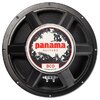
Panama Guitars British Ceramic 10-inch Guitar Driver ( 30 Watt | 8 Ohm)

sdyszlfmwsesswitib1l.jpg

Panama Guitars British Ceramic 10-inch Guitar Driver ( 30 Watt | 8 Ohm)

This British voiced masterpiece delivers vocal mids and has best in class low-end performance for a “Big” sound unlikely to be found with other 10 inch drivers, perfect for upgrading your 10-inch combo to give you classic British tones.

At 8 ohms 30W, The Panama BC0 is no toy, the same driver featured in our popular compact 4x10 cabinets delivers amazingly rich British tone in a tiny package, it's perfect for Bryan May-squee lead tones.

  • Powerful mid-range and impressive low-end response for its class
  • Designed for punch and clarity, with just the right amount of character
 
Last edited:
Then if the speakers in there are marked 8 Ohm, and there’s no funky added circuitry shenanigans(your cab is wired traditionally to the output jacks), then your cab could only possibly be 4 Ohm(parallel wired), or 16 Ohm(series wired).
So it’s 16 Ohm probably.

As outlined here: Speaker Impedance, Power Handling and Wiring | Amplified Parts
Their examples shoot for an 8 Ohms rating for each scenario.
 
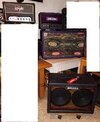
Blackheart Little Giant at 3W through a 12 & 10 cab (my purple box) and the Panama Loco through the Panama 2x10 at the same time....Nice!!

20180911_220246.jpg
 
Then if the speakers in there are marked 8 Ohm, and there’s no funky added circuitry shenanigans(your cab is wired traditionally to the output jacks), then your cab could only possibly be 4 Ohm(parallel wired), or 16 Ohm(series wired).
So it’s 16 Ohm probably.

As outlined here: Speaker Impedance, Power Handling and Wiring | Amplified Parts
Their examples shoot for an 8 Ohms rating for each scenario.
Hmm, so I am operating at 1/2 power and early breakup now?
 
Last edited:
OK, so since the Blackheart has a 16 ohm output (in addition to 8 and 4) and the puprple box is rated for 8 ohms, I switch the heads and cabs. It is all very different now! This is fun! Thanks for th guidance and making this possible Don!

Blackheart>>>>>Panama Cab

Panama Head>>>> RVA Special
 
Last edited:
Hmm, so I am operating at 1/2 power and early breakup now.
No. That’s the power handling of the cabinet. If your specs on the speakers is accurate, that cab can take 60 Watts of power from any given amp(like your Classic 50).
Unless you were talking about...
Cabinet impedance doesn’t affect tube amps in the same way as solid state.
If you were running a solid state amp that was rated for 100 Watts @8 Ohms, and you plugged that 16 Ohm cab in to it, the solid state amp would put out less power...some as low as 1/2 power(depending on the design).
 
  • Like
Reactions: RVA
FYI - from Panama in response to my follow-up question in case anyone gets one

Just to clarify, this is not a Stereo cabinet. You can plug in any 8 ohm or 16 ohm amp. And you can use either input as an extension to another cabinet.
 
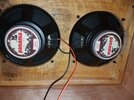
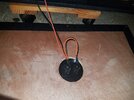
I popped the back off the cab. The speakers test @ 5.5 ohms when measured from the connections, although I did not disconnect anything when I took the measurement. As mentioned earlier, it measure 11.3 ohms from the tip and sleeve of a cable plugged into a jack. It appears that these are wired in series, so that ohms wold be additive at 16 ohms (despite the 5.5 and 11.3 readings). Does all that sound correct?

20180913_070610.jpg

20180913_070614.jpg
 
Back
Top