My 2204/Caswell #39 type amp

ivan H

Ambassador of Tubes & Grooves
Country flag
I've not shown this amp here before, so seeing as I had it out of the headcab due to a failed power tube I thought I'd show it. I built this probably 7 years ago & it's been modified a few times before I settled on this configuration. Basically a 2204 with the first coupling cap changed from an 0.022uf to a 0.0022uf to tighten the low end up, footswitchable to the Tim Caswell #39 added stage mod. The EL34's (winged C's) have been in it since the get go & the amp has had a LOT of hard use. Here's the one that failed
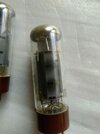
IMG_20200102_084241.jpg
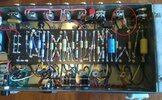
Took the HT fuse out instantly, didn't harm the screen grid resistor or anything else. Here's a couple of gutshots
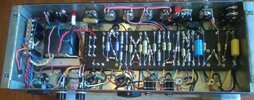
IMG_20200425_163325.jpg
The regulated power supply for the switching relay can be seen on the chassis sidewall. This is powered by a 5VAC winding on the PT, intended as a rectifier valve's heater supply. Here's a shot of the board
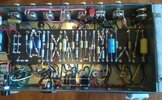
IMG_20200425_162842.jpg
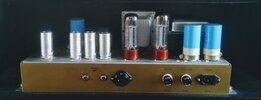
The Mustard caps are Aussie made Philips polyester film/foil 400V caps. These were made on Philips Mullard machines with Philips Mullard supplied polyester film & aluminium foil so are the same as their British made counterparts. I had a duet of new Svetlana's here so threw them in & biased to 66%. IMG_20200427_092534.jpg
Gave it about a 1 1/2 hour workout earlier today, all good again. Cheers
Edit:
Pre-amp tubes are all NOS items, V1 is a 163 series Blackburn Mullard, V2 & V3 are green text Sylvania, the PI is a red text Sylvania. Only one triode of V2 is used (switched in for the #39 mod) so it is only 1/2 heatered, the unused cathode, grid & plate pins are tied to ground. Cheers
 
Last edited:
Thanks guys, appreciated. Most of it follows a standard 50 what layout, though a bit of thought went into adding the extra stage & it's switching in & out. Cheers
 
Ivan, what are your thoughts on running your board grounds direct to the chassis versus a buss bar across the pots? Is it actually quieter, or just easier to swap out a pot?
 
That frick'n beautiful, Ivan. I didn't know that you are very knowledgeable on working on switching with relays. I don't even dare go there!

What was the #39 amp associated with? S.I.R. Studios?

I also noticed that you connected the preamp volume pot's R/C combo directly to the board and its .0022 cap, instead of connecting to the low input jack. Didn't know you can do that. No "bright" cap either! Is the R/C combo at stock values?

IMG_20200425_162842.jpg
 
That frick'n beautiful, Ivan. I didn't know that you are very knowledgeable on working on switching with relays. I don't even dare go there!

What was the #39 amp associated with? S.I.R. Studios?

I also noticed that you connected the preamp volume pot's R/C combo directly to the board and its .0022 cap, instead of connecting to the low input jack. Didn't know you can do that. No "bright" cap either! Is the R/C combo at stock values?

View attachment 42622
Yes, Tim Caswell designed the #39 mod while working at Studio Instrument Rentals (SIR). #39 was the stock No. of the amp he performed the mod on.
Switching relays are reasonably easy to wire in, basically they are a DPDT switch & wired much the same as a footswitch in an effect pedal. You do need to derive a regulated power supply for them.
The treble peaking R/C network is wired between the board & pot as the lower jack socket (upper when looking at the chassis underside) is used for the footswitch that operates the relay, so their is a single input jack socket. The small toggle switch on the front panel also operates the relay if the footswitch is not plugged in. There is an indicator LED above the toggle switch (can't be seen in pic) that shows when the added stage is switched in.
The treble peaking cap value is 0.001uf (1,000pf) instead of the normal 470pf. The #39 amp is very bright & this value helps fill the mids/upper mids somewhat. When I get more 0.001uf dogbone caps I'll put one on the volume pot.
I also used a HT dropper/decoupling resistor & filter cap for the added stage, where most don't. This avoids have two "in phase" stages (& one out of phase stage) supplied off the same HT node. An added benefit is that the added stage HT voltage is a little higher than the 2nd stage HT voltage. Cheers
 
Ivan, what are your thoughts on running your board grounds direct to the chassis versus a buss bar across the pots? Is it actually quieter, or just easier to swap out a pot?
The "localised chassis grounding" scheme we discussed in Sysco's thread is definitely a better way of grounding the amp. While the wire across the pots is a buss, it is not a proper application of a "grounding buss".
Star grounding, 2 star grounding, grounding bus, localised chassis grounding all have merits if properly done (& no system is "perfect"), but considering the "dual cap cans" being shared by the screens/PI & V1/V2, a properly done localised chassis grounding scheme is as good as any. Cheers
 
Yes, Tim Caswell designed the #39 mod while working at Studio Instrument Rentals (SIR). #39 was the stock No. of the amp he performed the mod on.
Switching relays are reasonably easy to wire in, basically they are a DPDT switch & wired much the same as a footswitch in an effect pedal. You do need to derive a regulated power supply for them.
The treble peaking R/C network is wired between the board & pot as the lower jack socket (upper when looking at the chassis underside) is used for the footswitch that operates the relay, so their is a single input jack socket. The small toggle switch on the front panel also operates the relay if the footswitch is not plugged in. There is an indicator LED above the toggle switch (can't be seen in pic) that shows when the added stage is switched in.
The treble peaking cap value is 0.001uf (1,000pf) instead of the normal 470pf. The #39 amp is very bright & this value helps fill the mids/upper mids somewhat. When I get more 0.001uf dogbone caps I'll put one on the volume pot.
I also used a HT dropper/decoupling resistor & filter cap for the added stage, where most don't. This avoids have two "in phase" stages (& one out of phase stage) supplied off the same HT node. An added benefit is that the added stage HT voltage is a little higher than the 2nd stage HT voltage. Cheers
Sure... that's all easy for you to say, ha ha!

A special request for a pic of the amp's front facade... :fingersx:
 
A special request for a pic of the amp's front facade... :fingersx:
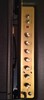
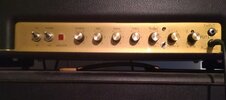
Haha, it still has a stock 4 hole plexi face plate that has been adapted for the control format. The pre-amp volume control (labelled "gain") is placed between the bright channel (channel 1) Hi & Low inputs. The normal channel volume control is used on the of input to the added stage, so is switched in & out with channel switching. Positioning it at a hair over 12 O'clock gives the normal #39 voltage divider values (Caswell's #39 does not include this control pot). The bright channels volume is now the (pre-PI) master volume. Labelling is done with a black marker, now nearly worn off
IMG_20200430_102745.jpg
I need to get a proper one made up. Cheers
 
Thanks guys, much appreciated. I tried both the #39 & #36 variants, & prefer this one. I'd like to do a 100 Watter just because it would be awesome, however I wouldn't get to use it all that often. I still may do one someday all the same. Cheers
 
Back
Top