Modeling v. Valve amps: The modern debate

RVA

Ambassador
Let's face it, as time and technology march on, this debate will get more heated. Modeling amps are getting better and better and tube quality is getting worse and worse, with NOS tubes becoming more rare every day. At the same time, not many of us wwnt to give up our speaker cabs for a flat resonse speaker, and we all love seeing those tubes glow. Let's not forget the sweet sound of natural breakup from the power section of an amp!

Yet I have to believe that with a generation that grew up with a cell phone in their hand and whose first "amp" was on their IPhone, change may be inevitable. So let's hear your thoughts, from those who use both, the perpetually curious like me and the die hards on both sides.

If you need to become more familiar with the debate, this video may help.

 
your probably right there RVA but tubes will still be around. i used to have a 40 watt Roland modeling amp and it was miles above the smaller roland amps.and frankblade got that new SS Orange combo amp and he likes it.most all of my amps use just 1 to 3 small tubes. the nice thing about SS amps is just turn the darn thing on and play it.you see i monkey with Ham and CB Radios and they still make the Linear amplifiers in tubes for those rigs,but they also got new SS ones that are exellent to.so there will probably always be both but ya the Modeling technology is really came along ways
 
Personally, I like to keep an open mind. The technology is just another tool in the hands of
the songwriter, or the performer, or the producer. I believe it's our business to utilize what ever
we can get our hands on, with the goal of making good music. And so it's our business to know
about the advantages and disadvantages of various tools. So we can apply them properly.

I'm old enough to remember the aulde equipment, from the day when that was all there was.
I was never that fond of tubes, thinking them antique technology from my parents' time.
I hated when they'd fail, and disliked carrying spares, but I did it because that's what one did.
I used to buy them from a store that stocked literally thousands of different types... their clientele
was the "stereo snob" crowd, as well as the "HAM radio (small) crowd" as well as the scruffy
musician crowd, so it was always interesting going in there. This was before computers, so the
store manager kept track of his inventory using an abacus or something like that.

The first time I saw a used Fender solid state amp for sale, I bought it happily. Hurray, no more tubes!
It was a Fender "Bassman Compact" combo amp, 1/15" and running about 120 W. (the idea of buying
a NEW amp was an alien concept to me... I was in business, trying to do the best I could with such
equipment as I could afford based on how much i got paid... so used equipment was the only practical
way to go).

That solid state amp gave good service for a couple of decades. (which says worlds)
No tubes, no distortion, no problem. *grins ...Just 120 W of Fender goodness. Because of the type of
music I played, and the size of the venues I played, I never turned that amp up past about 3 or 4.
So it was actually overkill. But I liked it. It weighed about forty pounds. Somebody sold me a
(probably stolen) bass speaker that had a HUGE magnet in the back, and a monstrous amount of travel in
cone... and I was like " OH YEAH... now I'm going to shake the earth..." But not only did that speaker weigh
about 25 pounds itself, but it wouldn't fit in the cabinet with that giant magnet. I tried playing it with the
back panel off, and then gave up and gave it away to a stereo snob, and put the stock speaker back in the
cab, and moved on, glad not to carry that heavy bastard around the sleazy dives where we were playing.

You can see where I'm going with this... I'm now playing my bass through a modeling amp. Mine's a Roland
Cube Bass 60XT. I love this little thing. It's got two tones that I find very useful, and I ignore all the other models.
I like having some f/x... although my philosophy as a bass player is that SOMEBODY in this band as to play clean..
guess who... So I use a minimum of f/x, on their lowest settings... just a touch. With this amp, I don't need a
peddle board for my bass. I also can pick it up in one hand and walk out with my bass in my other hand.
Hard to beat. It's got an XLR out on the back of the amp, so I don't need a direct box to connect to the P.A.
Just plug it in and let the sound man mix it through the mains, and I can shake the earth. But under control from
the sound board. Hard to beat. Solid state... no tubes, no distortion, no problem. I have an "overdrive" control
but I've never turned that up past about 3. It gives a usable crunch for some songs. Purists might argue that the
model is no good, but I've never taken any poop from purists of any kind. Mine works for me, and does all I ask
of it, simple and easy to use.. Among modeling amps, Roland is one of the good brands.
Acorn Theatre 09-14-12@100.jpg
 
If it sounds good, it is good.

However, what sounds good is very often closely connected to what feels good. And if you feel better playing a tube amp, it will sound better to your ears. Therefore I think tube amps will be around for a long time.
 
If it sounds good, it is good.

However, what sounds good is very often closely connected to what feels good. And if you feel better playing a tube amp, it will sound better to your ears. Therefore I think tube amps will be around for a long time.
Ah, bu t the new generation will have a new "feel good" spot, so how long really?
 
Last edited:
Personally, I like to keep an open mind. The technology is just another tool in the hands of
the songwriter, or the performer, or the producer. I believe it's our business to utilize what ever
we can get our hands on, with the goal of making good music. And so it's our business to know
about the advantages and disadvantages of various tools. So we can apply them properly.

I'm old enough to remember the aulde equipment, from the day when that was all there was.
I was never that fond of tubes, thinking them antique technology from my parents' time.
I hated when they'd fail, and disliked carrying spares, but I did it because that's what one did.
I used to buy them from a store that stocked literally thousands of different types... their clientele
was the "stereo snob" crowd, as well as the "HAM radio (small) crowd" as well as the scruffy
musician crowd, so it was always interesting going in there. This was before computers, so the
store manager kept track of his inventory using an abacus or something like that.

The first time I saw a used Fender solid state amp for sale, I bought it happily. Hurray, no more tubes!
It was a Fender "Bassman Compact" combo amp, 1/15" and running about 120 W. (the idea of buying
a NEW amp was an alien concept to me... I was in business, trying to do the best I could with such
equipment as I could afford based on how much i got paid... so used equipment was the only practical
way to go).

That solid state amp gave good service for a couple of decades. (which says worlds)
No tubes, no distortion, no problem. *grins ...Just 120 W of Fender goodness. Because of the type of
music I played, and the size of the venues I played, I never turned that amp up past about 3 or 4.
So it was actually overkill. But I liked it. It weighed about forty pounds. Somebody sold me a
(probably stolen) bass speaker that had a HUGE magnet in the back, and a monstrous amount of travel in
cone... and I was like " OH YEAH... now I'm going to shake the earth..." But not only did that speaker weigh
about 25 pounds itself, but it wouldn't fit in the cabinet with that giant magnet. I tried playing it with the
back panel off, and then gave up and gave it away to a stereo snob, and put the stock speaker back in the
cab, and moved on, glad not to carry that heavy bastard around the sleazy dives where we were playing.

You can see where I'm going with this... I'm now playing my bass through a modeling amp. Mine's a Roland
Cube Bass 60XT. I love this little thing. It's got two tones that I find very useful, and I ignore all the other models.
I like having some f/x... although my philosophy as a bass player is that SOMEBODY in this band as to play clean..
guess who... So I use a minimum of f/x, on their lowest settings... just a touch. With this amp, I don't need a
peddle board for my bass. I also can pick it up in one hand and walk out with my bass in my other hand.
Hard to beat. It's got an XLR out on the back of the amp, so I don't need a direct box to connect to the P.A.
Just plug it in and let the sound man mix it through the mains, and I can shake the earth. But under control from
the sound board. Hard to beat. Solid state... no tubes, no distortion, no problem. I have an "overdrive" control
but I've never turned that up past about 3. It gives a usable crunch for some songs. Purists might argue that the
model is no good, but I've never taken any poop from purists of any kind. Mine works for me, and does all I ask
of it, simple and easy to use.. Among modeling amps, Roland is one of the good brands.
View attachment 1583
Ever practical and well considered Col. The tools concept certainly goes a long way to reminding everyone what the end goal is.
 
Ah, bu t the new generation will have a new "feel goo" spot, so how long really?

Well, when you look at all the "retro" thinking going on, I believe there will be a market for tubes for a long time. Vinyl for instance, has made a real comeback.
 
I enjoy playing through a tube amp more than any modelling amp I've played through. It is about personal perception and what feels right to you. I've played with players that use modelling amps that have awesome tone and can play way better than me. It's what they are comfortable with. I hope we always have a myriad of choices when it comes to amps.
 
yeah, but what about GUITAR man...

That's a whole 'nother animal, as everybody well knows.
I like the sound of f/x for some songs, and clean for others, with my fave effect
being overdrive. I use chorus and reverb for my acoustics, but not at the same time.

And I'm happy to get my overdrive from a pedal, or a model. I don't fuss about purity
of effects, because when I use them it's usually at a very low setting. Just a touch.
So I don't ever play loud enough to push a big tube amp into breakup. (that's why I can still hear)
I believe this is one way to have a long career. Don't play in a band where the drummer hits
peaks sharp enough and tall enough to do you harm. If you're in a band where you need
ear protectors, you're in the wrong band. (NOTE: just my personal humble opinion. I don't
intend to annoy anyone or insult anyone with that bald statement. I just don't like pain).

The issue of tube warmth vs solid state's "sterile" sound seems like a non-issue to me, because
of the kind of music I play and the venues I play in. All my tones go through P.A. systems which are
ALL solid state AFAIK... except when I play electric guitar, and even those tones are sent to the board
from a direct box. So the only tube tones I ever use are from my hybrid tube/SS guitar amps, and
those are small handy amps. No big stacks for me, ever. I'm happy not to carry stuff like that.

Do I seem like the opposite of a metal maniac? I confess. Am I wrong about modern P.A. equipment
being all solid state? I don't know. Maybe others here know the answer, and will chime in.
I'm listening...

I like to play my electric guitars through hybrid amps like the Vox VT-30 and the Orange Micro Terror.
These really sound good to my ear. I have a Black Heart Little Giant, and that has a tube in one
section of the signal chain, which makes it a hybrid also. I like that one also, and have used it onstage
with a Sennheiser 609 hanging down in front.

So my take on the issue is from a practicality POV. I like the amps to stay small, so I don't harm my
back carrying them, and I don't harm my ears playing them, and they make good music so that my group
gets encores at the end of the evening, and we get invited back to play again by the presenter.
Those are the important issues for me anyway.
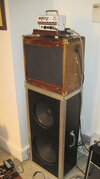
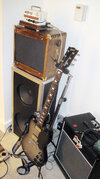
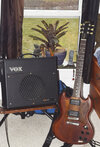
Orange tall rig@100.jpg April Orange 4@100.jpg Luna & Vox@100.jpg
The little Orange rig is about as simple as an amp can be. But it relates well to
my compact peddle board, and gives a nice crunch response to my favorite Blues Driver.
The Black Heart Little Giant is also very simple, with a few more controls. That one
too seems to do most of what i ask of it, and also plays well with my small pedal board.
Because the Black Heart is only 5W, I CAN push that into breakup with my SG or my Tele
and without knocking dishes off the shelves downstairs. But I like the clean sound of it.

The Vox VT-30 is quite complicated, and I had to read the manual multiple times and
go on the Vox amp site and read a lot of what other players had to say... and then I was
able to find two tones that are quite usable and good. That's all I do with it now. I don't need
a peddle board with the Vox, because the two models I've found usable actually sound very
good, one's for normal playing and one's for solo, and I can use the honking big Vox pedal
to cycle between them.

Actually, I've found many more models than two on this amp, that I like. It's cool because I
can save presets once I do find one that works. And find them quickly when I'm in the mood.
That for me is the beauty of a modeling amp... how much FUN it is. Then when you want to
settle down and practice for a show, you practice what you intend to perform. Then you perform
what you've practiced. For me, this works.

Also, on the VT-30, you can set it on "manual" and then it operates like a normal amp,
with no effects but reverb, which has its own control.
 
Last edited:
The modeling/processor vs. physical gear (because that's really what this is about) is an area of interest to me. I play both and am comfortable in both realms. My modeler is old: a Line 6 Pod X3 Live. It is technically obsolete, having been superseded by the Pod HD500X and the Line 6 Helix. But, you get the point. I also have tube amps and regular pedals.

I've played whole gigs with the X3 Live. Likewise, I've played events with the physical amp. Usually, the decision is one of logistics. If I'm playing a smallish venue and/or one with very limited stage room, I'll use the X3 Live. Otherwise, I'll tend to use the amp. Personally, I like to be able to get the sound I want from both setups. I really don't like seeing it as a This vs. That proposition, as in which is better. Use what makes the best sense for the event.

As for the question of one completely going away...I don't think there is such a cut-and-dried conclusion to be drawn. We like to think of change as a serial paradigm...meaning one technology gives way to another. It isn't so neat and tidy. Very often older things don't go away; their roles in the market just shift. To draw from an oft-mentioned example of obsolescence, do you know buggy whips ARE still made! Yup. The advent of motorized vehicles did not do away with horse-drawn carriages, and the requisite buggy whip. The horse-drawn carriage just assumed a different role in our society...one of status, elegance, or nostalgia instead of everyday transportation. So, the buggy whip never died...it just ended up in a different market. It no longer is a commonplace, mundane item. It actually is used in a very specialized role.

I'll use another example. I happen to be very fond of fountain pens. I have a few and actually use them on a regular basis. The development of the ball-point pen did not eliminate the fountain pen. The fountain pen just assumed a different role. It is less an instrument of daily writing, but they're still made. Some of them command very high prices, and they have a very loyal following among the young and old, alike. In fact, many years ago a group bought up some machinery used to make the bladders for the old lever-fill fountain pens. I've bought replacement bladders from them. It would be the equivalent of someone cranking up an old tube factory and remaking those tubes. Anyway, the point is, the newer, arguably better, pens did not eliminate the fountain pen. They merely shifted the fountain pen market.

As for guitars, thinking back to what was going on in the '80s, I'm sometimes surprised that Gibson and Fender are still here and still making their flagship models, and they are being bought by people of all ages.

As for what younger people are doing? They're really trying all sorts of stuff. I see kids trying amps out, as well as the other things. I don't think you can really generalize that kids will do THIS or kids will do THAT. Given the saturation and growth of digital technology and modeling, I don't see tube amps going away. But, they may assume a different place in the musical market.
 
Last edited:
Since my return to the electric guitar I've have stuck with solid state plug and play technology. I use a multi-effects pedal processor, so my amp really needs to be rather simple. My experience with modeling amps hasn't been positive. The Fender Champion I tried for a spell was extremely noisy. Despite all my efforts to reduce the noise, it remained. I don't know if this is an issue with all modeling amps but if it is, It's not for me. I have not tried modeling software yet, which is something that interests me. I like to try new things outside my comfort zone.
 
Back
Top