syscokid
Ambassador of War & Peace

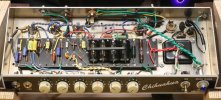
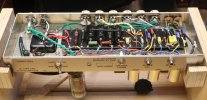
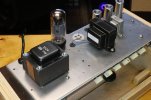
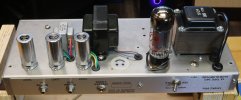
My Allen Amp Chihuahua, that I built from a kit, is a single-ended cathode biased amp that can operate with a 6V6 at 6 watts or a 6L6/EL34 at 10 watts. An 8 ohm speaker is always used. There’s a tube selector switch that does a couple things in order to operate the different tubes safely. When the switch is set to 6L6, the tube’s cathode biased resistance is 335 ohms and the OT’s 8 ohm output impedance is connected to the speaker jack. When the switch is set to 6V6, the cathode bias resistance is 500 ohms and the OT’s 4 ohm output impedance is connected to the speaker jack to still operate with an 8 ohm speaker.
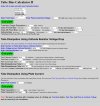
A couple days ago I decided to check the bias of the amp with a 6V6 installed, and I read 35 mA’s which is 93% of the tube’s dissipation. Definitely on the hot side! Installed a 6L6, flipped the switch to 6L6, and got a current reading of 59 mA’s which is 65% of the tube’s dissipation. This is very cold according to the online tube bias calculator. By altering the bias resistance of 335 ohms down to 200 ohms, the 6L6 now has 76 mA’s of bias current for 84% of dissipation… A cool, but not super cold bias.
Since I’m favoring the amp’s tones with the 6L6’s warmer bias, I feel like making this a more permanent alteration. What I don’t understand is, did the designer of the Chihuahua circuit, Mr David Allen, do this on purpose? Was it to compensate for the use of a EL34 instead of a 6L6? Other safety concerns?
Tube Bias calculator showing the 6L6 with a 200 ohm bias resistor:
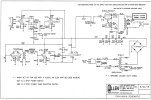
Changing the 1K/3W resistor at the tube selector switch to a 330 ohm/3W resistor, will make the 6L6 position produce a bias resistance of 200 ohms:
Maybe I should try a different 6L6 first, just in case the one that’s in the amp is a little wonky!
What y’all think?
A couple days ago I decided to check the bias of the amp with a 6V6 installed, and I read 35 mA’s which is 93% of the tube’s dissipation. Definitely on the hot side! Installed a 6L6, flipped the switch to 6L6, and got a current reading of 59 mA’s which is 65% of the tube’s dissipation. This is very cold according to the online tube bias calculator. By altering the bias resistance of 335 ohms down to 200 ohms, the 6L6 now has 76 mA’s of bias current for 84% of dissipation… A cool, but not super cold bias.
Since I’m favoring the amp’s tones with the 6L6’s warmer bias, I feel like making this a more permanent alteration. What I don’t understand is, did the designer of the Chihuahua circuit, Mr David Allen, do this on purpose? Was it to compensate for the use of a EL34 instead of a 6L6? Other safety concerns?
Tube Bias calculator showing the 6L6 with a 200 ohm bias resistor:
Changing the 1K/3W resistor at the tube selector switch to a 330 ohm/3W resistor, will make the 6L6 position produce a bias resistance of 200 ohms:
Maybe I should try a different 6L6 first, just in case the one that’s in the amp is a little wonky!
What y’all think?
Last edited: