Marshall Phase Inverter Voltages

Thanks fr everyone's input. I truly appreciate it.

I'll try to answer Ivan's email, to keep it up to date with the last few from Steve and Sysco.

You mention that the amp is a little "shrill". Might I ask, where are you setting the Master Volume? If you are setting the master low it contributes quite a bit to the amp sounding thin or shrill (the phase inverter being "driven" really thickens the tone). If you usually set the master up around 6 or 7 (or higher), disregard the previous.

Master is usually on 5. Gain a little lower, then I use the Klon KTR to thicken things up.


Next, the "treble peaking" circuit, located between the "low" input & the volume pot (comprised of the 470k resistor paralleled by the two ceramic disk caps). The stock cap value here is either a (single) 500pf or 470pf cap.
To explain how this circuit works, the 470k resistor attenuates all frequencies, except those passing through the cap (highs & high mids).
It appears on my 'phone that the two ceramic disk caps on your treble peaking circuit (a 68pf & a 500pf) are wired in series. This would give a total value of 59.859pf (60pf). This value would leave only the very high highs unattenuated. I personally would use a 500pf here.

I did order a couple of 500pF capacitors from Steve's Tube Depot link, along with a bunch of resistors and a 1000pF Cap in case I need it.

This brings us to the choice of ceramic disk or silver Mica for this cap. Silver micas impart a "smooth" quality to the highs while ceramic Disk caps impart a "grainy" quality to the highs. For blues & blues/rock the silver micas work well. For harder, more aggressive rock the ceramics work well.

I did order Silver Mica caps.

Besides using a "hot shield", a safer approach that Marshall used to combat shrillness in these amps was to install a small value (1kV ceramic disk) cap between the V1 pin 6 & pin 8 leads (mounted on the board).
However, I agree with your returning the amp to stock & correctly configuring the bias supply for EL34's before even thinking whether tone shaping mods might be of benefit. Cheers

I might have a few 1kV ceramic caps at the house. I think I bought them for a jumper to test Capacitor values in guitars. It was from a Dan Earline thing on StewMac. I can verify until I get home Friday.


I'll print out all the latest photos everyone posted, and save the files too. I believe that when everything is as it should be, the amp will sound pretty good. '77- '79 Marshall JMP amps have a great sound. Unfortunately, it's now a thirty plus year old amp, and many people have had their way with it.

Hopefully, Saturday or Sunday I can give you all and update.
 
Don't know if you know anything about using shielded coax cables for your input grid wire to pin 7 of V1. I copied this from a Metro Amp Assembly Manual for one if their old kit amps that they used to sell:


That's a 22 gauge shielded coax cable that is being used. You can run it under the board or over it like I did here:View attachment 28118

Remember that my wiring layout for V1 is flipped compared to yours. The Input 68K is connected to pin 2 on mine, and yours will be pin 7.


I am a bit confused by what's going on around the volume pot and input jack in this photo. I hope that I understand it better when I have some free time this weekend.
 
In won't include the photo in my reply, but this is the one I am curious about.

Syscos JMP_01.JPGSyscos JMP_01.JPG
 
It appears on my 'phone that the two ceramic disk caps on your treble peaking circuit (a 68pf & a 500pf) are wired in series. This would give a total value of 59.859pf (60pf). This value would leave only the very high highs unattenuated. I personally would use a 500pf here.
Thanks, Ivan... This is absolutely correct. Especially the calculations. I earlier had misinformed @SG John the wrong calculations... oops!
 
It appears on my 'phone that the two ceramic disk caps on your treble peaking circuit (a 68pf & a 500pf) are wired in series. This would give a total value of 59.859pf (60pf). This value would leave only the very high highs unattenuated. I personally would use a 500pf here.


What is the formula for figuring this out?

Thanks.
 
I am a bit confused by what's going on around the volume pot and input jack in this photo. I hope that I understand it better when I have some free time this weekend.
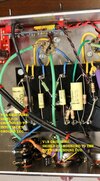
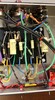
In this pic, I'm using a shielded coax cable for each grid wire connection for the V1 tube. I'm also using green shrink wrap sleeves to add the green color:

28193
 
Don't know if you know anything about using shielded coax cables for your input grid wire to pin 7 of V1. I copied this from a Metro Amp Assembly Manual for one if their old kit amps that they used to sell:
View attachment 28117


That's a 22 gauge shielded coax cable that is being used. You can run it under the board or over it like I did here:

Remember that my wiring layout for V1 is flipped compared to yours. The Input 68K is connected to pin 2 on mine, and yours will be pin 7.


I forgot to order a 68K 1 watt resistor when I made my order. I was able to find a 68K 2 watt resistor locally. Will this be ok to use?

Thanks.
 
I forgot to order a 68K 1 watt resistor when I made my order. I was able to find a 68K 2 watt resistor locally. Will this be ok to use?

Thanks.
What type of resistor is that 2 watt?

It should be carbon film or metal film. Or even carbon comp is OK. If it's carbon oxide, I wouldn't use it.

If your careful enough with the desoldering, you can reuse the stock "Piher-brand" 68k that's already on your amp's board.
 
I would just use the 68k Piher off the board. Anywhere in the signal path I would try to use these 70's era Piher's as they "color" the sound off the amp somewhat, more so than the Iskra's that Marshall used earlier. I would most likely use them for the 220k bias splitter resistors you are going to replace the 150k ones with. These are part of the bias circuit, but they also are the load (they provide a "potential difference") that the signal being applied to each output tube "develops" across & so are in the signal path. They are also subjected to reasonably large signal voltage swing. This is when resistors & caps "color" the tone most. They are still quite available, I buy them quite a bit. If you do seek them out, be sure they are 0.5 watt, not 0.3 & ask the supplier to match the two 220k resistors to 2% or better. Hope this helps. Cheers
 
I would just use the 68k Piher off the board. Anywhere in the signal path I would try to use these 70's era Piher's as they "color" the sound off the amp somewhat, more so than the Iskra's that Marshall used earlier. I would most likely use them for the 220k bias splitter resistors you are going to replace the 150k ones with. These are part of the bias circuit, but they also are the load (they provide a "potential difference") that the signal being applied to each output tube "develops" across & so are in the signal path. They are also subjected to reasonably large signal voltage swing. This is when resistors & caps "color" the tone most. They are still quite available, I buy them quite a bit. If you do seek them out, be sure they are 0.5 watt, not 0.3 & ask the supplier to match the two 220k resistors to 2% or better. Hope this helps. Cheers
Very cool and nerdy info... :celebrate:
 
I'm having a bit of a problem. I replaced all the caps, and also set up V1 with the new cable Sysco sent me. I could not get more than 6 milliamps when biasing the tubes. Then, I realized that I forgot to swap one of the 150K resistors for a 221 K resistor.

Forgot 150K.JPG


I replaced it with the 221K, and it burned out when I turned on the power. I swapped it again, and it burned out.


New 221K.JPG


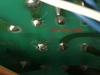
Here are shots of the backside of first the 221K resistor.


Neww 221K pins.JPG


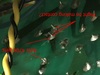
Here's a shot of the back of the 470K. It looks like it might be making contact with the 150K. In the schematic it looks like both of them are joined to the two 10uF capacitors.


Back of 470K Pins.JPG


What should I be looking at next? What would cause the 221K resistors to burn up after I did have the amp powered up? Could it have been some of the solder accidentally joining the 470K and the 150K when I made sure the 470K was soldered tight. I've been trying to get rid of the solder with an extraction tool. Thanks. Luckily, I'm working locally this week.
 
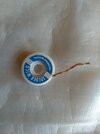
Hi SG John, sorry I didn't see this earlier. If you can get hold of some de-soldering braid IMG_20190724_073746.jpg
aka "solder wick" it will remove the unwanted solder quite easily & well. You need to have the iron tip clean & well thinned for it to work (otherwise the heat won't "transfer"). Simply place the braid on the unwanted solder & apply the hot, tinned iron. If there is a lot of solder to remove, place the braid a bit from its end on the solder & when the solder melts, drag the braid through it with the iron still applied.
As to the main question, yes, if you have accidentally "bridged" two connections it could cause a problem like this, depending on exactly what they are. As it is important, I would like to be fully awake to properly answer (I've not long woken up & had a big night), so will get back to you. Cheers
 
Hi SG John, sorry I didn't see this earlier. If you can get hold of some de-soldering braid View attachment 28815
aka "solder wick" it will remove the unwanted solder quite easily & well. You need to have the iron tip clean & well thinned for it to work (otherwise the heat won't "transfer"). Simply place the braid on the unwanted solder & apply the hot, tinned iron. If there is a lot of solder to remove, place the braid a bit from its end on the solder & when the solder melts, drag the braid through it with the iron still applied.
As to the main question, yes, if you have accidentally "bridged" two connections it could cause a problem like this, depending on exactly what they are. As it is important, I would like to be fully awake to properly answer (I've not long woken up & had a big night), so will get back to you. Cheers


I didn't know about that stuff. Nice! Hunting some down locally now. If I can't find any, I'll order a roll.
 
Ok, now that my head is back to only feeling about two sizes too big (it was our drummers birthday last night, & he's a "Keith Moon" type party animal & lunatic).
Firstly, before you changed out that single 150k resistor for a 221k it makes sense that you could only achieve 6mA plate current. That resistor is the AC bias supply dropping resistor. As you had already changed out the "other" bias supply's resistor (47k ?) the EL34's were biased cold. The 221k will drop a little more AC voltage than the 150k, getting the negative bias voltage back in the right range (hope that makes sense).
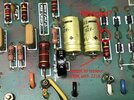
Now, for the "burning resistor" problem. Could you please show with arrows "on the top (component) side of the board", the two components you think may have "bridged"? You mention a 470k, but we don't have that value in this bias supply area of the board. Rather than make assumptions, I'll wait to know for sure. Please don't not attempt to power the amp up with the power tubes fitted until we get this sorted. Cheers
 
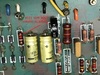
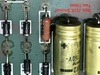
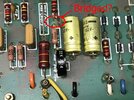
These are the two that I'm not sure if I bridged or not. According to the schematic, it seems they are connected inside the PC Board. But then, I'm not sure if I'm reading it correctly.


Forgot 150K_2.JPG


Bridged 470K.JPG
 
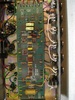
Back
Top