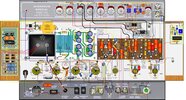
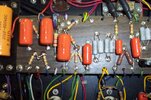
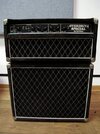
Found this on the web....
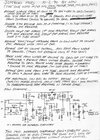


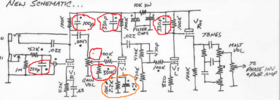
Well, after all that, I’m not interested in trying the mods anymore…Build it and find out. I see a bunch of issues 4K7 high gain input pin 7 osculation city 22K is as low as you would want to go
4K7 .68 UF on V1 cathode that's drawing a lot of current pin 3. 2K2 /10K = 6.1K even worse pin 8 sudden death 12AX7…

This is a very cool and useful mod…… a 5K trimmer with 82K 100K to dial in 7.3 volt differential pin 1 & 6 for sustain

Well, after all that, I’m not interested in trying the mods anymore…
This is a very cool and useful mod…
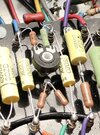
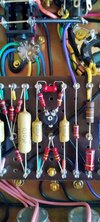
Here’s my attempt of the PI balance control on one of my 2204’s:
View attachment 88172


Not a well thought out modification, IMO of course. Would quite limit the frequency range of the amplifier. Aside from the higher frequencies (& harmonic content) being dumped by the 220pf to ground on the grid of V1 & the plate snubber caps on the first 3 stages, a lot of low end is being rolled off by replacing the 470k/470pf treble peaked with a 0.0047uf cap. Putting an 0.0047uf in series with the 0.022uf cap brings the total value to 0.003873uf. As Mr 67plexi said, 4k7 is too low a value for the V1a grid stopper.
Once the lows have been rolled off early in the pre-amp (0.003873uf coupling cap), they can't be "brought back" so to speak by simply increasing the value of the output coupling caps, because, well, they've already been rolled off. CheersNot shown on the schematic but described in the mod, is to boost the low end at the coupling caps between the phase inverter and power tubes.

This mod will kill all the highs.

See, the trick isI modded a 4010 to get close to JMP tones. I lowered the value of the bright cap. Don't just clip the stock one out. It
will kill you sound with single coil guitar
Lifted a leg on the two caps in the treble peaking circuit. They run in series with two resisters.
I cant remember the values though.
Put a good 5751 tube in the V1. Another old trick is to swap out the 12ax7 PI for a 12AT7.
I found I like NOS Mullard CV 4024. They used to be 40 bucks
This is all very easy to reveres back to stock
Just to be clear, that schematic in the OP is not a Headfirst mod. It’s a 32 year old modded schematic drawn by someone with the initials of “WTN”, and then posted by a member (not Jason Tong) of Facebook’s “Headfirst Amplification DIY Builders Group”.I am not impressed by the head first mods.... they are reckless hacks.... but at least this time he drew a schematic.
See, the trick is
JMP is power amp distortion, with a clean pre amp.
4010 (2203, 2204) was made for pre amp distortion.
When the power amp overdrives, it's going to become loud.
If you want the JMP to sound good it must be turned up to at least "7" and therefore very loud.
Then as a consequence, you then need to control the power amp loudness. (speaker attenuator etc)
Don't try to play the JMP on "2," you miss the point entirely. You should have bought a Princeton Reverb.
Playing it on "2" is worthless, and a complete waste.
4010 is preamp distortion....the loudness is controlled by master volume.
See the difference between preamp and power amp distortion?
If I had a great mod for an amp...I don't suppose I would post it.Just to be clear, that schematic in the OP is not a Headfirst mod. It’s a 32 year old modded schematic drawn by someone with the initials of “WTN”, and then posted by a member (not Jason Tong) of Facebook’s “Headfirst Amplification DIY Builders Group”.