Marshall 2203 Negative Feedback Tap

Cadorman

Ambassador of the Catocaster
Country flag
I'm getting somewhat close to finishing my 2203 build. I have the option of running negative feedback off of the 4 ohm or the 8 ohm tap. It will go to a 100k resistor before the presence pot. What will be the difference between the two? I know what happens when you alter the resistor value, but not the impedance.
 
I'm getting somewhat close to finishing my 2203 build. I have the option of running negative feedback off of the 4 ohm or the 8 ohm tap. It will go to a 100k resistor before the presence pot. What will be the difference between the two? I know what happens when you alter the resistor value, but not the impedance.
The 4 ohm tap has less feedback.
The feedback causes a deadening affect which stops ringing especially in the low frequencies.
The more feedback the less sustain basically, but the amp can get too boomy in the lows with less feedback.
So it's really just experimentation to see how you like it.
(personally) I disconnect the feedback entirely because I am sustain crazed maniac. But more sustain means you got to know how to control it from the guitar (it can get wild).
 
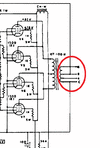
View attachment 37684
Dang nabbit, I don't understand! It's tapped to the 16ohm and 8ohm taps at the same time?
It doesn't ultimately matter which you use. My build diagram says to hook it up to the 8 ohm tap, or which ever one you prefer. As AMS said, the less negative feedback you add the more grind you will get. I jacked the NFB resistor up on my 900 to 130k IIRC. It really made the 900 sound much better by reducing the negative feedback.
 
^ I can't tell from the fuzziness, but I'm guessing that is supposed to be a loop over the 16 ohm tap to designate it is not connected.
 
It doesn't ultimately matter which you use. My build diagram says to hook it up to the 8 ohm tap, or which ever one you prefer. As AMS said, the less negative feedback you add the more grind you will get. I jacked the NFB resistor up on my 900 to 130k IIRC. It really made the 900 sound much better by reducing the negative feedback.
I wouldn't know what to expect out of a 100 watter, but I have a 2204/JCM800 50w on EL34's and a 2204 on 6505's. They both live and destroy in the 4 ohm tap with the stock 100k NFB resistor. 8 ohms is "meh"... 16 oms is a Debbie Downer!
 
I didn't see this thread yesterday, sorry, but I'll try to provide a bit of insight into Marshall use of NFB during the years to help you make a choice.
The first amps used 27k/16 ohm tap, which is a lot of NFB. This results in a tight, clean power amp.
As the circuit evolved the amps became (1) brighter & (2) more distortion oriented. One of the circuit changes was the use of a 0.68uf V2a cathode bypass capacitor. This boosts the frequencies above about 720hz, making for a brighter, gainier pre amp. The common negative feedback arrangement with the 820r/0.68uf V2a combination is 47k/8 ohm tap, though some amps have the feedback taken off the output jack making it variable depending on what impedance cab/s were used.
When the metal panel amps came about (mid '69-ish), the aforementioned mentioned V2a cathode arrangement was phased out & to compensate the NFB series resistor value was first increased from 47k to 100k on the 8 ohm tap, later changed to the 4 ohm tap. Decreasing the amount of NFB taken (increasing series resistor value &/or lower impedance tap) results in more "hair" & looser feel in the power amp.
My own personal preferences are;- if using the V2a 0.68uf bypass cap, 47k/8 ohm tap. If not, 100k on either 8 or 4 ohm tap depending on how I want the power amp to act.
2203's first came with 100k/8 ohm tap. IIRC, the change to 100k/4 ohm tap coincided with the change from EL34's to 6550's in the US. Now, which tap to use is just personal preference. Hope this helps. Cheers
Edit: You can use an even larger value feedback series resistor for an even more distorted & looser power amp section, though 200k seems to be the limit where it gets too messy. Cheers
 
Last edited:
Thanks Ivan H, that was very informational.
One more thing that may be of use to you;-
What value "presence" cap are you using? For amps that have the V2a 0.68uf cathode bypass cap fitted I usually stick with the 0.1uf presence cap, however for amps without the V2a bypass cap fitted I often use a 0.68uf presence cap, which make the presence control act kinda like a mid grind control. Cheers
 
I do not have the V2a cap, but do have the .1 uf presence cap. This is in accordance with the Valvestorm and Triode Electronics layouts. I saw on one of the layouts to use the resistance tap of choice with a 100k nfb resistor which is what prompted my question. I will try it like this and if it needs tweaking I can try the .68uf cap.
 
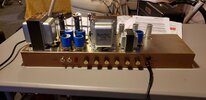
20200201_203649.jpg

Alright guys. Finished the wiring tonight and started testing. Initial fire up without tubes I smoked the pilot light. Had a 6.3v mistakenly installed vs. 120v. It was pretty damn bright for 20 seconds!

After cutting out the pilot, repowered up with no tubes for 10 minutes and no problems and absolutely dead quiet. Next I installed the preamp tubes and did the same thing. Perfect. They all lit up great and still dead silent.

Now I installed the power tubes and plugged in a cab and fired it up. Everything heated up perfectly, no smells and no noise. Cranked all the knobs to 11 and just got a minor white noise type sound out of the cab. Still no hum from the chassis and turning the tone knobs down affected the noise. I'm thinking all good!

Plugged in a guitar and nothing. It was as if I wasn't plugged in. Same on both hi and lo input jacks. I'm guessing I have something screwed up in the input jacks or the connection at V1. Any thoughts?
 
Bummer... !

Could be something in the input jack, but it could be a few other things. Assuming guitar, cable, and tubes are in good order:

Did you chopstick the components and wire, already?

Check voltages?

This would also be a good time to post detailed pics: Input jack, V1 and V2, good pic of the grounds...
 
I will flip it over after I put the wife in bed and start checking continuity from the input jacks to V1 for a start. I have a chunk of Mogami shielded wire between the two that I haven't used before. I'm thinking it is something input signal related as the amp is behaving very nicely otherwise.
 
Start at the power transformer first check secondary voltage then check pin 3 on the power tubes then pins 1 and 6 on the PI
and pins 1 and 6 on the pre amp tubes in that order. all you know is you have filament voltage if the tubes light up.
And check the 500mA HT fuse. If your B+ voltage is OK when you check the pins 1 and 6 for voltage on the pre amp tubes you should get a pop
through the speakers. Have fun
 
Okay, I was dyslexic on the input jacks. Now I have sound on the hi jack, but not the low jack. Decided I had better bias the power tubes before I went any further. Plugged my VHT meter into the middle two sockets and flipped it over. I had already noodled around on the amp for several minutes with no issues, but it sounded like a bass amp and I couldn't get any appreciable volume. Within a minute one of the end power tubes crazy red plated and popped. The other 3 are just fine. I had zero millivolts on one side and 40 on the other. Bias pot did nothing. Looks like I have some work to do.
 
Sorry to hear your having some problems with. Could you post some close-up pics of
(1) The bias supply circuit,
(2) The "bias splitter" resistors,
(3) The power tube sockets,
(4) The input jack sockets.
With the amps main power switch "on" & the standby switch in the "standby" position, the bias supply will still be powered up, while the HT will not be, so it will be possible to ascertain whether or not the bias supply trimpot is affecting the necessary negative voltage swing at pins 5 of the power tube sockets without the HT voltage present. Cheers
 
Back
Top