LP Replica Build

Fingerboard time :


Binding nubs are a real PITA to do but..............looks classy !


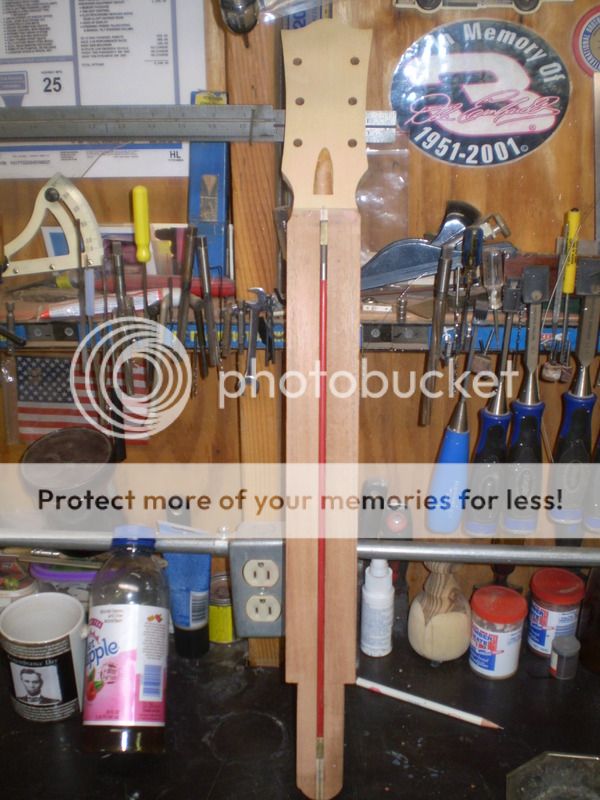
Neck:


Sled I built for cutting the 4.4 degree shoulders for the tenon:


I've never seen someone clamp binding on....That looks like it would save alot of time ???? Cool trick I gotta try that now.
 
Very nice!

I like that top - & I think it'll be more appealing once the hardware and pickups are on it to break up that long grain.
 
Some random shot's, test fitting neck, etc, etc :


That's about as far as I have gotten on this build. Got WAY to cold to work in the shop and the customer is in no big hurry !
Quick question ...did you go 4° at the neck tenon then 2° to bridge pickup route?
Just wondering I've seen some do it then others don't do the 2°
 
Well I did state this is a "59" replica build but I must elaborate, I'm using 59 specs and measurements but that's about it . That idea got totally blown out the window when the customer came over, picked up the rough cut body and cried....."It's too heavy" so had no choice but to weight relieve it.
You'll see in the pictures.
So, being it's NOT going to be a true 59 replica a few items were changed.
Mahogany Body and Neck, Indian Rosewood FB ( keeping my stash of Braz RW for myself...hehehe).
Celluloid Nitrate neck and body binding along with the inlays, 2 way truss rod instead of the traditional compression rod, American Holly headstock overlay.

Anyway:


weight relief holes actually dropped the completed body down from 6.8 lbs to 4.8 lbs after all of the carving was done.


Book matched Eastern Flamed Maple.....I got a HUGE surprise after it was done being carvied. You'll see further on.


Very cool. Can you explain a little about the over arm router? Also, whats the deal with the binding routing jig?
 
Quick question ...did you go 4° at the neck tenon then 2° to bridge pickup route?
Just wondering I've seen some do it then others don't do the 2°
The neck angle is 4.4 degrees, and the pickup plane is 1.2 degrees. pickup cavities are routed at the same angle as the neck so when they rest in the cavity the top of the pickups are parallel to the strings.
 
That sounds like some delicate work to get the angles correct. I must confess that although there might not be much I can't fix/repair/mod on a guitar, I've never made one from scratch (but, I sure would like to)...
 
Very cool. Can you explain a little about the over arm router? Also, whats the deal with the binding routing jig?
The binding router jig is nothing more then a trim router mounted to a floating base that rides on rails and is counter balanced with springs to allow it to freely move up and down. This jig follows the contour of the top allowing you to route the channel as it was done in the early days. Les Pauls had 2 different binding channels routed into the cut away, depending on the year. I don't remember when they changed the process but in the late 50's early 60's the binding followed the contour of the top as seen in the picture on the left. Then they changed to routing the binding channel around the entire top down to where the top joined the body, as seen on the right. From what I have read, the purpose of the wider binding in the cut away as to hide the joint of the maple/mahogany.


The overhead router is actually a pin router. A pin is mounted in the platform that corresponds to the diameter of the router bit. : Example, A 3/8 diameter cutting bit will have a 3/8's diameter pin set in the base. When using patterns, the pattern is mounted to the bottom of the piece of wood your working with. The pattern rides against the pin and the cutting bit from above routes the wood. Same as if you were to use a top mounted bearing on a bit and mount the patter on top of the wood.


Other uses for a Over Head Router:

 
Thanks for the info and videos. I'll be watching the video's a little later today. My experience with routers is hand held only. Ya, I grew up working with both regular powered tools and hand cranked drills, chisels, etc. I still luv's the feel and satisfaction of using plains, chisels, and sand paper. Not too long ago a buddy came by to show me an amplifier case he made by hand. I asked what he used to make the contours, recesses, etc. He said chisels and plains. Turns out he used to work in an old school wood shop in Jamaica. Nice looking cab made out of solid, and I do mean solid, pine...
 
Binding channel router

Thanks for this. @SG Lou I have another question: When doing a bound body with a sunburst finish, when would you actually attach the binding? I'm thinking after the burst is sprayed but before the clear coats. Is that correct? I actually did a bound body burst 20 years ago but can't remember how I resolved this issue.
 
Thanks for this. @SG Lou I have another question: When doing a bound body with a sunburst finish, when would you actually attach the binding? I'm thinking after the burst is sprayed but before the clear coats. Is that correct? I actually did a bound body burst 20 years ago but can't remember how I resolved this issue.
Binding is added before any finish work is done. Then you just spray the finish on and after the finish is dry you scrape any lacquer off of the binding, clean up the edges and then clear coat.
Do a YouTube search for scraping binding to see how its done but it's very easy to do, you just have to be careful you don't scrape into the wood and remove the finish.
 
Back
Top