Let’s talk budget gear

Budget is good...
Reverse engineered ripoffs, not so much.

Some budget manufacturers/marketers simply acquire a "thing" to take apart and then start knocking out copies without ever compensating the original designers. Sometimes they get shut down, but that requires court intervention, which is expensive. Plus, nearly all of this is coming out of a large Asian country that could care less about our stupid rules.

One whom I think of as a brother has a quotation which I think sums it up...
"Friends don't let friend's buy Behringer" Fezz Parka
When the original thing is no longer patented, the original manufacturer no longer has a monopoly. Many of these effects were patented back in the 50s and 60s, and have long since expired. In many cases, the original manufacturer still prices these things as though they still held a monopoly. When that happens, it is right and good that someone else comes in and makes a copy for less money.

For instance the Ibanez TS9, retails for $100. It's not a complicated circuit, couple of op amps, couple of pots, and a switch. There are companies making a profit selling the same circuit in a different box, for $20. If Ibanez wanted to keep this kind of competition at bay, they could reduce their prices or improve their product somehow. That's how a free market works. Competition is good for consumers.
 
A $600 guitar is not a "budget" instrument, it's pretty close to the average guitar price. Completely middle of the pack. I'd call $500-900 mid-range; anything above that is luxury and anything below that is budget.
This is a matter of personal opinion however,. Depends on the person and budget.

Pick a Gibby. They make no guitar in the 900 range so every Gibson is a luxury guitar?
No.
A LP Classic (in CDN $$) is now around 3k. A Studio is half that. The Studio is a budget LP, Classic is middle of the pack, for a LP.
Pick another guitar type and that line will move. I see guitars in the $350 range but also scores of them $1500 plus. When I browse our local dealer guitars, they rapidly hit $1000 and they have access to basically everything.

Depends on one's personal budget too. For me $1000 is the lower end of mid price.
 
Last edited:
When the original thing is no longer patented, the original manufacturer no longer has a monopoly. Many of these effects were patented back in the 50s and 60s, and have long since expired. In many cases, the original manufacturer still prices these things as though they still held a monopoly. When that happens, it is right and good that someone else comes in and makes a copy for less money.

For instance the Ibanez TS9, retails for $100. It's not a complicated circuit, couple of op amps, couple of pots, and a switch. There are companies making a profit selling the same circuit in a different box, for $20. If Ibanez wanted to keep this kind of competition at bay, they could reduce their prices or improve their product somehow. That's how a free market works. Competition is good for consumers.
But this ain't that...
No need to reverse engineer something where the design has entered public domain. And Behringer appears to have very little interest in 60 year old designs.

Andy Marshall, of THD fame, is a very solid example; he designed and released, through Jet City in Seattle, the PicoValve. Didn't take long for a bunch of copies to float cross the ocean...
the Bugera T5 Infinitum was not the engineering genius of Behringer. And nothing Andy could do about it.

That's just one example. It so happens that it's enough of an example for me to swear off the entire Behringer, and its subsidiary product lines, just as a matter of principle. You see, it also happens that I know Andy Marshall. He designs good stuff.

I don't like it when good people get screwed.
 
This is a matter of personal opinion however,. Depends on the person and budget.

Pick a Gibby. They make no guitar in the 900 range so every Gibson is a luxury guitar?
No.
A LP Classic (in CDN $$) is now around 3k. A Studio is half that. The Studio is a budget LP, Classic is middle of the pack, for a LP.
Pick another guitar type and that line will move. I see guitars in the $350 range but also scores of them $1500 plus. When I browse our local dealer guitars, they rapidly hit $1000 and they have access to basically everything.

Depends on one's personal budget too. For me $1000 is the lower end of mid price.
You forgot about Epiphone, which Gibson owns, and the Epiphone Les Paul. Which is a mid line guitar. Also there's a Gibson Maestro line, and Gibson Baldwin, both made in China and under $200.
 
You forgot about Epiphone, which Gibson owns, and the Epiphone Les Paul. Which is a mid line guitar. Also there's a Gibson Maestro line, and Gibson Baldwin, both made in China and under $200.
Yes Gibson owns it but Epiphone is not a Gibson as far as brand name. To each their own budget. Anything over 1000 is not automatically a high end guitar at all, to me.
 
But this ain't that...
No need to reverse engineer something where the design has entered public domain. And Behringer appears to have very little interest in 60 year old designs.

Andy Marshall, of THD fame, is a very solid example; he designed and released, through Jet City in Seattle, the PicoValve. Didn't take long for a bunch of copies to float cross the ocean...
the Bugera T5 Infinitum was not the engineering genius of Behringer. And nothing Andy could do about it.

That's just one example. It so happens that it's enough of an example for me to swear off the entire Behringer, and its subsidiary product lines, just as a matter of principle. You see, it also happens that I know Andy Marshall. He designs good stuff.

I don't like it when good people get screwed.

The thing is, the Jet City Picovalve copies a lot from earlier amp designs that are public domain. If there's anything new about it, he neglected to file for a patent and that's his lookout. Isn't this really the same thing as Jim Marshall copying the Bassman? Which Leo Fender copied from an RCA schematic.
 
The thing is, the Jet City Picovalve copies a lot from earlier amp designs that are public domain. If there's anything new about it, he neglected to file for a patent and that's his lookout. Isn't this really the same thing as Jim Marshall copying the Bassman? Which Leo Fender copied from an RCA schematic.
Well again, public domain is a different world. Once something enters it, or as in the case of a lot of Leo's amp stuff; GE, RCA, and Western Electric published the designs and invited everyone to have at it. (Selling more tubes along the way.)

Can one patent a circuit? In my day that sort of thing most often failed the "novel" and "non-obvious" test with the patent office...and until the development of the IC, I suspect there wasn't much novel going on. (Deliberately leaving the transistor out because, as I recall, the inventor didn't patent it, believing its use was limited to hearing aids and wouldn't find function anywhere else.

Only to have Sony bring the transistor radio to market.)

And I'm reminded that Alexander Dumble encased his "all identifiable markings removed from components" circuitry in a nearly indestructible black epoxy that would destroy prestressed sections of the electronics if broken open.

My thing is about treating originator's with respect. Having had my own work duplicated in that large Asian nation that cares nothing about respect, it's sorta a pet peeve.
 
Well again, public domain is a different world. Once something enters it, or as in the case of a lot of Leo's amp stuff; GE, RCA, and Western Electric published the designs and invited everyone to have at it. (Selling more tubes along the way.)

Can one patent a circuit? In my day that sort of thing most often failed the "novel" and "non-obvious" test with the patent office...and until the development of the IC, I suspect there wasn't much novel going on. (Deliberately leaving the transistor out because, as I recall, the inventor didn't patent it, believing its use was limited to hearing aids and wouldn't find function anywhere else.

Only to have Sony bring the transistor radio to market.)

And I'm reminded that Alexander Dumble encased his "all identifiable markings removed from components" circuitry in a nearly indestructible black epoxy that would destroy prestressed sections of the electronics if broken open.

My thing is about treating originator's with respect. Having had my own work duplicated in that large Asian nation that cares nothing about respect, it's sorta a pet peeve.
Yes, one can patent a circuit. Intel owns loads of patents for circuits, so do Samsung and Apple. But the "non obvious" test is a high barrier, in the world of audio. A minor tweak to eq is not gonna cut it.

Dumble's goop makes it possible to keep the circuit secret. He knew that his circuit was not novel and non obvious, secrecy was the only protection available.
 
Yes, one can patent a circuit. Intel owns loads of patents for circuits, so do Samsung and Apple. But the "non obvious" test is a high barrier, in the world of audio. A minor tweak to eq is not gonna cut it.
Are those actual circuit function patents or do they do an end run on the non-obvious?

I worked on a development that changed orthodontics forever. The patent office kept turning "Elastic Modules" down as obvious and not novel. Despite nothing even remotely similar being anywhere at the time.

The patent attorney involved went to bed following another in a long line of rejections, perhaps after a few glasses of scotch...

And sat bolt upright at 3:am with an epiphany.

Elastic was changed to "Force" and the application rewritten to address the device as conservation of energy force modules...an "energy saving device"...!

Bingo!

AlastiK® Force Modules were born.
Those little multi colored things that are synonymous with "braces"...
Prior to them, braces were held to the tooth by a band, a bracket, and thin "tie" wires that had to be twisted regularly to apply the force needed to move the tooth. Hence the term "tightening braces."

The inventor was my father. An orthodontist who'd suffered a wrist wound during WW2. He'd come home every evening in agony. He'd dreamed of these things but never got them to work right (my brother and I spent hundreds of hours cutting little sections of surgical tubing, rubber bands, whatever; later I did the force calculation testing and intra-oral imaging)...until he was coaching my little league baseball team along with a chemical engineer with Tektronix (oscilloscope folks)... The engineer told him he needed to change the material and the shapes. In a couple of years he stopped complaining of wrist pain.
 
Last edited:
Budget gear... that is a loose definition. I usually set the bar at < $300 for guitars, < $200 for keyboards, and < $50 for effects. But since I have a budget amp (Katana Mk1 100) with a chit load of effects built in the only effects pedal I have is does not meet my criteria. However the other two classes I do have a couple entries.

I got a small bonus one several years ago. There had been much talk about Harley Benton. I had an itch for an acoustic I couldn't scratch but got temporary relief with this...

HBA001-030 sm.jpg

I wasn't expecting it to be as good as it is. It plays and sounds well above it's price.

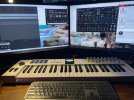
For keyboards I managed to get a new Arturia Essential 49 Mk3 to my door under $200.

IMG_2763.jpg

Fits nicely on my desk.
 
Are those actual circuit function patents or do they do an end run on the non-obvious?

When a microprocessor has a whole new architecture that nobody has figured how to make work before , that's gonna qualify. Intel (just as an example) has had between 4000 and 10,000 patents granted in each year for well over a decade.
 
When a microprocessor has a whole new architecture that nobody has figured how to make work before , that's gonna qualify. Intel (just as an example) has had between 4000 and 10,000 patents granted in each year for well over a decade.
The Patent Attorney's Dream!
 
Budget Instruments...
Got a couple.
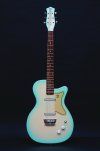
A cheap Korg keyboard and a 90's Danelectro...20221104_211255.jpgThe guitar was ~$175 when they reappeared after a couple decade hiatus but I traded a ... pos '57 Vintage Reissue Strat (twisted neck and all) for it and some other stuff (sorta wish I hadn't done that now, but it was key in eeking out some well deserved karma on the creep shop owner)

And, despite not being a pedal user, I picked up a cheap reverb pedal so I could plug my guitar into my tablet's voice recorder. I thought about a Strymon Big Sky but, let's see...$400+ to get used a couple times a year? Probably not wise.

Spouse would chop me into small pieces and feed me to the crows had I done that.
 
With the influx of new members, I’d like to resurrect this topic.

A couple of years back I went on a budget gear kick. I demoed budget amps, pedals, and whatever else I found. At times I would do a shootout between the budget item and its more expensive counterpart. I even put together a budget pedalboard from soup to nuts for under $300 and it was surprisingly good.

I shopped companies like Joyo, Behringer, Donner and some real no names. There were some real surprises and some duds.

Before I comment on my findings through that journey, I’d like to get some feedback and experiences from everyone else.

I know quite recently @Headache bought a budget guitar and he was generally pleased.

What if any budget gear or even parts have you had experience with? Good or bad.
giphy.gif
 
Back
Top