Les Paul owners check this out

Guess I’ve been lucky. None of my electrics really go out of tune playing them. But then I tend not to attack the things the way some of you do. No big string bends. I don’t “whammy” the Strat into the stratosphere. (See what I did there?) And if they do go out of tune while sitting…. All 6 strings will be in tune to each other…. Just equally sharp or flat when plugged into a tuner.

Equal amounts of sharpness - or flatness - across a group of strings is movement in the neck, probably due to humidity and/or temperature fluctuations.

The thin necks move around a lot.
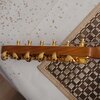
 
Here's a couple of important things to consider for tuning stability.

First of all, the strings must be adequately wound and evenly spaced across the tuning post. This provides adequate and even pressure across the nut floor.

This is generally (3) winds around the post for wound strings and (5) winds for plain strings, regardless of flat or angled headstock.

20220827_162237.jpg

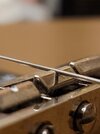
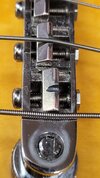
The saddle needs to be cut smooth and 1/2 of the wound string profile should be in the groove. Plain strings should be level with the top of the saddle.

20200907_031507.jpg

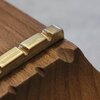
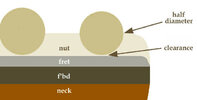
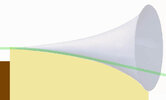
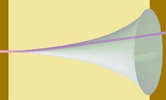
The nut slot should be no more than .003" above string diameter and cut with a funnel shape.

20220827_153501.jpg

There should be a "fall away" cut into the floor starting at about 2/3rds of the distance across the bottom of the nut floor.

20210520_074550.jpg

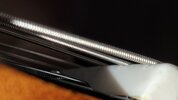
Saddle slots must be polished smooth.

20210423_170019.jpg
 
The only thing I disagree with is the number of wraps of string. I do no more than 2 on any string as I find that the less there is to stretch the more stable the tuning is. I have found over the years that the less string the better

I use the “self-lock” method and usually only need about 1 1/2 turns, at most, on the wound strings, often less.
 
If you observe these factors, you will have excellent tuning stability.
The only thing I disagree with is the number of wraps of string. I do no more than 2 on any string as I find that the less there is to stretch the more stable the tuning is. I have found over the years that the less string the better

Ive tried several different ways. The 3 turn wound 5 turn plain doctrine was shared with me by Wildwood's Greg Koch.

I tried fewer winds on the plain strings, but found the stability was better (as i was told it would be) with more winds due to the taper of the post loading the winds.

There's no one way to do it and if you can do it with 2 winds, then that's awesome!!!!

I use the “self-lock” method and usually only need about 1 1/2 turns, at most, on the wound strings, often less.

Locking the string isn't necessary, but you can do it. The string will still slip on the post and will need tome to take a "set" or settle in, regardless.
 
Last edited:
I use the “self-lock” method and usually only need about 1 1/2 turns, at most, on the wound strings, often less.

Yup.

I've found the nut is the tuning culprit about 95% of the time.

I'd argue even more than that. Like at least 98% IME.

If you are doing step and a half to 2 full-step bends, you will...

I honestly don't find this to be true on a Les Paul. Hell, I don't even make the most remote attempt to "stretch" the strings when I slap a new set on - I just put them on (using the method Smitty does), tune it up, and maybe have to retune a time or two on a couple of strings during the first 10 minutes or so of playing. Granted, I have only been able to pull this trick off with GHS strings, no other brand, so that may have something to do with it.
 
I honestly don't find this to be true on a Les Paul. Hell, I don't even make the most remote attempt to "stretch" the strings when I slap a new set on - I just put them on (using the method Smitty does), tune it up, and maybe have to retune a time or two on a couple of strings during the first 10 minutes or so of playing. Granted, I have only been able to pull this trick off with GHS strings, no other brand, so that may have something to do with it.

Yeah. I switched from D'Addario back to GHS a few months ago. I used GHS a long time ago. Anyway, the much faster "settling in" time is what I noticed right away with the GHS.
 
Oh sure, there's always a little settling in, but I don't need nearly the wraps to securely anchor the string.

If you are doing step and a half to 2 full-step bends, you will...

Not if you use the self-lock method. That's the whole idea. Even extreme bends don't pull the string loose. The more you bend, the tighter the string locks against itself. I have never on any of my guitars had a string come loose from the post, no matter how far I bend, ever since I began doing this about 15 years ago.
 
Yeah. I switched from D'Addario back to GHS a few months ago. I used GHS a long time ago. Anyway, the much faster "settling in" time is what I noticed right away with the GHS.

For me at least GHS blow every other string out of the water, across the board. They have the most balanced tone and output, string-to-string that I have found, never have the shrill high end that some like D'Addario's have, have the best bending feel and fast return to pitch and then the settling in thing is just icing on the cake.
 
Not if you use the self-lock method. That's the whole idea. Even extreme bends don't pull the string loose. The more you bend, the tighter the string locks against itself. I have never on any of my guitars had a string come loose from the post, no matter how far I bend, ever since I began doing this about 15 years ago.

Right. A Tech at the local music shop (Shout out to Ron at Bill's Music House in Catonsville, MD!) taught me this trick sometime in the mid-'80s and I have used it ever since. There's never any slipping at the post, and the less winds there are the less there is to stretch.

Edit: just looked at the Les Paul I have sitting in my office and its about 1-1/2 winds on each string and its perfectly stable no matter what I do. It sits on a stand in here and the temperature varies a lot from daytime to nighttime, especailly on weekends, and I almost never have to adjust the tuning - and when I do its almost always because it went a semitone or so sharp on all strings because of that fluctuation. Still in tune, just a tiny bit sharp, pretty much never flat no matter how much wanking I do on it.
 
They ... never have the shrill high end that some like D'Addario's have, have the best bending feel and fast return to pitch and then the settling in thing is just icing on the cake.

Ah yes...the D'Addario "sizzle"!
 
Ah yes...the D'Addario "sizzle"!

Yeah, always has driven me nuts when I have tried to use D'Addarios. Fizzy, then they start sounding OK...about two hours before they go completely dead and need to be replaced. They have always been my least favorite strings, by a pretty wide margin, and its unfortunate that all the strings that they are OEM for, like Gibson, exhibit the same shrill/fizzy quality. My go to are the Boomers, but I will string up with SIT's from time to time as well, a very close second.
 
Oh sure, there's always a little settling in, but I don't need nearly the wraps to securely anchor the string.

If you are doing step and a half to 2 full-step bends, you will...
Not if you use the self-lock method. That's the whole idea. Even extreme bends don't pull the string loose. The more you bend, the tighter the string locks against itself. I have never on any of my guitars had a string come loose from the post, no matter how far I bend, ever since I began doing this about 15 years ago.

Under heavy bends, the strings frequently fail at the lock-wind from brinnelingand stress. That's why i just stick witb Greg Koch's method...
 
Back
Top