

Call for price, Robert!
Geez!!!!

Call for price, Robert!


OMG is right. First I've heard of this model, thanks for posting Mr Plexi. Beautiful amp, I can only imagine that it sounds glorious.Marshall did make a 4 x 10" combo called a model # 1961 built in 1964 through 1965

The Elusive, Vintage, Marshall Super Tremolo
***CALL FOR PRICE*** Whenever a discussion turns to how the circuit for the first JTM45 was lifted nearly point for point from that of Fender’s 5F6-A Bassman combo, it seems there’s always a caveat about how it ended up sounding slightly different as a head through a closed-back 4x12" cab. Oh...www.truetonemusic.com
A micro would be a great project, I've been thinking of doing one for a while but haven't got around to. I've got suitable iron sitting on the shelf. I'm imagining you mean this Robrobinette versionThis thread is what motivated me to get started on another build i had in mind but had not put into action.
Got the iron on order and 3 NOS Sylvania 12AU7 on the way.
This micro uses both triodes of 1 12AU7 as push/pull power section.
Still mulling a scratch chassis or $50. premade Princeton Reverb chassis.
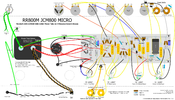
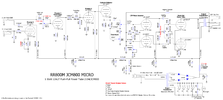
OMG is right. First I've heard of this model, thanks for posting Mr Plexi. Beautiful amp, I can only imagine that it sounds glorious.
A micro would be a great project, I've been thinking of doing one for a while but haven't got around to. I've got suitable iron sitting on the shelf. I'm imagining you mean this Robrobinette versionView attachment 34103View attachment 34104
Would be a great home use amp, or could be mic'd up for gigging (or re-amp the output). Sylvania's are excellent tubes, I've got three Sylvania 12AX7's in another amp & have used many, including 6CA7's in the past. Great US made tubes & the pre amp tubes can still be had NOS at good prices. Cheers

I'd love to downsize a 4x10 to where the speakers almost touch in the middle

I am not sure if that would be sonicly beneficial. There are formula to calculate cabinet size vs speaker configuration.
Don't worry you can follow along with your hot glue gun and Fisher Price amp kit.

OMG is right. First I've heard of this model, thanks for posting Mr Plexi. Beautiful amp, I can only imagine that it sounds glorious.
A micro would be a great project, I've been thinking of doing one for a while but haven't got around to. I've got suitable iron sitting on the shelf. I'm imagining you mean this Robrobinette versionView attachment 34103View attachment 34104
Would be a great home use amp, or could be mic'd up for gigging (or re-amp the output). Sylvania's are excellent tubes, I've got three Sylvania 12AX7's in another amp & have used many, including 6CA7's in the past. Great US made tubes & the pre amp tubes can still be had NOS at good prices. Cheers

I'm not sure, when you say "scratch chassis", if you mean a blank and undrilled chassis or repurpose an old chassis into a new circuit?Still mulling a scratch chassis or $50. premade Princeton Reverb chassis.


I also prefer IEC connectors for the AC, but with the old school hardwired AC cable method, it is so much easier and less time consuming to drill out the chassis hole needed for the old method and slightly easier in connecting the AC cable leads. However, if I had a fancy shmancy computerized surgical cutting machine, then an IEC style is a no-brainer!Very clean and awesome build!
Also IEC connectors are the shizz; Americans wish that they would be forced to use them so that they would be more available instead of those stupid wired-in AC power cables.
I also prefer IEC connectors for the AC, but with the old school hardwired AC cable method, it is so much easier and less time consuming to drill out the chassis hole needed for the old method and slightly easier in connecting the AC cable leads. However, if I had a fancy shmancy computerized surgical cutting machine, then an IEC style is a no-brainer!
That is exactly how I did this one, a Dremel cut-off wheel. I cut it slightly undersized, then filed it to size. By doing the two longer cuts first, the cut-off wheel is then worn down a little & so will do the shorter two cuts without over cutting.I did the IEC on a previous amp build. I had to use a Dremel to do it and it was a steel chassis. It would be a lot easier with your aluminium chassis, if you had a Dremel.
I have a sort-of-Dremel. Didn't even think of using it as a cut-off tool...I did the IEC on a previous amp build. I had to use a Dremel to do it and it was a steel chassis. It would be a lot easier with your aluminium chassis, if you had a Dremel.

I have seen them before but never realized who made them.Dremel is life.
Did you know that they used to make electric shoe polishers way back in the day?
View attachment 34196

Did you already look into ordering any ARS caps directly through ARS? They're actually located in Van Nuys, California, which is just north of Los Angeles.Well, the 16uf PI filter cap still has not arrived...
No, I haven't, but will, thanks for the heads-up on their location. I've been getting them through Valvestorm in the US & Watford Valves in the UK (which is where the 32uf/16uf is coming from).Did you already look into ordering any ARS caps directly through ARS? They're actually located in Van Nuys, California, which is just north of Los Angeles.
Also, do you know if ARS actually makes their own caps? They look identical to the F&Ts or Sprague Atoms.
Ha ha… I forgot the size difference between the ARS and F&T. Here's a couple pics of my old JCM800 showing just that:They (ARS) differ from the F&T's dimensionally, the ARS are 60mm in length whereas the F&T's are 50mm in length.
If anyone has any more info on these (ARS capacitors) I'd be interested in hearing...
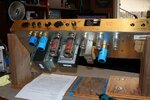
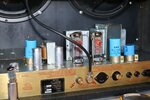
Yes, if the amp has not been powered up in more than a few months it pays to reform the filters.I'm also a firm believer in forming new caps. Even old filter caps that have not been used in a while can be reformed as long as they ain't leaking.
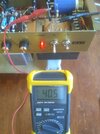
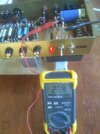 so shouldn't take long to get below a 5V drop. Then I'll put the NOS Mullard tubes in (including GZ34) & get the power tubes biased up. I usually bias to around 65% of maximum dissipation, rather than 70%. Probably have to wait until tomorrow to play through it. Cheers