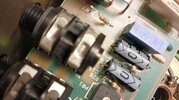
JCM900 reverb tank

We have to identify the amp better.
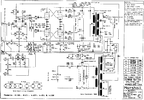
Is C15 connected from pin 1 to pin 6 of the phase inverter?

There are 2 different schematics, the part numbers on the 2 boards are different.
We need to find out which one you have.

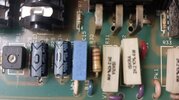
On the rear circuit board, there are 4X 5 watt big resistors.
Each 5 watt resistor connects to pin 4 of a power tube.
Are these 4 large (5 watt) resistors 470 ohm or 2.2 K ohm?


These amps came stock with either 5881 tubes or EL34 tubes.
The resistors tell you which version you have.
People often change them to different tubes....that's why we need to look and see "if" it's been changed.

Once we see which board you have and how it is set up, for which tubes...original or changed?
Then we know more.
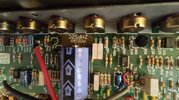
It's a stock EL34 JCM900. 2,2K 5W resistors.
 

Attachments

It's a stock EL34 JCM900. 2,2K 5W resistors.
OK
it seems that C15 is the bias voltage coupling cap...
replace C15 type X cap, replace C11, C12 (47n) with 500 volt or 630 volt capacitors, replace C13, C14 (10 uF100V) with 160V caps if possible, (these caps were over-voltage / wrong polarity, and they will no longer work)
check function of bias control pot, it may be fried.
The bias control must adjust smoothly, pin 5 DC voltage, 36 VDC to 46 VDC, if it does not replace it.

What has happened:
the PI coupling caps C11, C12 are bleeding high voltage into the bias voltage.
C15 apparently shorted out.
With that cap shorted the bias voltage will be too much (-71 volts) and it will shut off the power tubes.

We try to increase the voltage rating of the caps, because they were pretty minimal to start with. This is an issue for JCM 900s.
They used 250 volt caps where they should have used 400 volt.
They used 400 volt caps where they should have used 500-630 volt caps...

BUT do not put the tubes in or play the amp.
Need to run through all the voltage checks BEFORE you put tubes in.

If I was working on this amp:
I would replace all the electrolytic caps...increase voltage rating.
I would replace all the under rated coupling caps...
I would rebuild the low voltage power supplies, new zener diodes, new filter caps.
 
Last edited:
OK
it seems that C15 is the bias voltage coupling cap...
replace C15 type X cap, replace C11, C12 (47n) with 500 volt or 630 volt capacitors, replace C13, C14 (10 uF100V) with 160V caps if possible, (these caps were over-voltage / wrong polarity, and they will no longer work)
check function of bias control pot, it may be fried.
The bias control must adjust smoothly, pin 5 DC voltage, 36 VDC to 46 VDC, if it does not replace it.

What has happened:
the PI coupling caps C11, C12 are bleeding high voltage into the bias voltage.
C15 apparently shorted out.
With that cap shorted the bias voltage will be too much (-71 volts) and it will shut off the power tubes.

We try to increase the voltage rating of the caps, because they were pretty minimal to start with. This is an issue for JCM 900s.
They used 250 volt caps where they should have used 400 volt.
They used 400 volt caps where they should have used 500-630 volt caps...

BUT do not put the tubes in or play the amp.
Need to run through all the voltage checks BEFORE you put tubes in.

If I was working on this amp:
I would replace all the electrolytic caps...increase voltage rating.
I would replace all the under rated coupling caps...
I would rebuild the low voltage power supplies, new zener diodes, new filter caps.
I tested bias on pin 5. I got -58 Vdc to -75Vdc. I replaced C15 type X cap. Old C15 tested ok. I tested 22K bias pot, it's Ok. I replaced C13 & C15 10uF 160v. Same bias voltage. -55 to -75. R30 it's 22K on this amp. Schematics show 47K. I'll take look on components if I have C11 & C12.
Thanks
 

Attachments

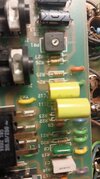
I replaced C11 & C12. 47 nF 630v. They are Big. I need ones with a properly shape. But this is provisional to get correct bias voltage.
The same mesuraments -75 to -58. Do I have resistors out of range? Do I have to desolder resistors to correctly verify their values? which is it?
stock C12 & C11 tested ok.
Thanks
 

Attachments

Last edited:
I replaced C11 & C12. 47 nF 630v. They are Big. I need ones with a properly shape. But this is provisional to get correct bias voltage.
The same mesuraments -75 to -58. Do I have resistors out of range? Do I have to desolder resistors to correctly verify their values? which is it?
stock C12 & C11 tested ok.
Thanks
-75 to -58 with the standby in warm-up or operate? Both?
There's an open resistor or an open broken trace on the board...
Check all the resistors in the bias circuit and confirm that there is a ground going to the circuit....
There has to be like -42 - -46 volts to run an EL34.

A resistor might test good but then when the voltage turns on, it can open.
This doesn't happen very often but it still can happen.

Yes if there is other components you may have to lift one lead of a resistor then measure it.
 
-75 to -58 with the standby in warm-up or operate? Both?
There's an open resistor or an open broken trace on the board...
Check all the resistors in the bias circuit and confirm that there is a ground going to the circuit....
There has to be like -42 - -46 volts to run an EL34.

A resistor might test good but then when the voltage turns on, it can open.
This doesn't happen very often but it still can happen.

Yes if there is other components you may have to lift one lead of a resistor then measure it.
Standby no operate. Standby off. I suspect R30 it's open. I will start on R30. I will test trace on the rear board as well. Let's see.
Thanks.
 
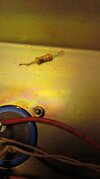
I found It. R30. Test 1,3 Mohms. You can see it's burned. Now if I can find one 22k 2W resistor. I think I need order It. No electronic components store where I live.
Why don't you put 2X 47K in parallel?
The fact that the resistor fried tells me that high voltage was bleeding into the bias....bad PI coupling caps.
 
I lift ones lead of R28, R29 & R7 resistors. All measure ok. Inside his % tolerance. Like I need order 22K 1W resistances I will order this 1/4W resistances as well. I don't have resistors.
 

Attachments

On the PDF R30 22K 1 watt metal oxide HT power ( B+) if that is fried you have a short, 22K voltage dropping string
check your HT fuse make sure it's the proper value. R30 fried would cause no sound no B+ power to Phase Inverter
 
HT fuses are ok. 500mA slow fuses. That mean, do are power tubes shorted?
I have X2 caps on my LM6100 and one on my JCM900 MK3 50W. Schematics show they need to be classe X. I had bias issues as well. Do I need replaced It? Y2/X1 caps are compatible?
Thanks.
 
On the PDF R30 22K 1 watt metal oxide HT power ( B+) if that is fried you have a short, 22K voltage dropping string
check your HT fuse make sure it's the proper value. R30 fried would cause no sound no B+ power to Phase Inverter
I ordered 22K 1W metal resistors, 1/4 W carbon film resistors and properly shape PI coupling caps. Also I ordered 4 47nF class X caps. I will replace It on my LM6100 and JCM900 MKIII amps.
This amp was used several times with a 4ohms cabinet into 16 ohms speaker output. My crazy friend use It like was the last day of his life. Maybe It has more parts broken. It will not be a surprise. On monday or tuesday It will arrive I guess.
 
Good news! :D
It works. I needed replace bias pot too.
Many thanks to Amp Mad Scientist and 67plexi.
I love it when people fix their own gear. :2Thumbs:

I wanted to make one more note on this:

Capacitor testers that use 9 volt batteries may not be accurate for high voltage capacitors.
To really test a high voltage capacitor:
you need a high voltage capacitor tester.
A high voltage cap tester will use 400 volts or more to test for leakage in a capacitor.
Testing a cap with low voltage may conceal the problems....you may miss the defect entirely.
 
I love it when people fix their own gear. :2Thumbs:

I wanted to make one more note on this:

Capacitor testers that use 9 volt batteries may not be accurate for high voltage capacitors.
To really test a high voltage capacitor:
you need a high voltage capacitor tester.
A high voltage cap tester will use 400 volts or more to test for leakage in a capacitor.
Testing a cap with low voltage may conceal the problems....you may miss the defect entirely.
Thank you so much AMS! Again you're help guiade me to resolve this issues. A cheap chinesse cap tester can't be accurate to test high voltage capacitors. Even low voltage capacitors.
 
Back
Top