JCM 900 SLX 5881 conversion to EL34 question

So heres what i began checking down:

The amp turns on with just power switch on and tubes removed. It turns on with standby on. Put the tubes back in and it blew another fuse, so stupid move there.

But i began checking the schematic and each resistor and capacitor. The biggest stand out i see is R30 Resistor here: 22k 1w Metal Oxide is dead. The other two: R28 Bias pot resistor is way oversized ( should be 22k, its 68k)and the R29 in the middle of the two is oversized as well ( should be 8.2k , its 22k)
View attachment 58944
View attachment 58948
I found incorrect values in the preamp section as well:
R16
R19
R23
R25
R27
I told you don't put the tubes back in until everything has been tested.
But nooooooooooo.

Take the tubes out.
Turn the power on.
Leave standby in warm-up position.
Do not turn standby to operate.
Measure pin 5 of the output tube sockets, what is the DC voltage on pin 5?
 
Well Hell, man! Definitely replace the dead R30 and make sure the V4 phase inverter tube is OK. Even if you think it's OK, at least replace it temporarily with another one. I'm assuming it's a 12AX7.

Your R28 is 3x the stock value which will give the amp's bias control 3x the range to dial in the bias point. Finding the desired bias point will be more sensitive because of this.

I'm not sure how your R29 also being 3x larger than stock will affect the bias circuit. But if you're going to replace the dead R30, might as well replace R28 & R29 with stock values.
 
Well Hell, man! Definitely replace the dead R30 and make sure the V4 phase inverter tube is OK. Even if you think it's OK, at least replace it temporarily with another one. I'm assuming it's a 12AX7.

Your R28 is 3x the stock value which will give the amp's bias control 3x the range to dial in the bias point. Finding the desired bias point will be more sensitive because of this.

I'm not sure how your R29 also being 3x larger than stock will affect the bias circuit. But if you're going to replace the dead R30, might as well replace R28 & R29 with stock values.
Excuse me but:
his ohm meter is reading a 25% error in all his measurements.

Fix the meter problem first.
There is no hope of troubleshooting a problem with an inaccurate meter.

A 16 ohm speaker should read: 12.6 ohms, not 16 ohms.
Cross the probes together: should read 0.2 ohms, not 2 ohms.

Replace the meter battery.
Replace the meter fuse.
Re-check the meter.
 
Last edited:
Excuse me but:
his ohm meter is reading a 25% error in all his measurements.
The measurements taken here correlate perfectly to the installed resistors. In fact, i even had some new, left over, 1/4w 22k and 57k resistors and my meter reads 22.1k and 56.9k on both. Being off by .1 in either direction is pretty accurate by any meter's standard. I used a second meter to verify accuracy and only had .3 difference in measuring each resistor. Whatever is going on in the speaker measurements, doesnt seem to be a meter issue if it can read that tightly together. Thats just an honest opinion.

I checked each resistor on the boards, regardless of their functions, to verify values. The ones i listed are not only incorrect by the meter but by their color coding. They are simply the wrong values, which raises the question: if there are this many incorrect components, certainly this has both suppressed voltage and released too much voltage at different areas of the amplifier, correct?

I will take a measurement of pin 5 on each socket here in a little bit, to get an idea of what voltage is coming down the line
 
The measurements taken here correlate perfectly to the installed resistors. In fact, i even had some new, left over, 1/4w 22k and 57k resistors and my meter reads 22.1k and 56.9k on both. Being off by .1 in either direction is pretty accurate by any meter's standard. I used a second meter to verify accuracy and only had .3 difference in measuring each resistor. Whatever is going on in the speaker measurements, doesnt seem to be a meter issue if it can read that tightly together. Thats just an honest opinion.

I checked each resistor on the boards, regardless of their functions, to verify values. The ones i listed are not only incorrect by the meter but by their color coding. They are simply the wrong values, which raises the question: if there are this many incorrect components, certainly this has both suppressed voltage and released too much voltage at different areas of the amplifier, correct?

I will take a measurement of pin 5 on each socket here in a little bit, to get an idea of what voltage is coming down the line

There are 2 schematics for the amplifier.
There is a difference in the board part numbers.
You have the wrong schematic probably.

If your meter is working correctly:
Take the tubes out.
Turn the power on.
Leave standby in warm-up position.
Do not turn standby to operate.
Set meter on DC volts.
Connect the black probe to metal chassis.
Connect the red probe to pin 5 of the output tube socket.
Measure pin 5 of the output tube sockets, what is the DC voltage on pin 5?
Measure all 4 output tube sockets and report the readings of all 4 sockets.
 
The measurements taken here correlate perfectly to the installed resistors. In fact, i even had some new, left over, 1/4w 22k and 57k resistors and my meter reads 22.1k and 56.9k on both. Being off by .1 in either direction is pretty accurate by any meter's standard. I used a second meter to verify accuracy and only had .3 difference in measuring each resistor. Whatever is going on in the speaker measurements, doesnt seem to be a meter issue if it can read that tightly together. Thats just an honest opinion.

I checked each resistor on the boards, regardless of their functions, to verify values. The ones i listed are not only incorrect by the meter but by their color coding. They are simply the wrong values, which raises the question: if there are this many incorrect components, certainly this has both suppressed voltage and released too much voltage at different areas of the amplifier, correct?

I will take a measurement of pin 5 on each socket here in a little bit, to get an idea of what voltage is coming down the line

OK
Now leave the meter connected above to pin 5 DC volts.

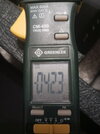
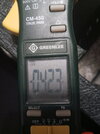
42.5 volts DC. ---standby set to warm-up.
Now (no output tubes installed)
Turn the standby to "operate."
Monitor the pin 5 voltage.
How much did the pin 5 voltage change, when you turned the standby to "operate?"
Check all 2 sockets.
Write the readings down for each socket and report the reading.

Be careful.
The high voltage will be turned ON.
But, you can measure from the top of the chassis, you don't need to measure from the inside of the amp.
 
Last edited:
OK
Now leave the meter connected above to pin 5 DC volts.

42.5 volts DC. ---standby set to warm-up.
Now (no output tubes installed)
Turn the standby to "operate."
Monitor the pin 5 voltage.
How much did the pin 5 voltage change, when you turned the standby to "operate?"
Check all 4 sockets.
Write the readings down for each socket and report the reading.

Be careful.
The high voltage will be turned ON.
But, you can measure from the top of the chassis, you don't need to measure from the inside of the amp.
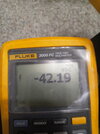
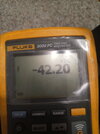
Dropped to -42.10VDC on each socket pin 5
 
Back
Top