Intonation Question:

Inspector #20

Ambassador of Tone
Fallen Star
Country flag
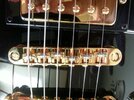
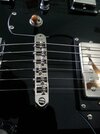
Ok...question - if we are working with a 24.75" guitar, and we measure the distance from the nut to a given saddle, the distance is very close to the same. However, we frequently see the saddles moved in many different positions.

I am curious to know why we see so many variations. I've had several of my own guitars that intonated with the bridge saddles in an almost straight line, and others where the saddle needed to be moved almost to its rearward travel range.

Thoughts???
IMG_20180403_45854.jpg
 
I think it’s just another of those no two guitars are alike things. The saddles on my G400 are all over the place with the G string saddle just about all the way back. Thought I was going to have to reverse the saddle to get proper intonation.
 
If you encounter a guitar or have one that is in perfect intonation, photograph the bridge. That pattern is a constant. I set my bridge to that pattern and I have very few adjustments to make when I install the bridge and strings.
 
Well, at long last, I got the intonation on the six string side of my doubleneck just right.

Every note is checked with a feather-light touch and set slightly flat. Then, every fret - from 1st to 20th - is checked for accuracy with a more dynamic touch, and I'm telling you, it's a beautiful thing to watch every note come up to pitch... :-)
 
With a plain third, you should see a lightning bolt, with each string being slightly longer as it is thicker. That resets when you get to the wound strings, because it is not the overall thickness that matters, but the thickness of the core wire. Thicker strings are stiffer, and they tend not to vibrate quite all the way to the ends. So you have to lengthen the string to compensate.

If your strings are not following that pattern there is some irregularity in their manufacture. That will probably come right at the next string change.
 
With a plain third, you should see a lightning bolt, with each string being slightly longer as it is thicker. That resets when you get to the wound strings, because it is not the overall thickness that matters, but the thickness of the core wire. Thicker strings are stiffer, and they tend not to vibrate quite all the way to the ends. So you have to lengthen the string to compensate.

If your strings are not following that pattern there is some irregularity in their manufacture. That will probably come right at the next string change.

Thanks, Don...
 
That's exact;y the pattern you will always see if the strings are good.

If the fret Sawer got the slots in the right place!!!

Seriously though, I have installed quite a few of these roller bridges from Philadelphia Luthier Tools. They are made by Sung iL in Korea. I install them in both the Gibson "small pin" and large 8mm import variations.

I like them for a number of reasons, but the increased travel and lack of a retaining wire are two of the biggest.

Now, i'm looking forward to getting this spare one modified for use with my 12 string, but thus far, the quotations for my rollers has been astronomical in nature...
 
If your strings are not following that pattern there is some irregularity in their manufacture. That will probably come right at the next string change.

That's pretty much what I've experienced from time to time. Every so often, I'll have to set a saddle abnormally forward or backward. Then, after changing strings I'll adjust again, and I'll more or less get the typical lightning bolt pattern.

Currently my favorite strings for consistency, feel, and longevity are Thomastik-Infeld Blues Sliders. They're expensive, and I only have them on one guitar, but I really like them. I also find that they break in rather quickly and you don't have the constant tuning and retuning after a string change nearly as bad with them as some other brands.
 
Last edited:
That's pretty much what I've experienced from time to time. Every so often, I'll have to set a saddle abnormally forward or backward. Then, after changing strings I'll adjust again, and I'll more or less get the typical lightning bolt pattern.

Currently my favorite strings for consistency, feel, and longevity are Tomastik-Infield Blues Sliders. They're expensive, and I only have them on one guitar, but I really like them. I also find that they break in rather quickly and you don't have the constant tuning and retuning after a string change nearly as bad with them as some other brands.

I never heard of those!
 
I never heard of those!

The Thomastik's are made in Vienna, Austria. You likely won't find them in your local guitar shop!

They're a little too pricey to keep on all my guitars. I currently only have them on my 2014 SG.

Interestingly, the plain strings have a brassy sheen to them; I'm not quite sure why. I believe it's some sort of corrosion resistance coating. Whatever it is, it doesn't flake or peel off. You know how sometimes the strings seem to grab at your fingers? Not with these.

Thomastik-Infeld Electric Guitar Steel/Nickel Round Wound with Silk Inlay Light, .009 - .043, SL109
 
Last edited:
The Tomastik's are made in Vienna, Austria. You likely won't find them in your local guitar shop!

They're a little too pricey to keep on all my guitars. I currently only have them on my 2014 SG.

Interestingly, the plain strings have a brassy sheen to them; I'm not quite sure why. I believe it's some sort of corrosion resistance coating. Whatever it is, it doesn't flake or peel off. You know how sometimes the strings seem to grab at your fingers? Not with these.

Thomastik-Infeld Electric Guitar Steel/Nickel Round Wound with Silk Inlay Light, .009 - .043, SL109

That's an interesting gauge spread...
 
Back
Top