
You are using an out of date browser. It may not display this or other websites correctly.
You should upgrade or use an alternative browser.
You should upgrade or use an alternative browser.
In Honor of the man that gave us the Les Paul
- Thread starter eSGEe
- Start date



yes please get 2 send me 1
Dude...I wish!
To be completely honest...though I was born and raised in Illinois, I have lived in Maryland for so long that I sort of identify more as a mid-Atlantic, Maryland-type.
(Or...is that a “Merlin”- type. My Northern Illinois accent keeps getting crossed with my Southern Maryland accent!)
PRS is a veritable religion among guitar players in these parts. Almost every guitar store has at least one on a hook.
I really would love to have one (no offense, @RVA ...aka, “Mr. Tuners”!)

RVA
Ambassador
No offense taken. I have 7 and love each one!Dude...I wish!
To be completely honest...though I was born and raised in Illinois, I have lived in Maryland for so long that I sort of identify more as a mid-Atlantic, Maryland-type.
(Or...is that a “Merlin”- type. My Northern Illinois accent keeps getting crossed with my Southern Maryland accent!)
PRS is a veritable religion among guitar players in these parts. Almost every guitar store has at least one on a hook.
I really would love to have one (no offense, @RVA ...aka, “Mr. Tuners”!)


Hey, I didn't see them all hanging on the walls in the updated mancave
 You got another room you ain't telling us about
Last edited:
RVA
Ambassador
The cases are full in that photoHey, I didn't them all hanging on the walls in the updated mancave

CabanaBoy
Ambassador of Electric Mayhem
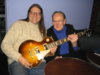
Met Les in '07 on my birthday. He was a very funny, and very nice man. Even though he wasn't as fast as he used to be, he still knew the right notes to play.
View attachment 30535
View attachment 30536
The guy on the left in the bottom picture looks like one of my older brothers... Had to show my wife...


chilipeppermaniac
Ambassador of Decibels
Les was a classic. And the man could play. I liked him - first met him in the 70s, when his friend and longtime soundman Tommy Doyle was winding me my first-ever set of bespoke pickups. Les' contributions to music are undeniable, including being one of the early advocates for solidbody electric guitars, a pioneer of tape speed manipulation & "sound on sound" overdubbing and even more importantly, co-designer of the first multitrack tape recorder. In his sound-on-sound days he also discovered/created the flanging effect.
Many feel it was entirely due to Les' creativity that studio production first began to become essentially an instrument in itself. Bing Crosby bankrolled his home studio and many famous artists came to record in his Hollywood garage because he could produce a sound that nobody else could.
He was a genuine inventor with many, many patents - including the first headless guitar, with tuners below the bridge. Unfortunately his version was aluminum and wouldn't stay in tune when warmed by stage lights. (I had a headless aluminum-necked Kramer in the 80s that had the same problem.)
Les pitched the idea of a solid body model to Gibson in the 1940s and was rejected. It was only when Leo Fender's bolt-on solidbodies began selling well in the early 50s that the Gibson management decided they'd better offer a solidbody of their own.
By that time Les had become a best-selling recording artist in his own right, rather than just a sideman. (And he'd built his own solid body, "the log," working after hours at the Epiphone factory. He used that guitar for recording for many years even while he was using the Gibson for his live shows.) So he was offered an endorsement deal and lent his face and name to the Gibson model.
Still, I think it's only fair to point out that it was Ted McCarty who created the iconic guitar that bears Les' name. Les fine-tuned the original bridge & tailpiece designs along with the neck alignment, which improved the playability significantly. Les was an inveterate tinkerer and IMO something of a mechanical genius. He also insisted it had to be a classy looking instrument and was entirely responsible for the iconic gold top color scheme and the "black tuxedo" style of the Custom model when it came out.
Les was furious when Gibson changed to the thin double-cutaway guitar that later became known as the SG. They didn't even have the decency to tell him about it; his first encounter with the new guitar was seeing one for sale in a music store window - with his name on it. Discussing that was the only time I ever saw him genuinely angry. He hated that design, partly because he thought it had odd balance and a too-weak neck joint, but I think mostly because for him it was forever associated with the insult.
Funny thing about that double horned version Gibson pissed Les off with, his wife Mary Ford played one. We all know the many years since the SG was to later become one of the most used and enjoyed guitars of so many guitar greats and fans for the next 50+ years.
chilipeppermaniac
Ambassador of Decibels
Smitty, my friend Todd has and plays a 90's or early 2000's PRS with Mccarty PUPS and does it great justice too.
Last edited:

BFT Gibson
Ambassador of Originality
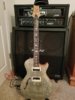
we are close in York PA.....most of my gear comes from Beltway area..dumped this asap..got it in trade....sent me back to Epi\Dude...I wish!
To be completely honest...though I was born and raised in Illinois, I have lived in Maryland for so long that I sort of identify more as a mid-Atlantic, Maryland-type.
(Or...is that a “Merlin”- type. My Northern Illinois accent keeps getting crossed with my Southern Maryland accent!)
PRS is a veritable religion among guitar players in these parts. Almost every guitar store has at least one on a hook.
I really would love to have one (no offense, @RVA ...aka, “Mr. Tuners”!)
chilipeppermaniac
Ambassador of Decibels
BFT, I am guessing you meant to say that you and that PRS did not bond, SO you got an EPI instead?

BFT, I am guessing you meant to say that you and that PRS did not bond, SO you got an EPI instead???
When i play a PRS, and then pick up an Ibanez JEM, (of which I am not a fan of) it's like I can feel where Paul was trying to go...if that makes sense.
BFT Gibson
Ambassador of Originality
I like all gear....but there is a sterility to PRS i just cant bond with(recording)..nice guitars..weird 25.1 thing going on...yeah in the semi hollow search..Korean Dot..used it on last song..was very niceBFT, I am guessing you meant to say that you and that PRS did not bond, SO you got an EPI instead?

SG John
Ambassador of Cool Guitars and Amps.
The guy on the left in the bottom picture looks like one of my older brothers... Had to show my wife...
Ha! I've heard that I have several Doppelgangers.
chilipeppermaniac
Ambassador of Decibels
SG John, I have heard that I have several Gangbangers.

eclecticsynergy
Ambassador of Electric Synergy
Coupla years ago the guys at work had the show Pawn Stars on and somebody came in trying to sell that guitar. He was a distant relative of Mary's as I remember; had documentation and everything. Piece of music history.Funny thing about that double horned version Gibson pissed Les off with, his wife Mary Ford played one. We all know the many years since the SG was to later become one of the most used and enjoyed guitars of so many guitar greats and fans for the next 50+ years.
chilipeppermaniac
Ambassador of Decibels
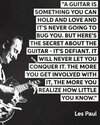
Good thing Les was not the bass player. Huh Adrian.
chilipeppermaniac
Ambassador of Decibels
Smitty, as I sad above, my friend Todd plays a Mccarty.
AND here is a bit of background on Paul and Ted

PRS McCarty Model: The Story of Paul Reed Smith and Ted McCarty
Maryland-based Manufacturer of Electric Guitars, Acoustic Guitars, and Accessories.
 www.prsguitars.com