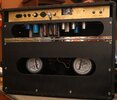
If you were building a 2203...

I would NEVER FOOGIN BUILD AN AMP ----- period
1. too many GOOD cheap ones are in existence
2. --------- SOLDERING ---- UGH
 
@Amp Mad Scientist what has to be changed to make a 2203 sound like a 2204? Is it negative feedback, or do you really need the smaller transformer sag?

I'm curious too...I have no clue. I'm like Oddball in "Kelly's Heroes" - I only ride 'em, I don't know what makes 'em work.

I just know that for the same volume the 50's are more responsive to dynamics, at least in my experience. The 100's are more authoritative in the low end but I just like the "feel" of the 50-watters.
 
oh good....... Im on wife #2 and still she throws me curve balls ........ ;)

though Ive learned a few tricks and wife 2.0 is BETTER than the first one ;)
 
What I would do is turn it into a 2204. I always thought they sounded better.
I just know that for the same volume the 50's are more responsive to dynamics, at least in my experience. The 100's are more authoritative in the low end but I just like the "feel" of the 50-watters.
giphy.gif


or do you really need the smaller transformer sag?
IMO, I think it's this... :celebrate:
 
A resonance/deep/depth/body/huevos mod is a very cool and simple mod in many amps. Crank it for low volume playing... Bring it back to stock as the volumes get louder. You need to add a pot. On the old Marshalls you could sacrifice the the voltage selector switch and install that resonance pot right there. It's a very convenient location and close to the speaker jacks.

Where it says "MAINS" on the back of the chassis is where I installed the resonance control:
5-14-20 (2) - Copy.JPG
 
The EQ spoils the sound.

I play with two other guitarists in this current band and we share rhythm and lead duties. My ability to alter my tone via the twin EQ's is a important element of my signature sound.

The left EQ pedal (shown on my board) was one of my very first purchases. It was modded by Modest Mike a few years back for silent operation.

I really depend on my EQ's live and my mid-range 'snarl' keeps me from getting lost in the mix.

The bandleader plays a super dark 2019 Gibson Firebird through one of my DSL40C'S that I gave him last Christmas as a gift.

Mikey plays a super bright 1974 P90 Gibson Les Paul through a DSL40C that I tubed based on my old recipe.

I fit right in that mid-range slot in the sonic spectrum.

I'd say that an EQ is absolutely essential for my sound...although I max-out the tone knobs on my Marshall Origin 50H...

I have reworked all the guitars and amps in this band and I serve as a guitar tech for (5) other local bands.
 
I play with two other guitarists in this current band and we share rhythm and lead duties. My ability to alter my tone via the twin EQ's is a important element of my signature sound.

The left EQ pedal (shown on my board) was one of my very first purchases. It was modded by Modest Mike a few years back for silent operation.

I really depend on my EQ's live and my mid-range 'snarl' keeps me from getting lost in the mix.

The bandleader plays a super dark 2019 Gibson Firebird through one of my DSL40C'S that I gave him last Christmas as a gift.

Mikey plays a super bright 1974 P90 Gibson Les Paul through a DSL40C that I tubed based on my old recipe.

I fit right in that mid-range slot in the sonic spectrum.

I'd say that an EQ is absolutely essential for my sound...although I max-out the tone knobs on my Marshall Origin 50H...

I have reworked all the guitars and amps in this band and I serve as a guitar tech for (5) other local bands.
I believe what AMS means is that the factory tone circuit ruins the tone. The way it works it removes volume from each section of the audio spectrum and evidently Marshall's design is pretty poor at this. Bypassing it would restore the signal. Using eq pedals either before or in a loop is a much better way to adjust your tone.
 
Back
Top