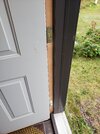
I need to replace my front door and it confuses me...

Cadorman

Ambassador of the Catocaster
Country flag
@Mitch Pearrow SJMP or anyone else familiar with replacing an entry door take a look at these pics and tell me how to remove this thing.
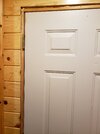
20200912_113835.jpg
I have the inside trim off and you can see the normal pine jamb around the door. It is 37.5 inches across on the outside.
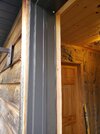
20200912_113859.jpg
Here is where I begin to get confused. This metal stuff ain't right.20200912_113918.jpg
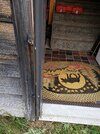
The metal goes all the way to the outside and is also 37.5 inches wide for the outside dimension.
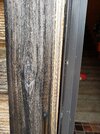
20200912_113927.jpg
Here's a close up of the 2x4 cedar trim on the outside with the metal door frame. There also seems to be metal flashing that extends from the door frame to behind the 2x4. I've never seen a door like this. How do I get it out?
 
OK Cador,. Here is what I see, and From my experience, I can only guess what you mean by what confuses you. Correct me if I am wrong.

YOU show where you removed the inside trim, ( called Casing)
Then from the outside, you show the Metal clad jamb. And looking down low, the Sill or Threshold. Now is where I can only guess your confusion lies.

Most people are unaware that your door is a WIDE Jamb door. as in your exterior wall of the house is not a 2x4 wall but likely a 2X6 WALL. This necessitates adding width to the jamb at the factory most times. ( special order) That way you get full depth to cover the opening 100% OF THE framing, EDGE of sheetrock, and outermost edge of the outdoor sheathing. It also gets you that full depth sill which you can see has 2 pieces connected together.

Why I say I am guessing your confusion lies, is at most BOX stores, the doors are all made for 2x4 walls which will net you a 4 9/16 deep door inside to inside on any trim pieces it has with it. Brick Moulding on outside of door. A 2x6 wall should measure 6 9/16 deep, 2x8 8 9/16,.....

Now as far as Handing goes, Stand on the inside of the door with your back to the door. If hinges on left, it is left hand hinge, If hinges on right, it is right handed.

Now for removal, Don't remove door until you are certain you have everything needed to fit perfectly.
 
Now it is possible to unhinge the door and put it aside and always be able to put it back. Take a punch, nail set, pointy end of a 5 in one tool and hammer up on the pins and pop em off to take the door off.

Then Measure carefully the rough opening. If a 3 foot door, it should measure about 38 width stud to stud, and the door frame will be close to 37.5 inches. The height on a normal door height will be 80 inches so the frame should be about 81.5 to 82 inches tall. MY guess is your opening height should be 82 inches + in order for the new unit to fit. Now if you have a taller door like a 7 foot door, That too will likely be special order.

The way I usually tear out a door that will not be re used somewhere, is I pop door off hinges, if it is nailed in place and not screwed, it comes apart fast. Sawzall across one jamb, and pry the 2 halves away from the framing. Be careful not to pull the top ( head piece) down on your own head. Then just use your pry bar ( flat bar) and pry the head down from the corner that held the jamb u just tore out. Then pry the other side jamb out where the door strike is.

If it is screwed in or you find extra large nails you aren't strong enough or find too hard to pry at, Use a sawzall with a Bimetal Hacksaw type blade in it to saw through all the fasteners, then you should be able to remove the whole door, or repeat the cutting of the jambs method I just went through.
 
Now, if you find any rot at the sill you will need to fix it, and at the bottoms of any of the studs too. Preferably you verify measurements of your new door to the rough opening width and height of the framing before demo,
After you did all this verify to test fit door DRY Fit in place before next step.

Take a level and see if the sill is level or out of whack. You will fight the install to no end if the sill tilts one way or the other. Same goes for putting a level on the jambs to check for plumb inside the Jambs, and also plumb in and out,,,,,,,,,,,,
Does the wall go straight up and down or if you follow the angle of it does the head lean in or out, or the wall bottom lean in or out? If you try to follow a crooked wall, the door will close and hit at the bottom before the top or top corner before the bottom and thus not hang or close properly. YOU must get the door installed plumb and not leaning, also level and plumb side to side, The door can't be " racked" essentially making a diamond out of it instead of a rectangle, Otherwise, the latch/locks won't line up. Here is where a helper and shims are vital. When shimming, I always shim the corners to take the racking out, shim behind each hinge and up and down the jambs at equidistant intervals. Then on the strike side, make sure to shim right in line with the striker to make sure there is meat for screws and meat to keep the latching firm.
Get a full tube of Silicone and seal the lower corners of the sill, then run a pair of beads from side to side, and even zig zag any extra silicone on the sill. this will keep water out of your house.
 
I also do this, When installing, I do not NAIL the jambs, Always Screws to secure and do it in the areas that you don't see when the door shuts.. This way if you do make a mistake, you can simply unscrew and sort it out. Also, as you shim, stand back away 6 feet or so and eyeball the gaps across the head and up and down the strike side. You want a good 3/16 inch EVEN gap to allow door to swing, and latch to latch, and also if you see the gap as tighter in the hinge corner than the strike side corner on the head, you know your door is racked and or sill is not level. Figure all this out before the final install with silicone at the sill.

When I get it all hung, I will Install door hardware and test operation. and after that, install minimal expanding foam, let dry, cut off excess and install trim. putty any screw/ trim nail holes, caulk trims, DONE
 
Last edited:
20200912_144439.jpg
It is a standard sized 36 inch wide right hand inswing insulated steel door. Like I said, the outside to outside of the jamb is 37.5 inches and the rough opening is 37.75-38 inches.
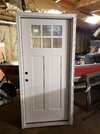
20200912_144413.jpg
This is the replacement door. The wall is made from 2x6 lumber. I am planning to remove the outside trim which is just stapled on and then building out the jamb to match the outside. This is on a concrete slab and the aluminum piece at the bottom will cover all the way out. The one on the old door overhangs by more than 2 inches.

I was going to Sawzall around the old door to remove it, but I can't get through the metal flange that seems to extend from the outer door frame to behind the outside trim.

Could this door have an exterior mounting flange? That is what I am wondering about.
 
Mitch, I am guessing Cador is describing like a Nail flange made of metal, like those plastic ones on Andersen windows.

Cador, You are right to put extension jamb on the outside of the 2x4 framed new door. Pull the Brick Mold off and glue and nail the new extension jamb. Also, you should be able to buy a extension sill if you need to make the new sill as deep as the old. Always best to attach it first, before installing door or extension jamb and trim. Just need to get the manufacturer's proprietary part, usually it rolls into a pre made slot in the stock sill
 
Last edited:
Back
Top