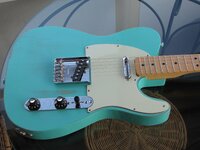
I fixed my Tele...

DirtySteve

Ambassador of Hold My Beer
Country flag
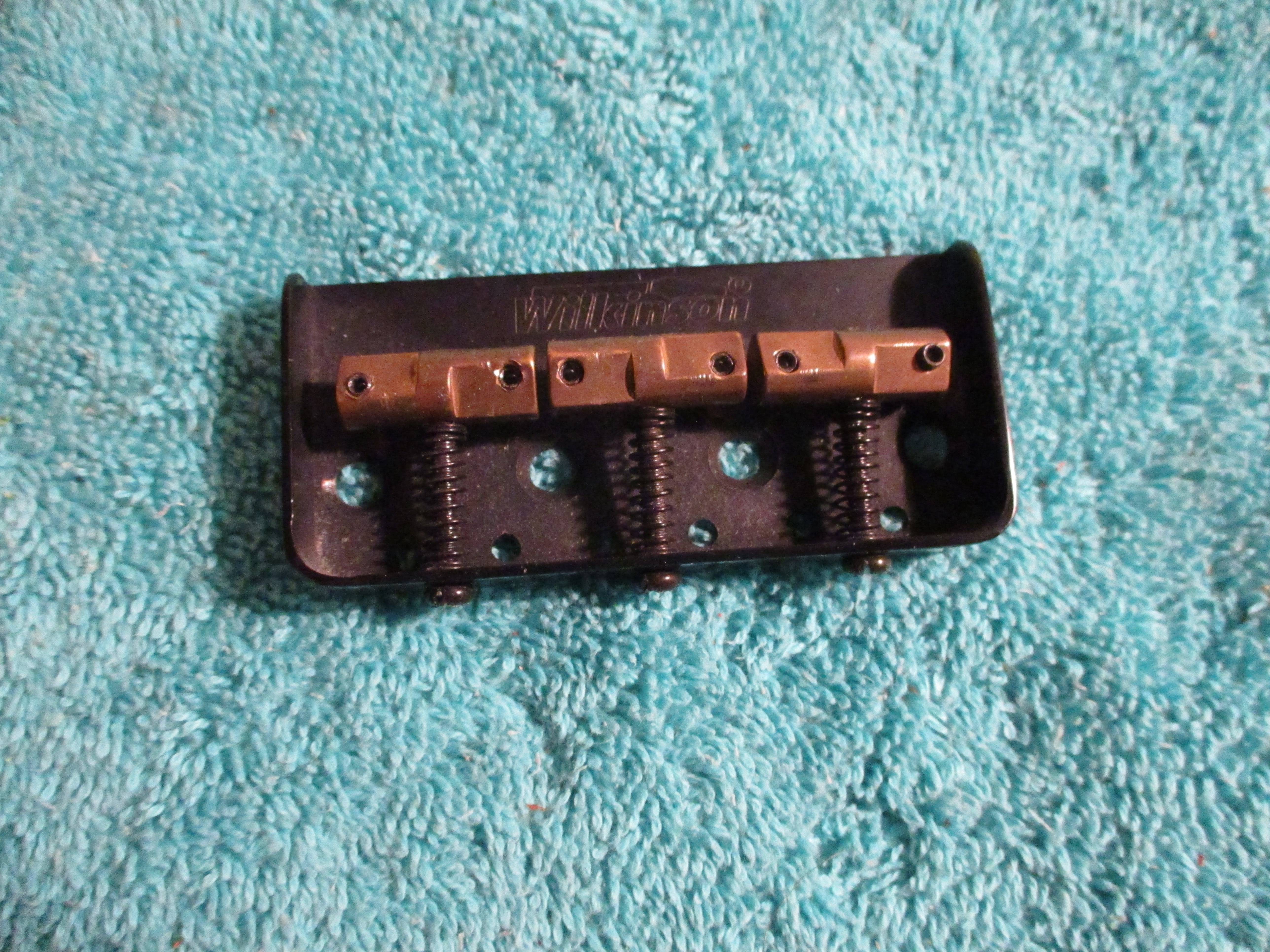
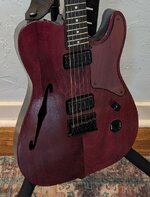
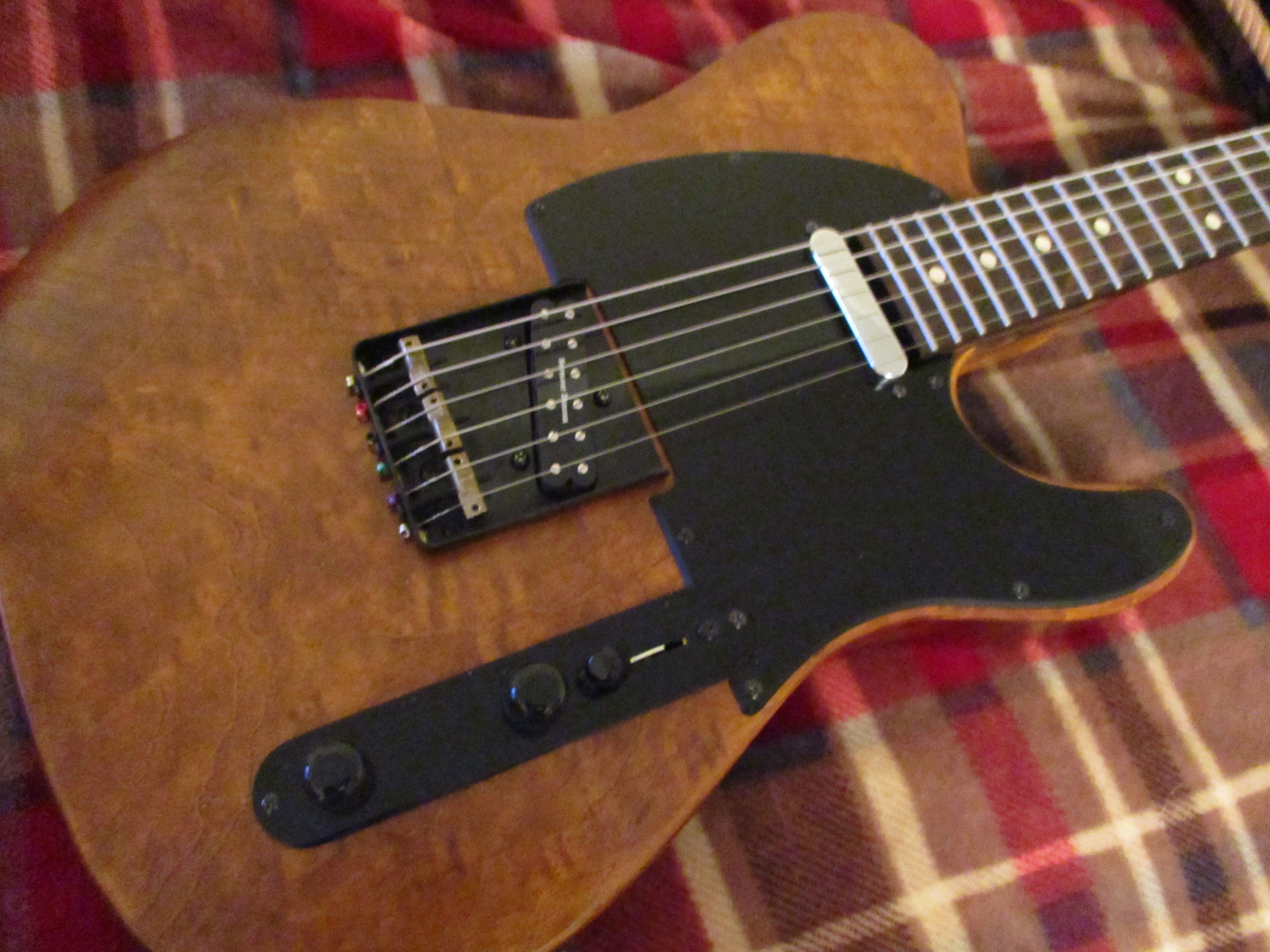
I was bitching about it in the wrong place so I'll start a new thread. I put a SD Red Devil in the bridge the other week and while the pickup sounded better for what I want, the guitar just didn't sound good overall. It took me a while to find it, but I swapped the thick plate 6 saddle bridge I had on it for the regular Tele thin plate bridge with the 3 barrel saddles back on. That 6 saddle heavy bridge worked great to tame the high end on the Tele bridge pickup, but it was killing the tone when I put the HB in it. It sounds much better now!

With the HB in the bridge now I can throw as much gain as I want at it, it sounds great clean and it pairs well with the Pure Vintage 64 neck pickup. I still need to set the intonation and tweak the set up a little after the strings settle in, I haven't found the sweet spot yet on pickup height, but so far so good. I think it's going to work for me now.
6IoyPZD.jpg
 
Last edited:
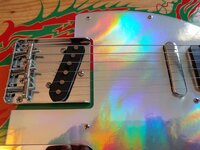
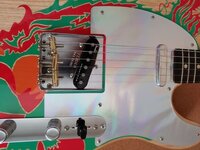
My Page Dragon Tele came with these "period correct" all-thread bolt shank saddles.

20210525_115115-s.jpg

I swapped them out for Fender Vintage compensated saddles.
They look a bit wonky, but the contact points are spot on.
The intonation is just fine for my level of playing ineptitude.

20210525_180447-s.jpg

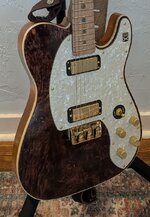
My Burl-top tele has Wilkinson compensated saddles that also work well.

comp.jpg
 
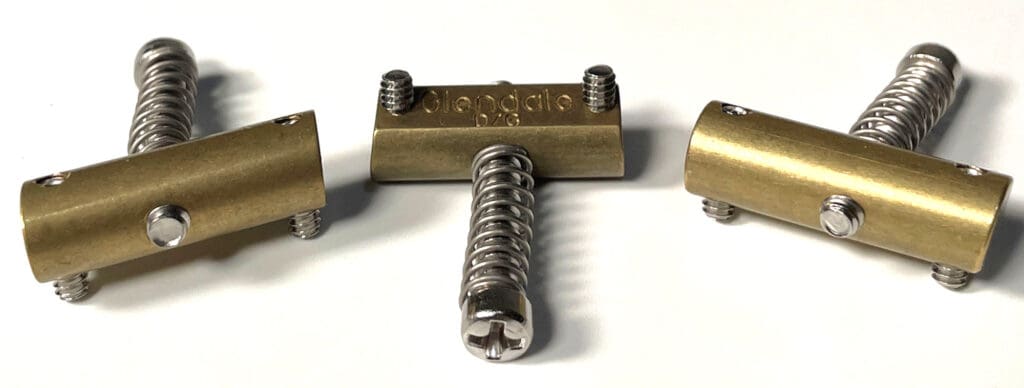
I used Glendale Saddles on mine at the recommendation of 67Plexi.


Here's the thread of my reworking that Tele.

Compensated Tele Saddles

Good read, thanks! I was noticing the Tom Anderson Teles with the short bridge on them. I have one of those and I almost put it on, but thought it might look funny. Now that I see his I might do that.

m1D2wuZ.jpg


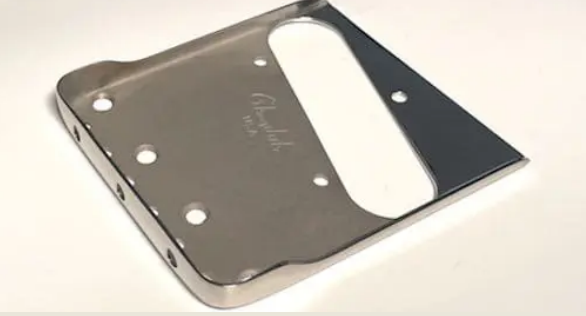
One thing I don't like about the bridge I just put back on it (and the reason I took it off in the first place) is the metal lip around the edges, especially on the high E side. My pinkie gets all tangled up between it and the high E string. I like the ones that have that lip filed down, but I can't find a black one.

Like this...
PFZkRUR.png
 
Last edited:
My Burl-top tele has Wilkinson compensated saddles that also work well.

View attachment 112886

That's what I have now, both of my bridges are Wilkinson with those saddles on them. They seem to intonate fine, but they're soft and the string tension puts a dent in them, but the saddles can move back and forth and mine have ended up with several dents in them. I just thought some better saddles might not do that, but there are a few different materials to choose from I wasn't sure what would be the best. Steel, brass, aluminum and I don't know what else.
 
That's what I have now, both of my bridges are Wilkinson with those saddles on them. They seem to intonate fine, but they're soft and the string tension puts a dent in them, but the saddles can move back and forth and mine have ended up with several dents in them. I just thought some better saddles might not do that, but there are a few different materials to choose from I wasn't sure what would be the best. Steel, brass, aluminum and I don't know what else.
Both of the sets of saddles I have in the pics above are brass.
Never noticed any dents from the strings.
The bridge on my Cabronita is a steel 6 saddle like a Strat hardtail, so that might be another option to consider.

Cab.jpg
 
Tom Anderson Teles with the short bridge on them.
How is your Tele grounded now? Usually, with the traditional sized plate, the bridge pickup carries the bridge ground. When a short plate is used, the bridge pickup does not connect to the plate anymore….and a ground wire needs to be run under the short plate bridge.

Edit: Fitz posted his as I typed, but his is routed for humbuckers.:shrug:

Yes…I started a Tele project way back, and I haven’t revisited it…we’ll just chalk it up to laziness. But I was going to do a short plate, and decided against it for several reasons…the ground routing was only one of them. Someday I’ll get up the guts to carve it up the way I want to, and finish it poorly…
 
How is your Tele grounded now? Usually, with the traditional sized plate, the bridge pickup carries the bridge ground. When a short plate is used, the bridge pickup does not connect to the plate anymore….and a ground wire needs to be run under the short plate bridge.

Yes…I started a Tele project way back, and I haven’t revisited it…we’ll just chalk it up to laziness. But I was going to do a short plate, and decided against it for several reasons…the ground routing was only one of them. Someday I’ll get up the guts to carve it up the way I want to, and finish it poorly…

Right now the ground wire is routed thru the bridge pickup cavity and is just stripped back and pinned under the bridge. When I used that 1/2 bridge before I drilled a hole under the bridge to the control cavity and I'd probably do that again. I'll have to touch up the finish between the bridge and the pickup rout if I do that, it's got a groove pressed in it from the wire. I'm not too worried about it though, I doubt it's very noticeable with the strings on. I'd probably do something about it, but I'm not too worried..
 
Both of the sets of saddles I have in the pics above are brass.
Never noticed any dents from the strings.
The bridge on my Cabronita is a steel 6 saddle like a Strat hardtail, so that might be another option to consider.

View attachment 112892

If you look at the pic I posted of my 1/2 bridge you can see the dents from the strings in the saddles, but that one's pretty clean, the one I have on it now has several dents in the saddles because I didn't realize it was happening until it was too late.
 
Last edited:
Another thing...With the Wilkinson saddles I have to shim my neck to be able to raise the saddles enough that the saddle height adjustment screws don't stick out on top of the saddles. The link I posted in post #2 claims those saddles don't do that. I don't mind having a shim in there, but I'd rather not need it for the reason I do.
 
I'd probably do something about it, but I'm not too worried..
Yep, you saw it first here folks, denial is a river in Egypt...

Y'all are hurting my head with the fancy custom stuff for a lowly Tele. i hate the ash tray bridge plate of normal Teles so I picked up a flat plate style - Gotoh I think with 6 saddles as that has to be better, right?!? Probably doesn't matter with my guitar hackery. So at least as modern looking as I'm going to go with the first Tele I've decided to keep.

Russ
 
Yep, you saw it first here folks, denial is a river in Egypt...

Y'all are hurting my head with the fancy custom stuff for a lowly Tele. i hate the ash tray bridge plate of normal Teles so I picked up a flat plate style - Gotoh I think with 6 saddles as that has to be better, right?!? Probably doesn't matter with my guitar hackery. So at least as modern looking as I'm going to go with the first Tele I've decided to keep.

Russ

That's the exact bridge I just removed.
pDRoDZd.gif
 
For what it's worth, I take Tele's seriously, and I'm fairly 'traditional' overall when it comes to them. I don't care for the weight reliefs, modern contours, 22nd fret (though it doesn't bother me), etc. I think Leo got it exactly right the first time with two exceptions and and the wiring is of course more a preference thing. The two 'flaws' in the original Tele were the truss rod being accessed from the body rather than the headstock (which had to do with the production process) and the 3 saddle arrangement. It's not a coincidence that the Strat had the 'improved' 6 saddle arrangement from the get go. When using 3 saddles there's always going to be a bit of a trade-off, whereas the 6 saddle arrangement can be as perfect as the instrument allows. The arguments for the old 3 saddle setup that I've heard basically boil down to

* it looks right, that's how Leo intended it
* the coupling of the strings in pairs allows the [insert vague tonal hypothesis]

Yes, Leo intended it that way before he worked out an even better solution. Clever man. As for the tonal aspects I deem them pretty much 'woo woo'. The other variables in the guitar outweigh any tiny, tiny effects that there *might* be. The saddles are touching the bridge plate in both arrangements as well as each other. Funnily, I seldom see 'purists' using an ashtray bridge with the cover installed, so they seem to concur that Leo had improvement to do in that respect.

Apart from the 'vintage look' I fail to see any true advantage to the old setup. The newer 6 saddle arrangement is easier to set up (as one string doesn't compromise another in the process), is less prone to shifting when replacing the strings, feels better for muting with the heel of your hand (to me, at least)** and allows you to set height, distance and angle for each string individually.

** I also prefer solid block saddles over the bent type initially found on the Strats. The bent type can cut into your hand over time which is annoying.

I hope that didn't come across as a rant, Steve. I just feel that you're going to regret the 3 saddle approach at some point and start messing about with it again...
 
I used Glendale compensated saddles on two f my guitars a Esquire and a Telecaster


Yep, you saw it first here folks, denial is a river in Egypt...

Y'all are hurting my head with the fancy custom stuff for a lowly Tele. i hate the ash tray bridge plate of normal Teles so I picked up a flat plate style - Gotoh I think with 6 saddles as that has to be better, right?!? Probably doesn't matter with my guitar hackery. So at least as modern looking as I'm going to go with the first Tele I've decided to keep.

Russ
That reminds me. My Broadcaster - Parts O'Caster has a Fender six saddle bridge. It works real well. I wanted the three saddle set up on the 50's Tele purely for aesthetics.

IMG_0472_resized.JPG
 
I used Glendale compensated saddles on two f my guitars a Esquire and a Telecaster

Look high quality, certainly.

A snippet from the their product description:

"Using state-of-the-art CNC machining centers, each saddle is precision-engineered from billet, ensuring flawless alignment and uniformity. It results in perfect harmony across all six strings, within an astonishing accuracy of .1 Hz. Glendale has reimagined the saddle design, ensuring the ends touch minimally, which significantly minimizes movement and enriches sound. The unique configuration allows for an increased string clearance on the E string side and a designed touch at the top—not the bottom—to effortlessly follow your guitar’s neck radius without forcing the saddles apart."


The thing is, the three saddle design is inherently unable to 'compensate' for some conditions without manually grinding/filing/altering them in a non-reversable way. Changing the gauge of strings is doable, but what about using a wound G instead of plain? There has to be a compromise made on the center saddle. What about switching between regular and custom/open tunings? Compromises must be made again. While I'm not saying that most arrangements can't be made to sound nearly perfect with them, the 6-saddle setup is simply superior from a physics perspective.

I wanted the three saddle set up on the 50's Tele purely for aesthetics.

That's a solid legitimate reason for choosing it. I'd be torn on that one, and I might even go for the same for the same reason. All my other Tele's have the modern 6 block saddle setup, so why not go for something else for a change.

Nice Tele, by the way - I like the Fender amp style knobs on there. Might actually do that to one of mine...
 
Back
Top