How Your Opinions On Gear Change When You Play Everyday:

Thanks...

Tell you what I experience with my stock Fender tremolo. The ONLY string that gives me trouble is the low E. I've eliminated the nut as a problem. Under intense magnification, the winds (only 2 or 3) around the low E post begin to unwrap as the bar is depressed. Although this is very slight, you can see the entire wrap begin to rotate on the tuning post and this keeps it from coming back to pitch, as the ridges on the winds do not always fall back in precise alignment as they wind back up to pitch when the bar is released. This constant CW/CCW rotation during tremolo use has worn out my low E tuner.

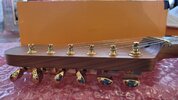
I'm curious if locking tuners will help this anomaly, because it only locks the tail of the string as has zero influence over the wrapped section. Unless, with a locking tuner, you could simply use less wraps???

My tremolo's range of motion is from E to G#, so about a 9 semitone drop with the bar against the pickguard....

I'd be curious to know how far you can drop your guitar's pitch with full bar use and tell me if it returns to pitch after such a divebombing excursion...

P.S. In order to eliminate the nut as a protentional problem, I took the nut slot out oversize (.055" on a .046" string) and reverse wound the string so it ran dead-straight through the nut.

You're just running into the reason there is an entire cottage industry devoted to improving stock Fender vibratos. They're fine for subtlety but a joke for serious business. Jimi Hendrix was a lot of things, but in-tune wasn't one of them.
 
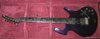
I have locking tuners on my 1992 Parker Fly Deluxe it's light it stays in tune does not break strings I had over 6,000 hours on a set of strings
as a test it was so grungy I had to clean it on inspection the old strings were fine same with the stainless steel frets new strings didn't sound any better

Parker Fly Deluxe 001.JPG
 
You're just running into the reason there is an entire cottage industry devoted to improving stock Fender vibratos. They're fine for subtlety but a joke for serious business. Jimi Hendrix was a lot of things, but in-tune wasn't one of them.

I've had really good fortune with my stock Fender, even with 9 semitone divebombs. All the springs and screws are genuine Fender.

Ditching the stamped saddles for homemade brass was a huge improvement.

The Graph Tech Tusq XL was great, but lasted only a month before I worevthe slots down enough the first fret clearance disappeared.

Bone was marginally better, but I'm making a brass nut.

There's just a few little details that I need to work out and I do not think - in all honesty - that locking tuners are the solution.

I can play a couple of days with zero tuning issues. But, then the low E will come back sharp. When it does, I can inspect the groove and see corregation marks from the string winds engraved into the bone.

If I dress the ot lightly, it's good for another few days and it will divebomb with 100 reliability, until the nut gets grooved.

Brass is next...
 
Last edited:
I've had really good fortune with my stock Fender, even with 9 semitone divebombs. All the springs and screws are genuine Fender.

Ditching the stamped saddles for homemade brass was a huge improvement.

The Graph Tech Tusq XL was great, but lasted only a month before I worevthe slots down enough the first fret clearance disappeared.

Bone was marginally better, but I'm making a brass nut.

There's just a few little details that I need to work out and I do not think - in all honesty - that locking tuners are the solution.

I can play a couple of days with zero tuning issues. But, then the low E will come back sharp. When it does, I can inspect the groove and see corregation marks from the string winds eye he'd into the bone.

If I dress the ot lightly, it's good for another few days and it will divebomb with 100 reliability, until the nut gets grooved.

Brass is next...

Locking tuners to one thing: make it easier to change strings. They won't help tuning stability, you need a locking nut/bridge for that.
The most stable guitars I've had in my life are Norlin-era LPCs, with maple necks and Schaller tuners.
 
Well, I'm really on the fence with the locking tuners. I like the concept of no drilling that the Hipshot and Ratio offer. Tuners are needed, I'm just void of any experience with them.
 
I think they look a bit retro actually in the industrial sense. I would like to try them, but I'm on the fence about how it would pull a wound string, under tension, across the chamfer in the center as you tighten it.

Let us know how they work. I'm quite interested to say the least.
Yea, I’m going to do a build thread soon. My concern right now is neck dive. Its quite a bit of mass up there. If they don’t work, I’ve got sets of Schallers to choose from.
 
I was chatting with @Mitch Pearrow SJMP this morning and thought some of you might find this post interesting.

As many of you know, I am a super loud, super rough player. I also use bass and resonance settings that frequently knock pictures off the wall in my home. A recent video I posted shows this effect actually happening. Since out band lineup has recently changed, "The Governor" who held everyone back is now gone and as a result, we are all able to play much more freely and without any drama. Here's a listing of some of my experiences:

Bought two brand new Greenbacks from Sweetwater. Blew the surrounds off the cones in 2 weeks.

You cannot return speakers to Sweetwater (or any other supplier that I know of) so I just had to write off the loss. I gave the blown speakers to a chum who likes to recone them.

In retaliation, I bought 2 brand new 75 watt Creambacks from Sweetwater - blew the surrounds off of those in two weeks. Another loss.

The ONLY speakers that have survived my amp settings are the 50 Watt WGS Reaper 55Hz and the Jensen Neodymium Stealth 80 Watt

I am now breaking at least 1 string every 4 hour show. I am breaking them midway down the length of the string. They never break at the break-over point at the bridge or the nut. I've just accepted this and build alternate solos into my practice routine and try to switch guitars mid way through a live set.

I sent the broken string and these photos to Ernie ball and got 100 sets of strings in return.

Now, I've just gotten to the point where I have to change strings after every show.

Many times, I can make the warp on my 'G' string "choke up" on the string during 2-1/2 step bends in songs like Buddy Guy's "I Smell A Rat."

Wore the frets on a 2019 Schecter Hellraiser C!FR flat in just over a year of use.

Wore out the Graph Tech Tusq XL nut on my new Warmoth neck from .020" first fret clearance to .009" in less than 2 months

Collapsed (2) Gotoh Nashville Bridges and one Gotoh ABR-1's in less than 1 year, at standard tuning (Ernie Ball .046" x .009") without the strings contacting the bridge.

Gotoh's tech department thinks this is partly due to my extreme string bends, how I slam my hand down on the bridge while playing rhythm and my habit of pressing down on the strings between the stop bar and bridge to simulate a tremolo.

I now use only the Aluminum ABR-1 from Philadelphia Luthier Tools (# LPC-1272/1143-NK ) and I now use the Aluminum Nashville (# LPB-1218 ) and add roller saddles to them. Problem solved.

I could go on and on about the failures I have experienced, but this should give you an idea of what I am up against trying to keep all this gear running with daily/nightly use.


View attachment 66724

View attachment 66722

View attachment 66723
As I have said many times before:
The speakers should be rated 2X the power of the amplifier.
This insures reliability.
Speaker ratings are for clean power, not distortion.

If you want reliability, use EVM speakers.
Again and again, the 2X power rule has proven itself to be correct.

This idea comes from Dan Armstrong, one of the greatest techs who ever lived.
Read it or weep. Listen to the experts and learn how.
 
I’ll let y’all know when and if I ever actually play every day. :rolleyes:

Get up and start playing!
As I have said many times before:
The speakers should be rated 2X the power of the amplifier.
This insures reliability.
Speaker ratings are for clean power, not distortion.

If you want reliability, use EVM speakers.
Again and again, the 2X power rule has proven itself to be correct.

This idea comes from Dan Armstrong, one of the greatest techs who ever lived.
Read it or weep. Listen to the experts and learn how.

Good info!
 
Back
Top