Helping Out With Strange DSL40C Problem:

More often than not, it's the preamp tubes. We see a lot less problems with output tubes.

But DSLs in general suffer from a Voodoo curse.
People love the way they sound. But those DSL amps act up a whole bunch.

I've owned two and gigged them daily, plus work in the studio with zero issues.

I did, however, keep them covered when not in use and dusted them out with compressed air frequently...
 
The cathode follower tube, which is V3b in the DSL40, is a common tube failure due to the high positive potential on the cathode.
A 12AX7/ECC83 should have a maximum heater to cathode rating of 200V (or at minimum 180V), however the data sheet of some current production 12AX7/ECC83 types show this rating at 100V. These types won't fair well in a cathode follower position (or cathodyne phase inverter).
If possible, check the datasheet's maximum heater to cathode rating for the tube type you are intending to use as a cathode follower. If you can't find the datasheet's, use a JJ803S for this tube position as it will handle the high cathode potential. Cheers
 
Last edited:
Robert, pics of old tubes. any signs of red plating? Any other possible burned spots, resistors, caps.

I sure would be reluctant to have just swapped tubes, set bias and put back into service until I verified there was no malfunctions that could wipe out a PCB board, Transformers or other expensive components.
 
Thanks for this information. I used an ECC823 in V1 and TAD 7025-WA in V2 through V4...
If possible, check the datasheet's maximum heater to cathode rating for the tube type you are intending to use as a cathode follower.
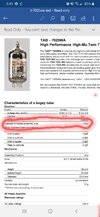
Here's the data sheet for that TAD 12AX7WA:
20201129_174702.jpg

So, it seems that particular tube's max cathode rating is a 150v. Can't find any preamp voltage specs for the DSL40C. But I seen posted power tube plate voltages of 465v. At least on some JCM800s with about the same plate voltages, the V2 pin 8 cathode follower voltage is around 180v. The DSL's cathode follower should be V3's pin 8.
 
Here's the data sheet for that TAD 12AX7WA:
View attachment 53147

So, it seems that particular tube's max cathode rating is a 150v. Can't find any preamp voltage specs for the DSL40C. But I seen posted power tube plate voltages of 465v. At least on some JCM800s with about the same plate voltages, the V2 pin 8 cathode follower voltage is around 180v. The DSL's cathode follower should be V3's pin 8.

Yup,

1606703900499.png
 
I've owned two and gigged them daily, plus work in the studio with zero issues.

I did, however, keep them covered when not in use and dusted them out with compressed air frequently...

It could very well be humidity / dampness that contributes to the insulation failure.
It is a good idea to cover the amp to keep moisture from circulating.

Also Fog Machines:
the vapor from fog machines (non-CO2 fog) can be extremely corrosive to circuit boards and electrical devices.
Especially "Fog Juice." This stuff can literally destroy circuit boards.
 
Robert, pics of old tubes. any signs of red plating? Any other possible burned spots, resistors, caps.

I sure would be reluctant to have just swapped tubes, set bias and put back into service until I verified there was no malfunctions that could wipe out a PCB board, Transformers or other expensive components.

Tubes V2 and V3 exhibited arcing where the tiny wires affix to the electrodes. This visible arcing coincided with the abrupt "short circuit" tone. The power tubes looked great!!!!
 
Here's the data sheet for that TAD 12AX7WA:
View attachment 53147

So, it seems that particular tube's max cathode rating is a 150v. Can't find any preamp voltage specs for the DSL40C. But I seen posted power tube plate voltages of 465v. At least on some JCM800s with about the same plate voltages, the V2 pin 8 cathode follower voltage is around 180v. The DSL's cathode follower should be V3's pin 8.

Hmmmmm....5751???
 
It could very well be humidity / dampness that contributes to the insulation failure.
It is a good idea to cover the amp to keep moisture from circulating.

Also Fog Machines:
the vapor from fog machines (non-CO2 fog) can be extremely corrosive to circuit boards and electrical devices.
Especially "Fog Juice." This stuff can literally destroy circuit boards.

Good to know!!!!
 
Here's the data sheet for that TAD 12AX7WA:
View attachment 53147

So, it seems that particular tube's max cathode rating is a 150v. Can't find any preamp voltage specs for the DSL40C. But I seen posted power tube plate voltages of 465v. At least on some JCM800s with about the same plate voltages, the V2 pin 8 cathode follower voltage is around 180v. The DSL's cathode follower should be V3's pin 8.

From the Eurotubes Website:


V3 is the final gain stage and cathode follower so here we tend to stay with 12AX7 / ECC83 type tubes. You can maintain the gain, increase it or smooth it out with a Gold Pin tube. The only tubes we stay away from in V3 are the long plate tubes which are more prone to feeding back in the lead position.


ECC83S Standard -


ECC83S High Gain -


ECC83S Gold Pin -


ECC83 MG Standard -


ECC83 MG Gold Pin -
 
V3 is the final gain stage and cathode follower so here we tend to stay with 12AX7 / ECC83 type tubes. You can maintain the gain, increase it or smooth it out with a Gold Pin tube. The only tubes we stay away from in V3 are the long plate tubes which are more prone to feeding back in the lead position.
I'm not educated enough on the "promise" of the pins being "gold". Maybe the "gold" plating improves contact and reduces corrosion. Other than that, I think it's all marketing dribble.

Long plate preamp tubes are known to become microphonic in combo amps because of their proximity to the combo amp's speaker(s).

The TAD that is cathode rated for 150v will probably be ok, even if the actual voltages are a bit higher. There are a few tubes with a higher rating, but there are a lot more tubes out there with less than a 150v rating as Ivan has stated.

Another culprit towards tube failure is not letting the tubes cool down before the amp is moved. Which also includes rocking the amp back and forth for those that like to hear the reverb tank splash around or banging on them by slamming your drink onto the top of amp's cab, as an example.
 
I'm not educated enough on the "promise" of the pins being "gold". Maybe the "gold" plating improves contact and reduces corrosion. Other than that, I think it's all marketing dribble.

Long plate preamp tubes are known to become microphonic in combo amps because of their proximity to the combo amp's speaker(s).

The TAD that is cathode rated for 150v will probably be ok, even if the actual voltages are a bit higher. There are a few tubes with a higher rating, but there are a lot more tubes out there with less than a 150v rating as Ivan has stated.

Another culprit towards tube failure is not letting the tubes cool down before the amp is moved. Which also includes rocking the amp back and forth for those that like to hear the reverb tank splash around or banging on them by slamming your drink onto the top of amp's cab, as an example.

Great points!!!!

These guys are super rough on their equipment too!!!!!!
 
Here's the data sheet for that TAD 12AX7WA:
View attachment 53147

So, it seems that particular tube's max cathode rating is a 150v. Can't find any preamp voltage specs for the DSL40C. But I seen posted power tube plate voltages of 465v. At least on some JCM800s with about the same plate voltages, the V2 pin 8 cathode follower voltage is around 180v. The DSL's cathode follower should be V3's pin 8.
It's not just the voltage on the cathode followers cathode at quiescent (no signal) condition, you see we get some reasonably large AC (audio signal) voltage swings here too.
Lets suppose that the cathode is sitting at 180V+ & also that at the cathode follower we are seeing a 40V peak to peak (20V+/20V-) signal. 180V+ plus 20V+ = 200V+ that the cathode is seeing on the positive going excursions of the audio signal.
As you can see, this is well above the rating of the TAD 7025WA.
It could very well be humidity / dampness that contributes to the insulation failure.
It is a good idea to cover the amp to keep moisture from circulating.

Also Fog Machines:
the vapor from fog machines (non-CO2 fog) can be extremely corrosive to circuit boards and electrical devices.
Especially "Fog Juice." This stuff can literally destroy circuit boards.
Some good points here. Humidity & dampness/moisture are the enemy of tube amps, as well as dust (which is conductive). Combined they can wreak havoc & bring about arcing, which in turn can result in "carbon tracking" that will facilitate further arcing. Valve sockets in older amps is a common place to see this occurrence. Cheers
 
Last edited:
It's not just the voltage on the cathode followers cathode at quiescent (no signal) condition, you see we get some reasonably large AC (audio signal) voltage swings here too.
Lets suppose that the cathode is sitting at 180V+ & also that at the cathode follower we are seeing a 40V peak to peak (20V+/20V-) signal. 180V+ plus 20V+ = 200V+ that the cathode is seeing on the positive going excursions of the audio signal.
As you can see, this is well above the rating of the TAD 7025WA.

Some good points here. Humidity & dampness/moisture are the enemy of tube amps, as well as dust (which is conductive). Combined they can wreak havoc & bring about arcing, which in turn can result in "carbon tracking" that will facilitate further arcing. Valve sockets in older amps is a common place to see this occurrence. Cheers

What tube would be appropriate???
 
Back
Top