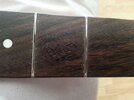
Guitar set up

I see the point. Perhaps, I was a bit overbearing in my comment. For me, I don't always mess with my setup, but as often as I goof around with things, I'd go broke paying someone to tweak things for me. Once I started to learn how to do it, it took a lot of the fear factor out of it, and I began enjoying my instruments more.

You hit the nail on the head! I was supporting a local Luthier by my constant fiddling around with stuff...
 
I see the point. Perhaps, I was a bit overbearing in my comment. For me, I don't always mess with my setup, but as often as I goof around with things, I'd go broke paying someone to tweak things for me. Once I started to learn how to do it, it took a lot of the fear factor out of it, and I began enjoying my instruments more.

I'll add that knowing how to do you own setups can help with troubleshooting little things, too. The more comfortable you are with things like setups, the more willing you are to try to find and fix little annoyances on your own.

Oh, don't get me wrong. If I didn't have to mess with it I certainly wouldn't, but have to just to keep them working the way I want. Even string wear will effect the setup, and while I change my strings pretty often I don't do it every week.
 
I have a fantastic luthier near me. Even though I would often make adjustments on my own, I would still bring my guitars once in a while for a total setup.

Then I got my $79 epipohone LP. I couldn't see spending a $50 setup on a $79 guitar. I used it as my canvas of learning.

Fast forward to the completion of My Gibson Les Paul assembly. Not sure why, but I figured I put so much energy into it, I may as well get it setup professionally.
So I pick it up at the luthier, and he says No Charge!! Why? I ask. He replies, "because I didn't need to do anything to it"

As far as setups go, ill be doing my own from now on.
 
Do you know how many people don't even change their own strings. I change my strings because I play often. I practice 2 hrs every day and that's not counting some gigs I do. I take my guitar into the Luthier and says he barely has to do adjustments after one year of playing. Where I live I get all four seasons from hot and humid to freezing cold. I don't understand this , I could see it if your changing your strings often by cutting all 6 strings at once then it throws things out of whack. I never cut all my strings at once. When I change them I cut them one at a time and then replace the string, this way the tension remains on the neck then once a year I have it tuned. Like I said the Luthier said he hardly had to make any adjustments works this way for me.
 
I do need to be clear. I am certainly not opposed to anyone seeking the services of a good luthier, even if just for a periodic "sanity check" on how you're doing things.

But, for me, ultimately, I want to know how to take care of these things on my own.

Agreed!!!!
 
Do you know how many people don't even change their own strings. I change my strings because I play often. I practice 2 hrs every day and that's not counting some gigs I do. I take my guitar into the Luthier and says he barely has to do adjustments after one year of playing. Where I live I get all four seasons from hot and humid to freezing cold. I don't understand this , I could see it if your changing your strings often by cutting all 6 strings at once then it throws things out of whack. I never cut all my strings at once. When I change them I cut them one at a time and then replace the string, this way the tension remains on the neck then once a year I have it tuned. Like I said the Luthier said he hardly had to make any adjustments works this way for me.

My 1987 Squire had one neck adjustment in 30 years of playing - but it's had three fret levels in that some period of ownership.

My 2005 Schecter C1 Hellraiser neck was perfect after 13 years - never had to touch it.
 
I saw one in the store the other day that looked just like yours. Those are nice looking guitars.

Nice guitar, 24 frets, EMG's are quiet, but not enough character to suit my sonic tastes. I paid over $1,000 new for it in 2005 and I tried to sell it for over a year. No dice, even dropped it down to $300.00. I sold it a couple of weeks ago for $250.00 just to free up some space in my rack....
 
I like to take a guitar in for my luthier to look over and set up right after I buy one.
Or in the case of guitars I've gutted and modded, I'll take it to him after I install parts,
and have him fine tune things. He's got tools I don't own, and can measure things
I can't as well... So he's worth it.

Once it's had a good professional job like that, I've found that I can keep it that way.
It's good to know how, and to own a few basic tools. And if something goes wrong, I
can usually fix it. But I'm happy to pay him to do work I'm not as good at, because when
I need him, I'm glad he's there. He repays me by giving me good prices and quick service.
 
I like to take a guitar in for my luthier to look over and set up right after I buy one.
Or in the case of guitars I've gutted and modded, I'll take it to him after I install parts,
and have him fine tune things. He's got tools I don't own, and can measure things
I can't as well... So he's worth it.

Once it's had a good professional job like that, I've found that I can keep it that way.
It's good to know how, and to own a few basic tools. And if something goes wrong, I
can usually fix it. But I'm happy to pay him to do work I'm not as good at, because when
I need him, I'm glad he's there. He repays me by giving me good prices and quick service.

Since I have learned to level and crown, I am yet to see an uncut fret have any real degree of symmetry. The tonal improvement on a properly leveled and crowned neck is unbelievable.

On my 2016 Gibson SG T Series, the factory fret work was horrendous. I tolerated it for a long time, but ultimately, it had to be fixed.

Several frets had been flattened on the treble side and were still high. The sides of some frets had bulges from the hammer blows used to seat them.

In one area of the SG's neck, the contact pattern was off the fret's centerline, and it took several passes of both file and block to restore the crown to the absolute center of the fret.

Typically, I see the saddles align in almost a straight line after crowning - and that's after doing quite a few for private clients.

I believe this is one of the most important - and overlooked aspects - of a quality setup...

Here's a photo I took of a Fender Stratocaster fret that was deformed by an errant hammer strike. I've seen better examples on my bench recently, but I don't photograph all of them...

IMG_20170910_38587.jpg
 
Last edited:
Back
Top