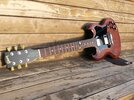
Gibson Les Paul Fretboard Replacement

Fretboard dyeing is very common. Do you kill a 300 year old tree to get 8 pure black fingerboards from or do you take a younger, smaller tree and dye the equal quality miscoloured wood and get 50 high quality fingerboards?

Me... I waste no part of the Buffalo!

Or, to ask a different, but similar question: Do you chop down 10 - 20 trees looking for that perfectly black ebony, and waste the remaining 9-19 trees because they were brown, instead of black?

Believe it or not, that is what really happens. That practice is changing, thanks to folks like Bob Taylor, but it used to be the norm.
 
Big-Leaf-Mahogany.-392x230.jpeg

We are losing upwards of 80,000 acres of tropical rain forest daily, and significantly degrading another 80,000 acres every day on top of that.
 
Or Gibson tells you they use Rosewood, but it actually appears to be something else....

View attachment 4033

That may actually be rosewood. It stands to reason that if manufacturers are beginning to use ebony that they used to reject, such as examples with streaks, that they may be doing the same thing with rosewood. I don't know that for sure, but it seems reasonable to me.

At any rate, I think we as guitar players will need to learn to accept that grain and color variations in fretboards will become more and more normal. I can see the day when we "ooh" and "ahh" over the natural figuring in the fretboard as well as the body. That won't really be bad thing.
 
As a guy who worked with wood his whole adult life for a living, I actually enjoy seeing the uniqueness of the fretboards with "character"
If one wants plain old "even" grain all over with little variation then shop for and buy the guitars that are built that way. If one likes "character" as I do, at least by makers like Gibson offer guitars that also have streaks, dark and light patches etc in the fingerboards so we have a choice to buy them as well. In the end, I think we all would agree that feel, playability, reliability of electronics and ultimately good sounding music is what really matters the most.
 
No issues there. I see your points. The Luthier looked as this Gibson SG and said he suspected the fretboard wasn't rosewood, but some other wood, the name I cannot remember, but started with a "G" as I recall...

It's very hard wood...
 
Granadillo ( Link posted below)
vvvvvvvvvvvv
Know Your Fingerboards

PS. THIS IS FOR WAV to answer.
Why do links not show up as links but instead as words? When they are words, I might not know to click on it to make it even go where the link will open and tell me anything?

Has this always been this way or am I imagining it didn't always convert a link to words?
 
Granadillo ( Link posted below)
vvvvvvvvvvvv
Know Your Fingerboards

PS. THIS IS FOR WAV to answer.
Why do links not show up as links but instead as words? When they are words, I might not know to click on it to make it even go where the link will open and tell me anything?

Has this always been this way or am I imagining it didn't always convert a link to words?

They are yellow words. Normal text is white
 
That may actually be rosewood. It stands to reason that if manufacturers are beginning to use ebony that they used to reject, such as examples with streaks, that they may be doing the same thing with rosewood. I don't know that for sure, but it seems reasonable to me.

At any rate, I think we as guitar players will need to learn to accept that grain and color variations in fretboards will become more and more normal. I can see the day when we "ooh" and "ahh" over the natural figuring in the fretboard as well as the body. That won't really be bad thing.
Granadillo.
Granadillo ( Link posted below)
vvvvvvvvvvvv
Know Your Fingerboards

Excellent! Thanks for the clarification/correction, guys!
 
Back
Top