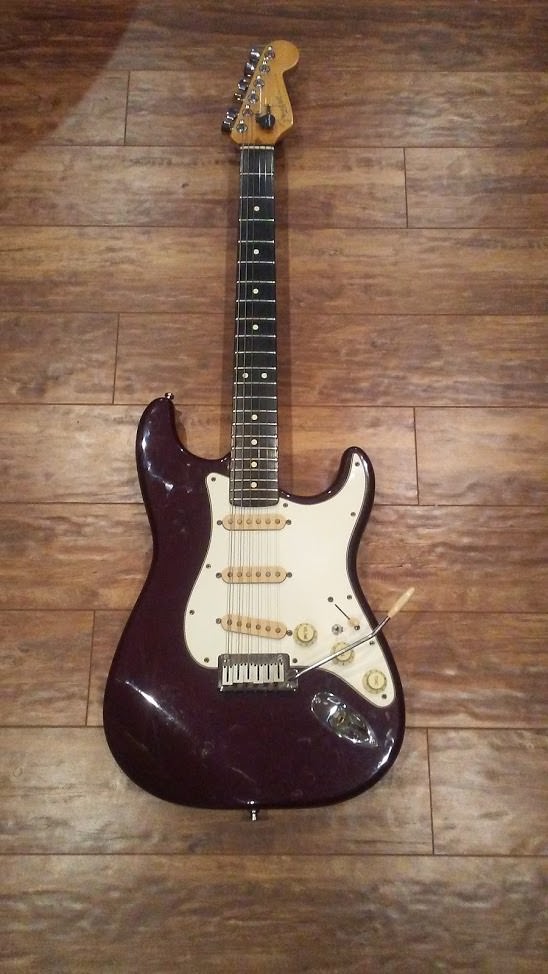
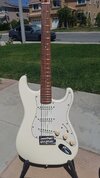
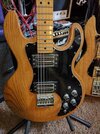
Here are my thoughts I posted in the other forum/thread to which Sergio is referring.
To set the context, my comments weren’t posted as a rebuttal or argument. I did not feel things were antagonistic or confrontational toward me on the other poster’s part, either. The poster merely posted some things he felt were design flaws. In fact, I see his point in some cases.
Specifically, he cited the following:
He felt it was a flaw for Fender to only offer a 3-Way switch in Strats and not change to a 5-way until about 20 years later.
He felt it is a flaw that the bridge pickup has no tone control.
He cited how the volume knob and switch get in the way of strumming.
He felt it is a flaw that the neck and bridge pickups cannot both be selected at the same time.
He felt the vibrato could not be kept in tune unless it is decked.
He claimed the Trem system “eats” nuts.
He noted how the bridge digs into your hand.
He believed the output jack cannot be used with a 90 plug.
Sooo....here’s what I said...
“Lots of interesting observations. No hate from me. I don't believe in getting mad at someone over something like preferences in guitars! Life's too short and there's too much music to enjoy.
But, I will offer a few thoughts...
First, I think it's worth noting that Leo Fender did not develop the Stratocaster in a vacuum. Some artists of the day had input into it's design, so it is a bit of a collaborative effort with musicians. I think some perceived design "flaws" from our vantage point of historical hind-sight are more a matter of features and capabilities that were simply not anticipated by Fender or the contributing artists.
Second, I draw a distinction between design "flaws" and design "progression". A flaw would be some problem that prevented the device from performing its intended function. A progression would be some new capability or feature.
So, let me dive in...
1. The 3-way switch.
To me, this is design progression. The original 3-way performed it's desired function. However, the 5-way was developed to accommodate the habits of some to use the "in-between" position for added "quack". You have a point about it taking 20 years to use the 5-way switch, though. Incidentally, not all Strat players consider the 5-way switch to be an improvement. Some Strat players actually don't like the "in-between" position and the resultant sounds and swap the 5-Way for a 3-way.
2. Why doesn't the bridge have a tone control?
This, to me, is borderline between the concept of a flaw and progress. My Strat has a bridge tone from the factory. It is wired so that if I select any combination with the bridge pickup, the lower tone knob controls the bridge tone. This is a development by Fender. Fender has also developed the S1 switching system to address even more tonal options. So, I do get your observation and don't entirely disagree. It seems to me this would be something they'd have done from the start, too. Though, I think it's only fair to point out that Fender has developed solutions that progress beyond the original design to meet some customer wishes.
3. Volume knob and switch in the way of strumming.
This certainly can happen and many do have this complaint! But, this isn't so much a design flaw as it is a matter of technique and personal playing style. I've read statements before of people having the same complaint about the Les Paul switch position because of the same thing - getting in the way of strumming. A lot has to do with personal physiology and how a person's arm naturally flows when strumming. This isn't to say those who have the issue are playing "wrong". But, I don't have the issue. I made the comment earlier that I really like an ES-335 style of guitar. It feels very natural and instinctive to me. Others can't stand it.
4. No neck and bridge pickup.
Fender did address this with the S1 switching system, which allows even more options. So, no. It wasn't part of the original design, but Fender did address customers' needs, based on the myriad custom wiring schemes that people have developed over the years. Interestingly, not all Fender fans like the S1 and it only appears on premium-level guitars. There again, I wouldn't call this fixing a "flaw" as much I'd call it a new feature set.
4. Vibrato.
I set mine up to be a full floating system - I don't deck it. Mine stays in tune pretty well. It's stable enough to use during performance without worry. However, I observe a few procedures similar to a Bigsby. I lubricate the nut with graphite. I make sure the strings are stretched out. I also installed locking tuners. I find locking tuners to be better than the self-lock stringing method when using vibratos. The locking tuners went a long way toward improving the stability. I also use a wound-third string and I don't run my strings under the string tree. In one sense I do see the point about thinking the vibrato may be flawed, but I improved my overall stability not by doing anything to the trem, itself, but by addressing other areas. So, I'm not averse to admitting there is some flaw somewhere, though I can't say it's strictly with the trem. My personal sense is that the development of new products since 1954, like locking tuners, actually make the trem more usable now than when it was first released.
5. Trem system that eats nuts.
No comment. I've not experienced this. It wouldn't be the fault of the trem as much as the nut.
6. Bridge Design that cuts your hand.
Originally, Strats had a cover over the bridge, similar to the Telecaster ash tray. The protruding allen head screws were not anticipated to be an issue, since the whole affair was under a cover. However, people soon started taking the cover off, as they did with the Tele. However, the modern cast saddles are smooth and don't dig into your palm at all. They are more comfortable than even a Gibson bridge. However, it did take a very long time for Fender to come out with these. So, I would share a bit of a complaint there. Nevertheless, keep in mind that Fender has its purist crowd, too. So, some of the time it's taken to implement new features may be partly a function of not displeasing them. I don't know...but it seems a possible scenario.
7. Output jack doesn't allow for 90 degree plug.
This isn't true. I've done it. It does look a little odd, but you can do it. Personally, if this is to be considered a design flaw, I'd fault the SG worse. The simple, front-facing jack requires use of a 90 degree plug if you have a Maestro or Bigsby and want to swing the arm back. A straight plug interferes with that. There were a few versions of SGs made in the '80s and the new 2018 SG HP guitars which have a side-mounted jack, which I much prefer.
Anyhoo...bottom line is that I don't entirely disagree that some Strat elements do (or did) have some shortcomings, but other items don't really strike me as "flaws", per se.”