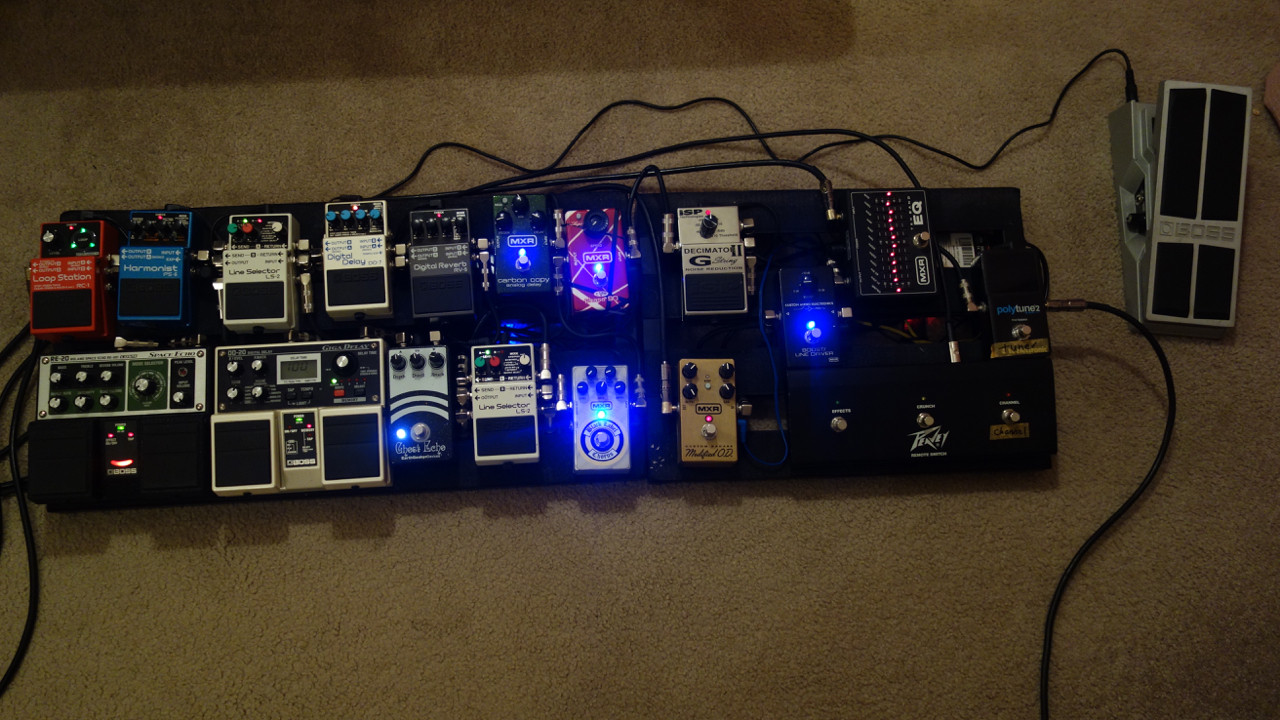
For Mr Grumpy: my current pedalboard configuration

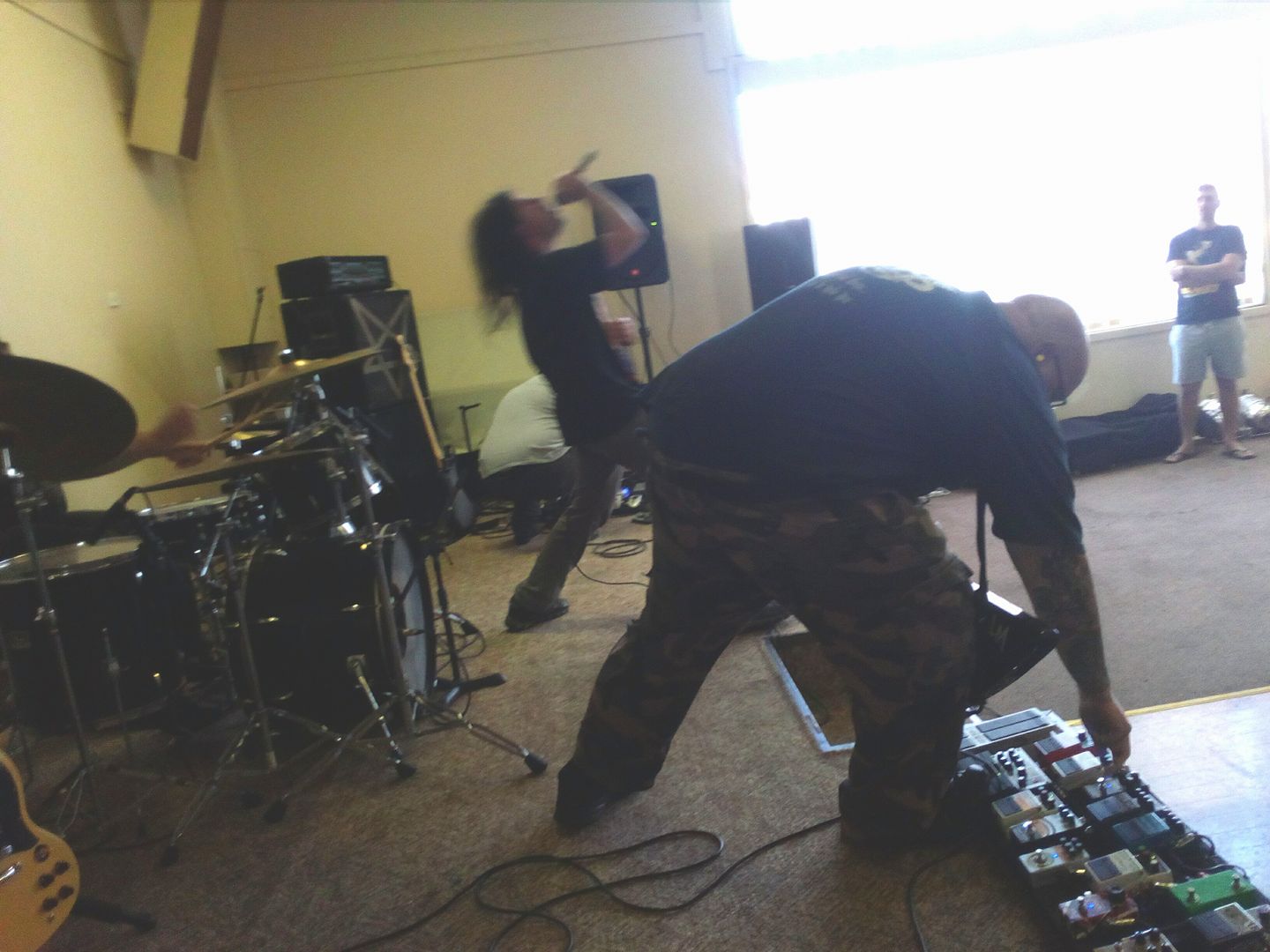
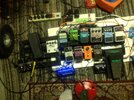
Somehow a friend managed to get this photo yesterday (at Metal United Down Under, Port Pirie) without seeing my butt crack as I reached down for the knobs on my MXR Carbon Copy

ax0b6B7.jpg
 
For your entertainment.

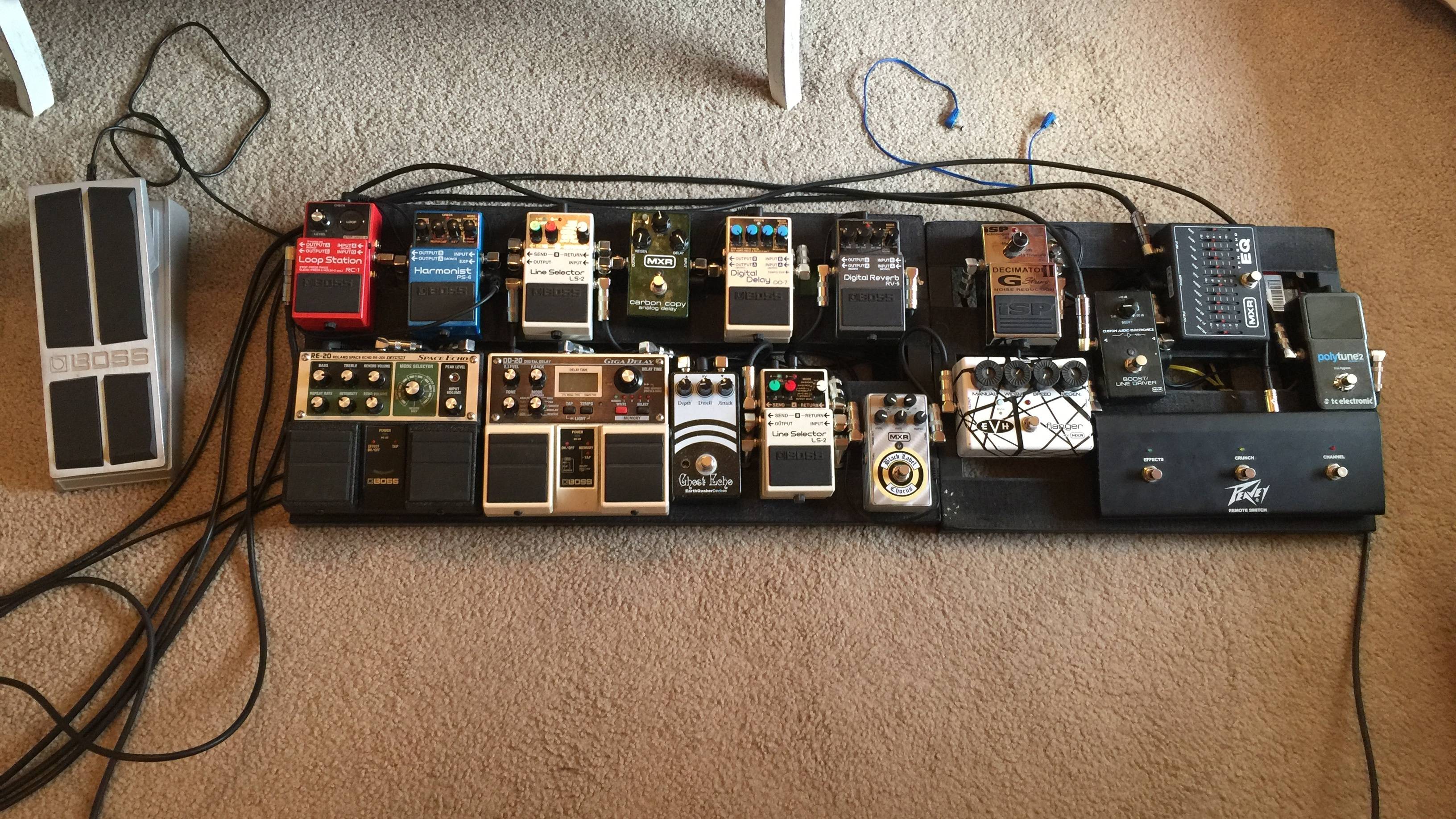
I acquired a Boss DD-20 Gigadelay at the Port Pirie show above in a trade (got rid of a Trace Elliot Super Tramp combo) so I had to restructure my second board. Luckily the guy I had been discussing the trade with on Facebook was in one of the other bands on the bill, so that made it easy!

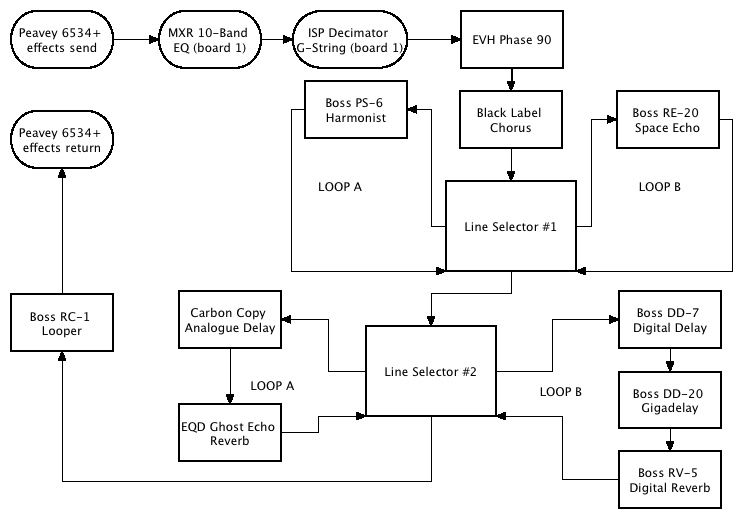
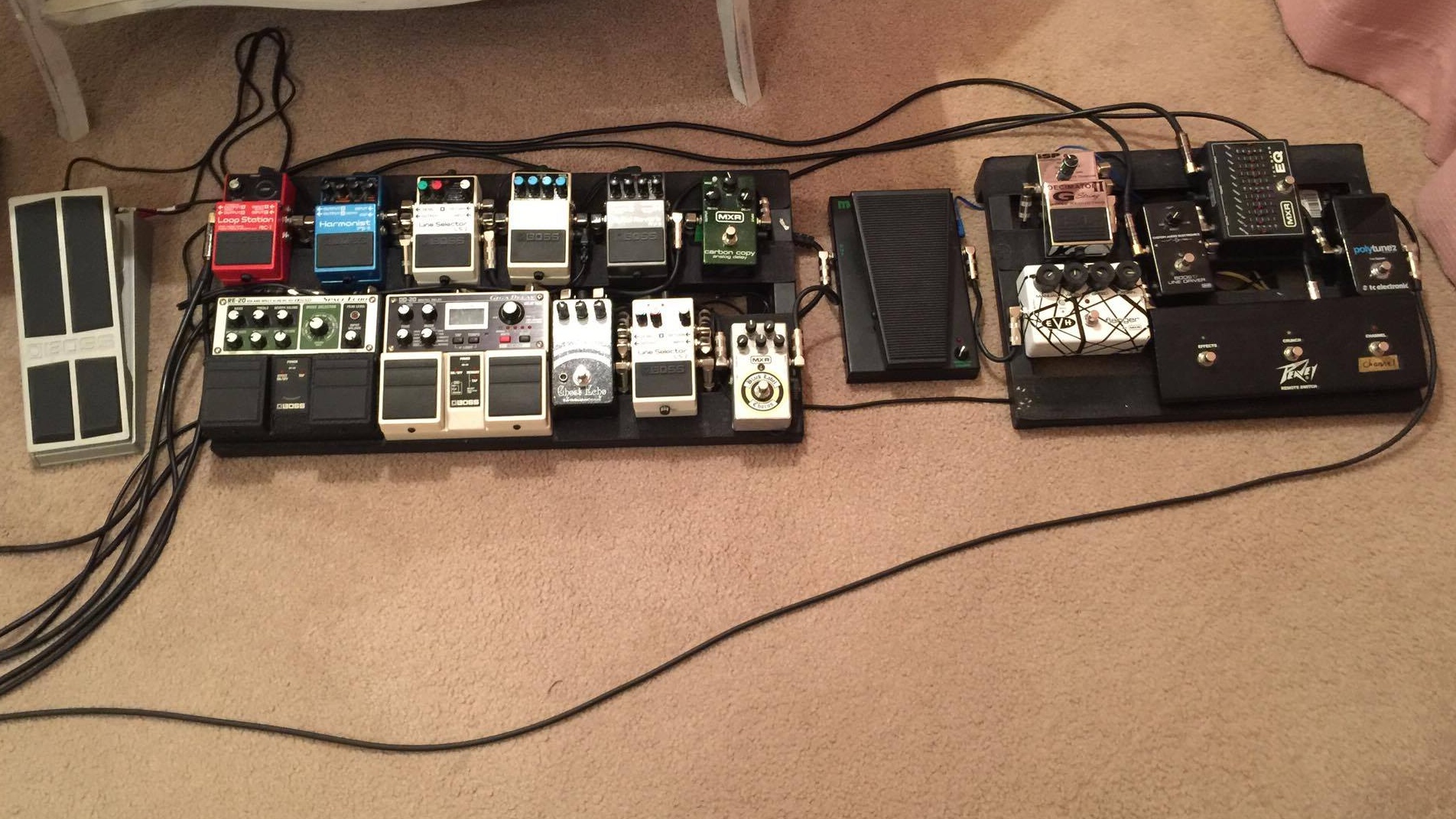
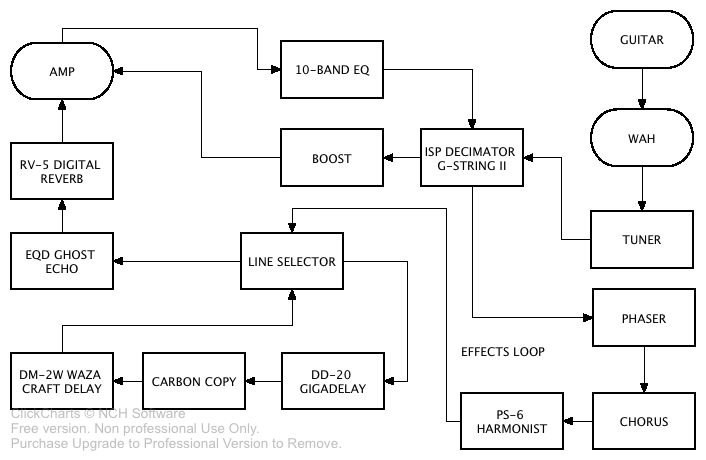
Well I got my second pedal board back together tonight, and I haven't had a chance to play through it yet due to the late hour, but I have taken a photo of my setup now and constructed a diagram of the signal chain of my effects loop! A couple of things can be seen in the diagram. First the relatively short signal path when bypass is engaged on each of the two Boss LS-2 Line Selectors. Second, that the RE-20 Space Echo and PS-6 Harmonist are in separate loops on the first LS-2, and that by moving the selector I can engage various loops, connect them in series (A->B) or mix them (A+B). The second LS-2 also has two loops, which provide separate rhythm and lead tones, plus a bypass, which can be combined in various ways. I can of course turn specific pedals within loops on or off. I doubt that I would run the DD-7 and DD-20 together, for example, but they would have different settings, e.g., Reverse on the DD-7 and Warp on the DD-20. The Phaser and Chorus precede the LS-2s and are shared, as is the RC-1 at the end. It is also possible to combine the two LS-2s in various ways, e.g. Loop A on #1 with either Loop A or Loop B on #2, a mix of A+B on #1 with either loop on #2, etc.
9LXPyZ8.jpg


I've got a guitar cable with right-angle connectors at each end on the way from an eBay seller to deal with that annoying problem of the cable sticking straight out of the input on the Polytune Blacklight

V9K4Uck.png


The Boss FV-500L expression pedal is connected to the PS-6

The signal chain of the front end is very simple. It runs from the guitar through the Polytune then through the GUITAR IN/OUT of the ISP Technologies Decimator G-String II, then through the MC401 Boost/Linedriver and M77 Custom Badass Modified O.D. to the input jack of my Peavey 6534+
 
For your entertainment.

I acquired a Boss DD-20 Gigadelay at the Port Pirie show above in a trade (got rid of a Trace Elliot Super Tramp combo) so I had to restructure my second board. Luckily the guy I had been discussing the trade with on Facebook was in one of the other bands on the bill, so that made it easy!

Well I got my second pedal board back together tonight, and I haven't had a chance to play through it yet due to the late hour, but I have taken a photo of my setup now and constructed a diagram of the signal chain of my effects loop! A couple of things can be seen in the diagram. First the relatively short signal path when bypass is engaged on each of the two Boss LS-2 Line Selectors. Second, that the RE-20 Space Echo and PS-6 Harmonist are in separate loops on the first LS-2, and that by moving the selector I can engage various loops, connect them in series (A->B) or mix them (A+B). The second LS-2 also has two loops, which provide separate rhythm and lead tones, plus a bypass, which can be combined in various ways. I can of course turn specific pedals within loops on or off. I doubt that I would run the DD-7 and DD-20 together, for example, but they would have different settings, e.g., Reverse on the DD-7 and Warp on the DD-20. The Phaser and Chorus precede the LS-2s and are shared, as is the RC-1 at the end. It is also possible to combine the two LS-2s in various ways, e.g. Loop A on #1 with either Loop A or Loop B on #2, a mix of A+B on #1 with either loop on #2, etc.

9LXPyZ8.jpg


I've got a guitar cable with right-angle connectors at each end on the way from an eBay seller to deal with that annoying problem of the cable sticking straight out of the input on the Polytune Blacklight

V9K4Uck.png


The Boss FV-500L expression pedal is connected to the PS-6

The signal chain of the front end is very simple. It runs from the guitar through the Polytune then through the GUITAR IN/OUT of the ISP Technologies Decimator G-String II, then through the MC401 Boost/Linedriver and M77 Custom Badass Modified O.D. to the input jack of my Peavey 6534+

Now I know why my porchlight in California dims sometimes.
 
Setting on LS-2 #1 will generally be A/B/BYPASS and the same for LS-2 #2, but for the outro I will probably change the settings to either A->B/Bypass (series) or A+B/Bypass (mix) so that I can use all of my effects and make a massive noise

Generally though LS-2 #1 will only be used for intros and outros while LS-2 #2 will function like a rhythm/lead switch, although on one cover song we do we will actually go BYPASS->RHYTHM (A/green) -> LEAD (B/red) -> RHYTHM (A/green), skipping through bypass really quickly when I change from B to A.
 
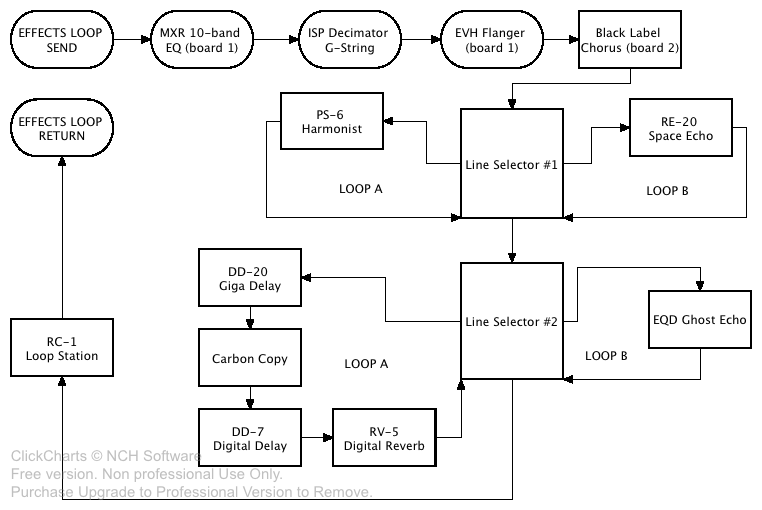
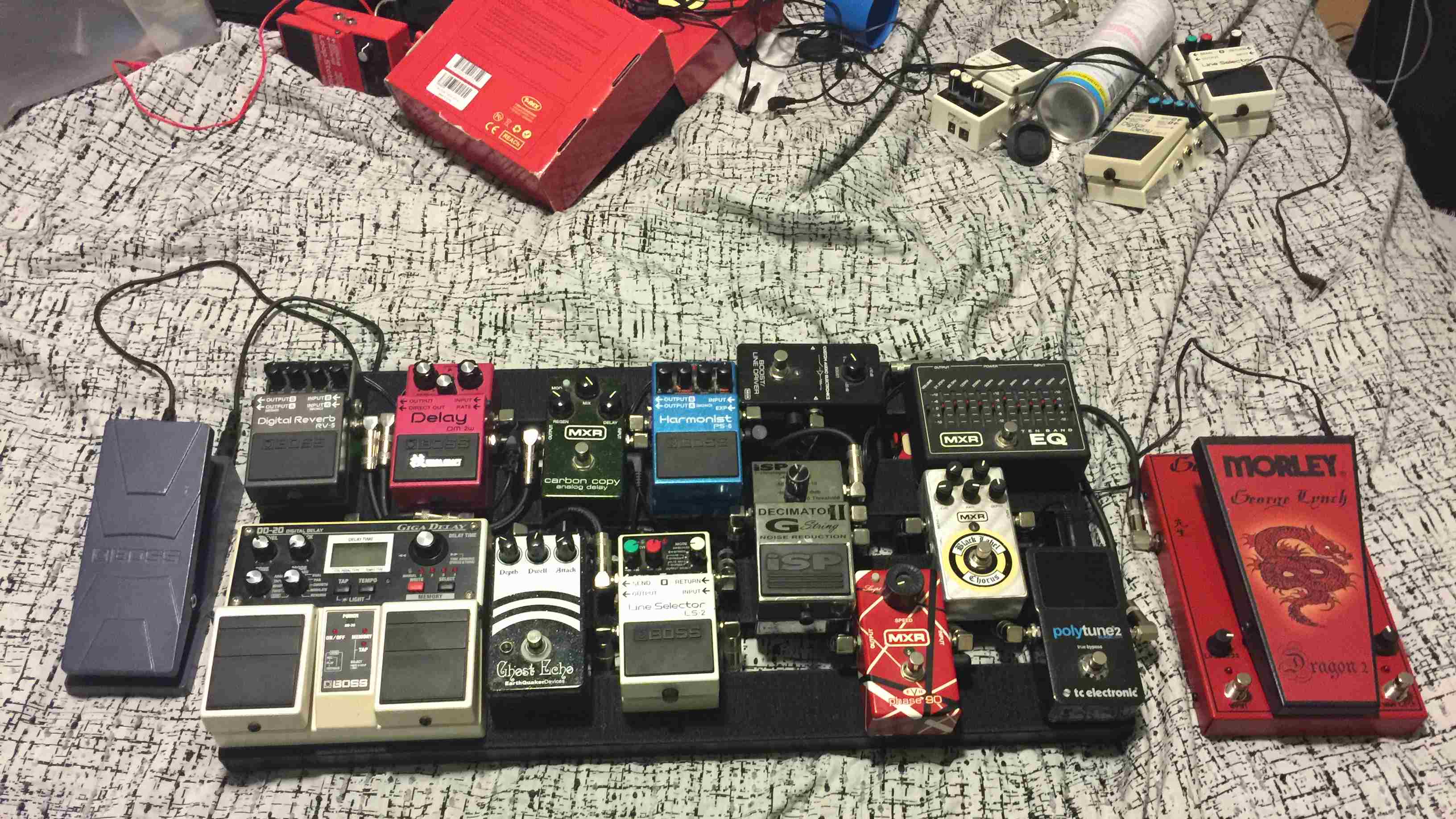
I haven't had a chance to test this, but I figured you'd get a laugh out of it. Didn't bother with another one of those schematics. It's basically the same except the EVH Flanger has replaced the EVH Phase 90 when I took the overdrive off the small board. The Morley volume pedal is between the flanger and the chorus. The other pedal is set up as a double expression pedal for the DD-7 and the RE-20, not sure if that will even work.

yphGK1U.jpg
 
I rejigged my board. Moved my lead pedals to Loop A of the second LS-2 because that seems to flow better. Also moved the Carbon Copy into that loop as delay wasn't very useful on my rhythm sound. The EVH Phase 90 has been replaced with an EVH Flanger. If I use the Morley volume pedal that goes between the EVH Flanger and the Black Label Chorus. I only use one delay at a time so it doesn't matter what order they are in.

Bf46G5x.png
 
IMG_5663.JPG FKeeping the color pedals before the overdrive and Fuzz is the only rule I keep on seeing. Then finding the best place to get that pedal to do what it should is the trick. Be true to yourself and realize some pedals just ain't for you. I have a stack on the side lines that won't do what they say.
The Echoplex needs to be in the front of the amp. Every thing else is fine in the loop. I only gig with three or five pedals. I like all if I am recording playing for fun.
 
The drive pedals never last on my board. The phaser and flanger seem to switch places. Depending on how much room I have really. I generally prefer the flanger but if space is tight I make do with the phaser. My favourite effects are reverb, delay, and chorus. I get a lot of drive from my amp

Here's a photo of my board at present:

j86QRhz.jpg
 
Yeah, when you have a gain heavy amp then gain pedals are of limited use. When I had the little 1 watt baby Randall I tried main gain/OD pedals and none of them sound as good as the amp with the gain up.
 
Here's a video of me using the board with the Morley Little Alligator. I am planning to mod the Morley as its sweep is a bit weird

 
Last edited:
I am downsizing my board to just the PT-2 as that will help me avoid dramas like those I experienced this week with broken connections.

The more connections you have, the more potential points of failure.
 
Here's the simpler configuration. Hopefully it doesn't let me down live. I only use the channel selector once in the whole set so I am going to leave the footswitch home and just use the button on the head when the intro finishes. I also didn't use the looper much. The 10-band EQ and boost pedal run off the 18V outlet on the Fuel Tank Chameleon. The MXR phaser, chorus, and delay are daisy-chained from one outlet on the Chameleon as they have been fine with that before. The LS-2 runs from an outlet on the Chameleon and also powers the RV-5. The PS-6 and DD-20 have their own outlets on the Chameleon. The rest of them - the Waza Craft delay, the Ghost Echo, the tuner, the ISP Decimator G-String II, and the Morley wah all have individual outlets on the Fuel Tank Junior power supply. The EV-30 is passive and operates the DM-2W and PS-6 simultaneously.

hqtdclU.jpg


5Avc80B.png
 
Last edited:
Here's the simpler configuration. Hopefully it doesn't let me down live. I only use the channel selector once in the whole set so I am going to leave the footswitch home and just use the button on the head when the intro finishes. I also didn't use the looper much. The 10-band EQ and boost pedal run off the 18V outlet on the Fuel Tank Chameleon. The MXR phaser, chorus, and delay are daisy-chained from one outlet on the Chameleon as they have been fine with that before. The LS-2 runs from an outlet on the Chameleon and also powers the RV-5. The PS-6 and DD-20 have their own outlets on the Chameleon. The rest of them - the Waza Craft delay, the Ghost Echo, the tuner, the ISP Decimator G-String II, and the Morley wah all have individual outlets on the Fuel Tank Junior power supply. The EV-30 is passive and operates the DM-2W and PS-6 simultaneously.

hqtdclU.jpg


5Avc80B.png

Damn, man. Soon you'll need a map and compass to figure out how to connect things...:D
 
It's not that hard actually. The issue was more just the number of connections making it extremely difficult to troubleshoot when something went wrong.

When I want to play a lead part I just hit the line selector, which is only one loop now. Before I had two line selectors running two loops each.

You set the volume level for the line selector by turning the green knob. This adjusts the volume boost for leads.

The line selector has all of the delays on it, so you can set up the delays between songs or while playing an other part and then kick in the sound when you need it with one switch. I can run the delays in various combinations. I might put the Carbon Copy ahead of the DD-20 yet, so that I have the choice of analog->digital, digital->analog, or analog->digital-> analog if I want to stack delays.

Most of the time the Ghost Echo is on. I turn it off for some faster palm-muted passages. The RV-5 is really there mainly to give a point that's easy to hook up the return cable, but I might use it for an intro with the DD-20 in tape mode now that the Space Echo is off my board. The pitch-shifter is mainly operated through the expression pedal. I will have to be more mindful of its settings now that it is not isolated in its own loop. I will have to move it out of S-Bend mode if I don't want it to activate when I am using the same expression pedal for the Waza delay. There is always a cost in terms of control when you simplify. We have a new vocalist now. Hopefully he doesn't flip over my expression pedal like the previous one. I might reverse the polarity on it though just in case. That way then the toe is down the pedal is off, when it is up it is fully on. The problem was that he would hook his microphone cable in the open jaws and then flip it, activating the pedal as it would depress slightly.
 
BKP Nailbomb (in the Explorer): 15.7 kΩ
BKP Warpig (in the SG): 21.5 kΩ

Here's a video of me using the delays, flanger, and pitch-shifter on my board with the Explorer tonight to create some Venom style sonic idiocy

Bit of a weird camera angle ... I look like a demented Quasimodo humping someone's leg! :barefoot:


FOOK!
 
Back
Top