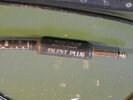
Fender "quality" guitar cable

bea

AmBASSador of the F Clef
Country flag
... found that in our wastebin. From the guys who share the rehearsal room with us. Well, actually a trivial and common problem and, of course, easy to fix.

Aside from demonstrating why every guitar ad bass player should be able to use a soldering iron it gives a clear impression of the "quality" of the Fender cable which is almost completely lacking:
Under a very thick (and protective) coat of rubber a really thin shield - just a few thin wires - and an accordingly thin central lead. Bending "protection" just by a heat shrinking tube and that not even applied carefully. No better than those 5€ cables from Thomann.
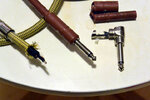
DSC_4173.JPG
 
surprise 90° Neutrik SilentPlug
those are always surprises, not only the 90° ones.
The main reason is that the plugs are a little bit thinner than the standard defines - just about 0.1 mm. But that is enough for frequent contact problems, especially in active instruments where stereo sockets are used to switch the power. I use them but i always have a spare non-silent plug cable at hand.

There is actually a cheaper version of the silent plugs with a smaller ring and correct thickness. Also Neutrik. I have one cable supplied with it but do not find a source to buy those plugs.

I use this cable with my practice setup (a mixing console attached to the computer). Here a pic:

DSC_4174.JPG
 
Last edited:
Gone are the days of twisty cords, twisting broken wires together and using any ole tape you could get your hands on, and banging on the top of your amp saying something along the lines of 'come one $*)*($%&(*)$%&@#_$(_$#@#(, work already'. Oh, and wrapping your broken strings around a safety pin loop so you could keep using the string (providing it broke off on the bridge end). I'm sure I'm not the only one who's old enough and was poor enough in their younger days to know what I'm talking about - lol. So, the secret of why do you just wind your strings up in a loop at the headstock instead of cutting them off - why, in case the string breaks at the right end of course - well, and better radio reception. I wonder how many bass players boil their strings two or three times to make them last longer now days - lol. Oh the memories. Ok, I'm done rambling now...
 
those are always surprises, not only the 90° ones.
The main reason is that the plugs are a little bit thinner than the standard defines - just about 0.1 mm. But that is enough for frequent contact problems, especially in active instruments where stereo sockets are used to switch the power. I use them but i always have a spare non-silent plug cable at hand.

There is actually a cheaper version of the silent plugs with a smaller ring and correct thickness. Also Neutrik. I have one cable supplied with it but do not find a source to buy those plugs.

I use this cable with my practice setup (a mixing console attached to the computer). Here a pic:

View attachment 32599


I have been fortunate with mine, although it is used primarily for electric guitar. I do use it for bass occasionally, but three out of five are passive basses here. I had read of this problem, and forgot until your reminder. I also have read of alignment issues with the sleeve if the tip gets bent at all. :)
Since he is a bassist with active basses, I my just find a good quality 90° cable end around here...I’m sure I have a few.
 
I learned how to solder by fixing old cables. I cleaned them up, resoldered, and shrink wrapped under and over the barrel.

My soldering started when I bought an Ampeg SVT 350H bass head with a broken off tab on a slider for the EQ. I was blessed to have gone to visit a friend who was partnering with Dave Barber of Barber Pedal fame as some circuit board soldering was being done. By seeing how the boards had holes that the component leads pass through and get soldered, taught me what I needed to know for disassembly and installation of the new slider. Of course it wasn't until later did I learn of solder suckers and other aids for this job.

In addition, my friend who I fixed his EPI Dot headstock, showed me about "tinning" as we fixed a pot on one of his Strats and this began my basic soldering lessons.
 
Last edited:
Oh yeah and back to the funniest part of the SVT repair. I got the part and took it out of the package and realized I was in for a bigger job than anticipated. It was then and when I opened up the amp, that I would see it required the SOLDERING/Desoldering I wasn't expecting. HA, my dumbazz thought it was going to be some plug n play component like I was so used to in auto repairs.
 
I've been using Pro Co cable for years and never had a problem with them. The most problematic cables I've had are Monster Cables with the sealed tip..... impossible to fix.
 
I will have none of those under my roof. Some think that Gibson has been engaged in some poor behavior recently....they have not even come close to the depths of that cable company.
Mostly CBI, ProCo, Belden, and Mogami here....anything but that other company.

They are evil (Monster).

Mostly George L's for me, but I have an old Fender-branded Whirlwind that is just awesome and of all things a D'Addario cable that is super-sturdy and sounds great.
 
Back
Top