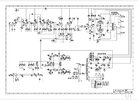
I saw this conversation online and decided to post some of it here, so that our great resident amp gurus can comment.
This discussion was about how and why Engls' seem to produce so much gain:
"There is one thing in the ENGL amps that I noticed and implemented in my GXT100 mods:
They use a 330k anode resistor and a 3.3k cathode at about 350v I think.
My goal is to figure out how many fet or mosfet stages one would need to cascade to achieve a similar distortion quality and compression.
I am assuming something like the Shaka express clipping stages with perhaps one or two more or a pair of bs170 BOR/SHO type at the tail might get close. I realize that 4 or 5 fets is
considered a limit due to noise and I'm thinking lower gained stages would be the way to go.
What exactly is going on with that tube arrangement with regard to level and clipping?
The playability is really nice even at lower gain settings, harmonic heaven and dynamic.
The other side of my crate has the Boogie Mark 2 type config stock and with a touch of eq it does a pretty good Mark series. I tried that with od channel with same result before I changed it
to the desired ENGL config.
Now I want it on the floor in a pedal.
The crate od tube is driven by an clean opamp section and still achieves a damn good Engl sound.
I'm pretty sure figuring this out is the key."
Reply:
"
You could plot the loadline but overall I think what is "going on" is just carefully applied equalisation pre/post/within distorting gain stages.
I don't think you get a magic formula to great tone just by selecting specific cathode and plate resistances within a single gain stage. Amplifier is always a complete circuit, not a single gain stage; everything affects everything.
Anyway, with B+ of approximately 350V the main differences between 330K/3K3 bias vs. the more generic 100K/1K5 bias is that the former has a plate DC offset much more "centered" in relation to B+ and -slightly- higher gain. The gain difference might, in practice, be negligible but the different DC operating point means that the 330K/3K3 circuit will clip quite symmetrically (resulting into dominance in odd harmonic content) while the 100K/1K5 circuit will clip in more asymmetric manner (resulting into more even order harmonic components in distortion).
The initial clipping of the 100K/1K5 circuit takes place in the positive excursion of the waveform and is somewhat compressing type because of gain modulation due to plate voltage approaching B+. At some point of enough overdrive the clipping becomes so severe that the tube simply goes into cutoff (no current flow), which results into quite "hard" clipping. In this type of circuit this happens long before negative halfwave even starts to clip.
In the 330K/3K3 circuit the clipping starts to take place simultaneously at both at positive and negative excursions (remember, the clipping of this circuit is much more symmetric). The positive halfwave clips pretty much the same way as in the previously discussed circuit (but due to lower plate DC voltage there's less gain compression before hard clipping), negative halfwave clips due to saturation and grid conduction. Since no gain modulation at all takes place at negative voltage excursions it's just straight "hard" clipping once it takes place.
In essence, the 100K/1K5 circuit is asymmetric clipping with slight distortion from gain compression at one halfwave before severe clipping starts. The 330K/3K3 circuit stays moderately "distortion free" to the point where it starts to hard clip rather symmetrically.
Overall, I don't think all this matters too much. Our ears aren't too great in perceiving fine nuances of any of this. To us it usually just sounds "distorted". It's how you apply EQ to that whole process that really defines how the distortion sounds."
Next Reply:
"I noticed that in the powerball and wondered if it was " oh , if 220k plate is good 330k will be even better! "
Hadn't got around to trying to analyze the powerball , how much low end roll off or brightness there is early in the
circuit, but it does have a clarity in the distortion [ full chords ] that I like and wanted to find out how much of the
circuit was responsible for that."
Next Reply
"Basically, what's happening with that 33k Anode -resistor/3k3 Cathode-resistor combination is that the maximum current-flow from the Cathode to the Anode is being reduced, the 330k resistor and the 3k3 resistor limits the maximum current that can flow when the triode-stage is fully conducting, since these resistors are about three times the typical "Standard" values (100k and 1k) about a third of the current can flow, now, the thing about Triode stages is that as you reduce the maximum current-flow, the voltage-gain of the Triode stage will increase, you only have to look at a set of transfer-curves for the Triode-stage to see how the voltage-gain increases, as the maximum current decreases the DC load-line gets progressively less steep, sorry if this sounds a bit technical......
 "
"
Final Reply
"I think the MK2c influenced the Bogner Snorkeler. Then the snorkeler influenced Engl. If you look at the Engl "Straight" you see the Bogner snorkeler, almost dead nuts, into something similar to a mesa coliseum PA. The snorkeler has two stages of 330k/3.3k. Then Engl replaced the second stage 330k/3.3k with a standard 100k/1.5k and moved towards what we think of as Engl today. IMO, there is something about the 330k/3.3k combo. Try it at 320V B+. That has been sort of a sweet spot in my experiments (as well as where Engl puts it in some of their designs). YMMV..."
This discussion was about how and why Engls' seem to produce so much gain:
"There is one thing in the ENGL amps that I noticed and implemented in my GXT100 mods:
They use a 330k anode resistor and a 3.3k cathode at about 350v I think.
My goal is to figure out how many fet or mosfet stages one would need to cascade to achieve a similar distortion quality and compression.
I am assuming something like the Shaka express clipping stages with perhaps one or two more or a pair of bs170 BOR/SHO type at the tail might get close. I realize that 4 or 5 fets is
considered a limit due to noise and I'm thinking lower gained stages would be the way to go.
What exactly is going on with that tube arrangement with regard to level and clipping?
The playability is really nice even at lower gain settings, harmonic heaven and dynamic.
The other side of my crate has the Boogie Mark 2 type config stock and with a touch of eq it does a pretty good Mark series. I tried that with od channel with same result before I changed it
to the desired ENGL config.
Now I want it on the floor in a pedal.
The crate od tube is driven by an clean opamp section and still achieves a damn good Engl sound.
I'm pretty sure figuring this out is the key."
Reply:
"
You could plot the loadline but overall I think what is "going on" is just carefully applied equalisation pre/post/within distorting gain stages.
I don't think you get a magic formula to great tone just by selecting specific cathode and plate resistances within a single gain stage. Amplifier is always a complete circuit, not a single gain stage; everything affects everything.
Anyway, with B+ of approximately 350V the main differences between 330K/3K3 bias vs. the more generic 100K/1K5 bias is that the former has a plate DC offset much more "centered" in relation to B+ and -slightly- higher gain. The gain difference might, in practice, be negligible but the different DC operating point means that the 330K/3K3 circuit will clip quite symmetrically (resulting into dominance in odd harmonic content) while the 100K/1K5 circuit will clip in more asymmetric manner (resulting into more even order harmonic components in distortion).
The initial clipping of the 100K/1K5 circuit takes place in the positive excursion of the waveform and is somewhat compressing type because of gain modulation due to plate voltage approaching B+. At some point of enough overdrive the clipping becomes so severe that the tube simply goes into cutoff (no current flow), which results into quite "hard" clipping. In this type of circuit this happens long before negative halfwave even starts to clip.
In the 330K/3K3 circuit the clipping starts to take place simultaneously at both at positive and negative excursions (remember, the clipping of this circuit is much more symmetric). The positive halfwave clips pretty much the same way as in the previously discussed circuit (but due to lower plate DC voltage there's less gain compression before hard clipping), negative halfwave clips due to saturation and grid conduction. Since no gain modulation at all takes place at negative voltage excursions it's just straight "hard" clipping once it takes place.
In essence, the 100K/1K5 circuit is asymmetric clipping with slight distortion from gain compression at one halfwave before severe clipping starts. The 330K/3K3 circuit stays moderately "distortion free" to the point where it starts to hard clip rather symmetrically.
Overall, I don't think all this matters too much. Our ears aren't too great in perceiving fine nuances of any of this. To us it usually just sounds "distorted". It's how you apply EQ to that whole process that really defines how the distortion sounds."
Next Reply:
"I noticed that in the powerball and wondered if it was " oh , if 220k plate is good 330k will be even better! "
Hadn't got around to trying to analyze the powerball , how much low end roll off or brightness there is early in the
circuit, but it does have a clarity in the distortion [ full chords ] that I like and wanted to find out how much of the
circuit was responsible for that."
Next Reply
"Basically, what's happening with that 33k Anode -resistor/3k3 Cathode-resistor combination is that the maximum current-flow from the Cathode to the Anode is being reduced, the 330k resistor and the 3k3 resistor limits the maximum current that can flow when the triode-stage is fully conducting, since these resistors are about three times the typical "Standard" values (100k and 1k) about a third of the current can flow, now, the thing about Triode stages is that as you reduce the maximum current-flow, the voltage-gain of the Triode stage will increase, you only have to look at a set of transfer-curves for the Triode-stage to see how the voltage-gain increases, as the maximum current decreases the DC load-line gets progressively less steep, sorry if this sounds a bit technical......
Final Reply
"I think the MK2c influenced the Bogner Snorkeler. Then the snorkeler influenced Engl. If you look at the Engl "Straight" you see the Bogner snorkeler, almost dead nuts, into something similar to a mesa coliseum PA. The snorkeler has two stages of 330k/3.3k. Then Engl replaced the second stage 330k/3.3k with a standard 100k/1.5k and moved towards what we think of as Engl today. IMO, there is something about the 330k/3.3k combo. Try it at 320V B+. That has been sort of a sweet spot in my experiments (as well as where Engl puts it in some of their designs). YMMV..."