DSL40C Surprise:

But a SS power section AVT 50 watt should not bury it..
A JCM 800 2203 100 watt thru a 4x12 shouid ultimately kill a DSL40 if volume is up enough. Depends on speakers tho etc
I had one many years ago. Would kill many PA systems. I also had a DSL40C. Great little amp.

In 2015, I sold my 1959T (actually a 1968 model) and Marshall #1990 8x10 cabinet. The amp had an extra gain stage added by Tim Caswell (signed by him inside the chassis) and it had a push/pull pot that activated a boost feature. The tremolo circuit was removed to make room for the extra gain stage and the amp had a FX loop. I owned a GMC Suburban just to move it around. It had 6550 tubes, IIRC. I was offered an insane amount of money for it, sold it and ever since, I've been downsizing.

Honestly, I don't miss it. It was a PITA and only sounded good at deafening volumes.
 
By comparison, a 40w like the DSL40C is fairly on par in terms of volume as a 50w amp. Not a great deal of volume difference.

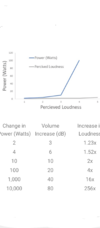
For whatever it is worth: there is not much perceived "loudness" between a 50w and a 100w either. A 100w is not twice as loud as a 50w. Quite the contrary, its only about 3dB on a normal day, which is very loud to our ears. I know this sounds COMPLETELY stupid but allow me to explain:

It takes 10x the amount of wattage to double the "loudness" humans would regularly hear. So if you want double the total volume of a 50w? Its gonna take 500w.
Here's a chart to help explain

Screenshots_2022-01-01-19-11-47.png

Its quite believable that a 40w DSL kept up with or even possibly exceeded the Carvin 100w by a couple factors:

The Carvin full stack is dissipating its 100w capability across 8 12" speakers. That's really only giving a maximum of 12.5w per speaker, so even if they were 25w Greenbacks, they are operating at about 50% of their total capability. If they were something more standard like 65-75w speakers, now they are operating far less, about 1/5th of their capability.

Meanwhile the DSL40C

The DSL40C however was operating a single 75w speaker as you mentioned. So it was pushed around 53% of its capability.

All of this seems stupid still right? Well remember: you were in a small space and you still can only hear what your ears perceive by your surroundings. If this was outside in the open, the full stack Carvin would carry WAY farther than the DSL40C, which IS the reason stacks were invented in the first place: casting out to the crowd before PAs were really worth much more than just letting the singer be heard. But you were within a small area and distance doesnt play a factor: you're hearing it right in your face and having it bounced back at you immediately.

Hope this helps? Lol
 
By comparison, a 40w like the DSL40C is fairly on par in terms of volume as a 50w amp. Not a great deal of volume difference.

For whatever it is worth: there is not much perceived "loudness" between a 50w and a 100w either. A 100w is not twice as loud as a 50w. Quite the contrary, its only about 3dB on a normal day, which is very loud to our ears. I know this sounds COMPLETELY stupid but allow me to explain:

It takes 10x the amount of wattage to double the "loudness" humans would regularly hear. So if you want double the total volume of a 50w? Its gonna take 500w.
Here's a chart to help explain

View attachment 78234

Its quite believable that a 40w DSL kept up with or even possibly exceeded the Carvin 100w by a couple factors:

The Carvin full stack is dissipating its 100w capability across 8 12" speakers. That's really only giving a maximum of 12.5w per speaker, so even if they were 25w Greenbacks, they are operating at about 50% of their total capability. If they were something more standard like 65-75w speakers, now they are operating far less, about 1/5th of their capability.

Meanwhile the DSL40C

The DSL40C however was operating a single 75w speaker as you mentioned. So it was pushed around 53% of its capability.

All of this seems stupid still right? Well remember: you were in a small space and you still can only hear what your ears perceive by your surroundings. If this was outside in the open, the full stack Carvin would carry WAY farther than the DSL40C, which IS the reason stacks were invented in the first place: casting out to the crowd before PAs were really worth much more than just letting the singer be heard. But you were within a small area and distance doesnt play a factor: you're hearing it right in your face and having it bounced back at you immediately.

Hope this helps? Lol

Super interesting explanation!!!!!
 
By comparison, a 40w like the DSL40C is fairly on par in terms of volume as a 50w amp. Not a great deal of volume difference.

For whatever it is worth: there is not much perceived "loudness" between a 50w and a 100w either. A 100w is not twice as loud as a 50w. Quite the contrary, its only about 3dB on a normal day, which is very loud to our ears. I know this sounds COMPLETELY stupid but allow me to explain:

It takes 10x the amount of wattage to double the "loudness" humans would regularly hear. So if you want double the total volume of a 50w? Its gonna take 500w.
Here's a chart to help explain

View attachment 78234

Its quite believable that a 40w DSL kept up with or even possibly exceeded the Carvin 100w by a couple factors:

The Carvin full stack is dissipating its 100w capability across 8 12" speakers. That's really only giving a maximum of 12.5w per speaker, so even if they were 25w Greenbacks, they are operating at about 50% of their total capability. If they were something more standard like 65-75w speakers, now they are operating far less, about 1/5th of their capability.

Meanwhile the DSL40C

The DSL40C however was operating a single 75w speaker as you mentioned. So it was pushed around 53% of its capability.

All of this seems stupid still right? Well remember: you were in a small space and you still can only hear what your ears perceive by your surroundings. If this was outside in the open, the full stack Carvin would carry WAY farther than the DSL40C, which IS the reason stacks were invented in the first place: casting out to the crowd before PAs were really worth much more than just letting the singer be heard. But you were within a small area and distance doesnt play a factor: you're hearing it right in your face and having it bounced back at you immediately.

Hope this helps? Lol

Tell you something...

One of my producer friends stopped by today to pick up their Christmas gift and he asked about the 8200. Ok, I know I'm just a geek with a 28 year old Valvestate, but I'm genuinely impressed with these amps. Anyways, I cranked it up and he was floored at how loud it was at a relatively low volume knob setting. When this guy speaks, I always listen. He's got a Dumbledore Overdrive Special and several other boutique amps, so his opinion carries a lot of weight with me. He also commented on the chorus, "Oh, wow, that's a fuller, richer chorus than my JC-120
 
By comparison, a 40w like the DSL40C is fairly on par in terms of volume as a 50w amp. Not a great deal of volume difference.

For whatever it is worth: there is not much perceived "loudness" between a 50w and a 100w either. A 100w is not twice as loud as a 50w. Quite the contrary, its only about 3dB on a normal day, which is very loud to our ears. I know this sounds COMPLETELY stupid but allow me to explain:

It takes 10x the amount of wattage to double the "loudness" humans would regularly hear. So if you want double the total volume of a 50w? Its gonna take 500w.
Here's a chart to help explain

View attachment 78234

Its quite believable that a 40w DSL kept up with or even possibly exceeded the Carvin 100w by a couple factors:

The Carvin full stack is dissipating its 100w capability across 8 12" speakers. That's really only giving a maximum of 12.5w per speaker, so even if they were 25w Greenbacks, they are operating at about 50% of their total capability. If they were something more standard like 65-75w speakers, now they are operating far less, about 1/5th of their capability.

Meanwhile the DSL40C

The DSL40C however was operating a single 75w speaker as you mentioned. So it was pushed around 53% of its capability.

All of this seems stupid still right? Well remember: you were in a small space and you still can only hear what your ears perceive by your surroundings. If this was outside in the open, the full stack Carvin would carry WAY farther than the DSL40C, which IS the reason stacks were invented in the first place: casting out to the crowd before PAs were really worth much more than just letting the singer be heard. But you were within a small area and distance doesnt play a factor: you're hearing it right in your face and having it bounced back at you immediately.

Hope this helps? Lol
Yep double the power equals 3 dB as mentioned earlier which is very little and 10 dB or 10x power is twice as loud. Log scale!
 
There's been some good points raised already. It's quite probable that the 40 & 80 watters share the same 'board. Transformers we'll maybe come back to later. A duet of EL34's operated in Class AB1 (as they are in this amp) can output in the vicinity of 70 watt "at full clip". I personally don't think the DSL would be pushing them quite that hard. Aside from speaker efficiency & sensitivity ratings etc, @Jethro Rocker mentioned something that I'd like speak further on & that is the way in which the two different cabinet types "disperse" sound waves. A closed back 4x12 cabinet is very "directional" in that it disperses sound waves in a very narrow beam straight out in front of it. The DSL combo's open back cabinet on the other hand, disperses sound waves much more widely, both in front of & behind it. Basically, the open back DSL cabinet has a much wider "dispersion angle" than a closed back 4x12. Now this is the important part,,,. Given two cabinets, containing speakers with the same efficiency & sensitivity etc, the cabinet with the widest dispersion angle will be the most "efficient" cabinet.
Then we have the two types of sound waves, "direct" sound waves & "reverberation" (reflected) sound waves. Given an enclosed venue, we can easily imagine the result of using either type cabinet. The closed back 4x12 with its narrow "beam" of direct sound waves will pretty much produce "reverberation" type sound waves off the rear wall only, while the DSL's with its wide dispersion angle open back cab will produce reverberation sound waves off all hard surfaces. So even though the two 4x12 cabs move a much larger wavefront, the DSL's open back 2x12 cabinet disperses the direct sound waves more efficiently throughout the venue, as do it's "reverberation" sound waves.
I'd like to hear @Amp Mad Scientist speak on this, as I believe he is much more knowledgeable in this field than I am.
Ok, I need to get another beer & to pull a couple through. Cheers
 
Last edited:
In 2015, I sold my 1959T (actually a 1968 model) and Marshall #1990 8x10 cabinet. The amp had an extra gain stage added by Tim Caswell (signed by him inside the chassis) and it had a push/pull pot that activated a boost feature. The tremolo circuit was removed to make room for the extra gain stage and the amp had a FX loop. I owned a GMC Suburban just to move it around. It had 6550 tubes, IIRC. I was offered an insane amount of money for it, sold it and ever since, I've been downsizing.

Honestly, I don't miss it. It was a PITA and only sounded good at deafening volumes.
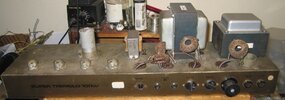
Some day will finish restoring my 1968 ST-100

Marshall super Tremolo #10412 001.JPG
 
There's been some good points raised already. It's quite probable that the 40 & 80 watters share the same 'board. Transformers we'll maybe come back to later. A duet of EL34's operated in Class AB1 (as they are in this amp) can output in the vicinity of 70 watt "at full clip". I personally don't think the DSL would be pushing them quite that hard. Aside from speaker efficiency & sensitivity ratings etc, @Jethro Rocker mentioned something that I'd like speak further on & that is the way in which the two different cabinet types "disperse" sound waves. A closed back 4x12 cabinet is very "directional" in that it disperses sound waves in a very narrow beam straight out in front of it. The DSL combo's open back cabinet on the other hand, disperses sound waves much more widely, both in front of & behind it. Basically, the open back DSL cabinet has a much wider "dispersion angle" than a closed back 4x12. Now this is the important part,,,. Given two cabinets, containing speakers with the same efficiency & sensitivity etc, the cabinet with the widest dispersion angle will be the most "efficient" cabinet.
Then we have the two types of sound waves, "direct" sound waves & "reverberation" (reflected) sound waves. Given an enclosed venue, we can easily imagine the result of using either type cabinet. The closed back 4x12 with its narrow "beam" of direct sound waves will pretty much produce "reverberation" type sound waves off the rear wall only, while the DSL's with its wide dispersion angle open back cab will produce reverberation sound waves off all hard surfaces. So even though the two 4x12 cabs move a much larger wavefront, the DSL's open back 1x12 cabinet disperses the direct sound waves more efficiently throughout the venue, as do it's "reverberation" sound waves.
I'd like to hear @Amp Mad Scientist speak on this, as I believe he is much more knowledgeable in this field than I am.
Ok, I need to get another beer & to pull a couple through. Cheers

Happy New Year!!!!

I believe you are spot-on in your description of functionality.

I have bought, sold, and lost money (mostly, but not always) on gear for as long as I can remember. I had less money than some, but I probably chased the rabbit as much as anybody.

In my personal experience, I find it really tough to beat this "1/3rd open back" 2x12 cabinet. When I say that, I'm not just talking sound, but portability too.

It's a kind of sweet spot between 4x12 and 1x12.
 
Back
Top