Do you detune your acoustic?


Above is a link to a nice chart of how environmental relative humidity relates to moisture content ans some other interesting stuff. If 50% RH= 9% MC, and 25% RH = 5% MC, it if not too surprising the there would not be too much of a dip below 8% MC since youwould need sustained RH in the 30s in the wood's storage place.

I also disagree with the "sudden change" in humidity principle. Study and experience has taught many that would neither gains or sheds moisture quickly. Even the gentleman in the video said that he needed to keep wood in his attic for more than a month to achieve acceptable lower levels. I would think that in this context, "sudden" is not an appropriate guide. I think "sustained " is more appropriate. Otherwise, you could not "suddenly" go to a gig without ruining your guitar
 
Last edited:
I also disagree with the "sudden change" in humidity principle. Study and experience has taught many that would neither gains or sheds moisture quickly. Even the gentleman in the video said that he needed to keep wood in his attic for more than a month to achieve acceptable lower levels. I would think that in this context, "sudden" is not an appropriate guide. I think "sustained " is more appropriate. Otherwise, you could not "suddenly" go to a gig without ruining your guitar
I suppose my “sudden change” feelings relate more to finish damage….checking/cracking, changes in drum shells and their tuning, finish and hardware fittings(rattles and such). Guitars and drums shift with the humidity levels directly(at least that’s been my observation in my location). This does show up at gigs, and is something that I’ve taken into account for, automatically, for years. Always unpack the guitars etc as early as possible to allow them to acclimate…otherwise we will be tuning at every opportunity for the first X amount of time during a set. This happens anyway, as the room packs up with sweaty, dancing humans, the humidity and temperature rise, and the band starts to go sharp. Particularly winter, and summer, gigs…with poor climate control…
 
I keep my Martins tuned down some, but not loose ..the thought of tuning up again. EEEK!

I believe belly bulge is more a matter of the quality of a guitar. I could be wrong but if a high-end guitar company doesn't take a guitar being merely tuned into consideration when building then what is the point. The guitar would have what, a ten year "shelf life". I think good guitars hold up. Like I said, I kinda meet in the middle on the loosening factor.

As far as that steel tool goes for belly bulge, to me it doesn't make sense. It takes the tension of the wood so it can be immediately expose to instant pressure again later? EEEK! (#2) Seems it would bulge around it anyway if it was going to.

Id: Keep proper humidity, loosen strings a bit, oil the fretboard on occasion. Maybe there are more things, but I'm sure to do those anyway.
 
I keep my Martins tuned down some, but not loose ..the thought of tuning up again. EEEK!

I believe belly bulge is more a matter of the quality of a guitar. I could be wrong but if a high-end guitar company doesn't take a guitar being merely tuned into consideration when building then what is the point. The guitar would have what, a ten year "shelf life". I think good guitars hold up. Like I said, I kinda meet in the middle on the loosening factor.

As far as that steel tool goes for belly bulge, to me it doesn't make sense. It takes the tension of the wood so it can be immediately expose to instant pressure again later? EEEK! (#2) Seems it would bulge around it anyway if it was going to.

Id: Keep proper humidity, loosen strings a bit, oil the fretboard on occasion. Maybe there are more things, but I'm sure to do those anyway.
This makes great sense.

I don't think there is any perfect solution. Loose strings are worse for the neck but better for the belly. Heavier strings are better for tone, but more strain on the bridge and belly and more of a problem for necks without a truss rod.

Try to strike a balance, I guess.
 
I suppose my “sudden change” feelings relate more to finish damage….checking/cracking, changes in drum shells and their tuning, finish and hardware fittings(rattles and such). Guitars and drums shift with the humidity levels directly(at least that’s been my observation in my location). This does show up at gigs, and is something that I’ve taken into account for, automatically, for years. Always unpack the guitars etc as early as possible to allow them to acclimate…otherwise we will be tuning at every opportunity for the first X amount of time during a set. This happens anyway, as the room packs up with sweaty, dancing humans, the humidity and temperature rise, and the band starts to go sharp. Particularly winter, and summer, gigs…with poor climate control…
I know the finish issues. Remember when my nitro finish "shattered" from a the temp of the air from an aerosol can?

As for the immediate changes at a gig, is it possible that it is temperature more than humidity? Both metal and wood are affected by significant temperatures changes.
 
I know the finish issues. Remember when my nitro finish "shattered" from a the temp of the air from an aerosol can?

As for the immediate changes at a gig, is it possible that it is temperature more than humidity? Both metal and wood are affected by significant temperatures changes.
I do remember that, now that you’ve mentioned it. What a bummer! That was horrific!

I used to be obsessive with the hygrometer/thermometer when I first got this house by the swamp. I have a couple of them, and keep them around for observation. So yes, temperature does come into play.
I don’t recall bringing out the hygrometer to an outdoor gig, but I bet the hot sunshine would be a massive factor…much like proximity to a campfire.
 
As for the immediate changes at a gig, is it possible that it is temperature more than humidity? Both metal and wood are affected by significant temperatures changes.

Oh, I think temperature is definitely an issue. I’ve had times when I’ve played in cold weather but was standing underneath a vent. When the heat turned on for any amount of time, I’d have to retune the guitar. When the heat turned off and the things got cooler on the stage area, I‘d have to retune again.

HVAC systems don’t really trigger off of temperatures on a stage. They generally use thermostat controls for the rest of the building. So, it’s possible the rest of the building or even audience area could be comfortable, but the stage could be too warm or get too cold, especially if you’re right underneath a vent.
 
This whole experience led me to setup all my acoustics. I lowered the string gauge to 11-52 and detuned 1/2 step when I cased them. I will likely leave them tuned to pitch in the summer months.

BTW, all my guitars share a humidity controlled room that stays aound 42% RH on average year round.
 
In response to consistency, that is what I try to do the best that I can. It is difficult, but I try. In the spring through summer and early fall, my cellar is basically around 50-60% humidity. Unless I'm away for work, and my wife doesn't empty the dehumidifier, this is the constant. From November to early March, the cellar is about 33-37% even though I have a humidifier running. This is with the out side air at 80% humidity with me living by the ocean. The furnace seems to suck out any humidity, and it needs to be replaced. When all the latest work on the house is done, I hope to get a larger humidifier for the cellar, and be able to keep a constant of 50-55% year round.
 
Last edited:
In all the years I had acoustics, I never detuned any of them, or humidified them, or babied them in any way. They got thrown in the back of a van driven all over the country (and Europe) in the summer, the winter, gigged and then thrown back in the van, whatever.

My son and grandson have my last two now, they're still going strong 15 years after I stopped using them.
 
I have two acoustic guitars left. These were the ones I could not bear to be without.
So I'm inclined to pamper them. I read this thread with interest, and will tell you my
experience with humidity change and guitar dynamics.

When my Cindy was diagnosed with a brain tumor in 2019, I retired from my photo
business and from touring with Mustards Retreat. I sold all my "vintage" instruments
because I thought we might need money as her treatment proceeded. I reduced my
collection of instruments from 11 to five.
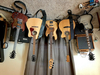
guitar family 2019@100.jpeg
These I kept with me as we traveled to Tucson AZ, and stayed there during the course of Cindy's Cancer.
They were necessary for my morale. The electrics did not suffer from the change in climate, altitude or
humidity. They are pretty well sealed with varnish, and I had no trouble with them.

The acoustics are different from one another. The Martin is an XC1T, considered to be one of Martin's
'bargain" guitars and equipped with back and sides made of High Pressure Laminate (HPL)
whatever that is. Spruce top. Its neck is made of "Stratabond" which means it is laminated like a butcher block
except with thin strips, maybe 1mm thick. In spite of its dubious & non traditional construction, that Martin
is a brilliant guitar, with excellent tone and a fine pickup system. The Stratabond neck is very stable tuning wise,
and the HPL back and sides give plenty of resonance and tone. In addition, these materials are much less affected
by changes in temperature, humidity and altitude than any other guitar I have owned.

Pretty cool. I had no trouble with the Martin, and she kept my spirits up, which I needed badly.
I did NOT de-tune that guitar, but I am in the habit of using alternate tunings, so she went up and down
from DADF#AD to standard, and EBEAbBE and back to standard etc etc... The Martin gave great service
and no wood issues. No proud frets, no belly, no cracks.

The Gibson is my 2018 J-45 AG, which was my consolation prize for selling so many prized instruments.
It's also an innovative instrument, with back and sides made of walnut, maple neck, walnut bridge and fretboard.
The top is good spruce, and the bracing underneath is traditional Gibson construction... the J-45 design has
been around for decades. My experience with the Gibson has been that she is much more affected by drying
out. If I leave her on the stand too long, her neck will back-bow and she developed a belly. I've had her set up
three times since buying her. Each time she needed some humidification by the luthiers, each of whom has a
special way of re-humidifying peoples' guitars. For the Luthiers, it's routine work. Setup has been able to return
my Gibson to playable condition. And I've learned not to leave her out on a stand in the Arizona dryness, or in the
Michigan Winter dryness. Hard for me, because when I like a guitar a lot, I like to have her out on a stand
where I can gaze affectionately at her, or just pick her up and tune up and play.

The lesson learned is that drying out can really do a number on an acoustic guitar, and so can over-hydrating.
My lovely Gibson went from back bowed to action way high, because I brought her out of Arizona this autumn,
and stored her in my sister's damp basement while I sorted out my new life and found a place to be. Setup was
expensive but worth it. When that guitar is in fighting trim, she's a joy to play. When she's unhappy, she can
be impossible. Vigilance and TLC is the ticket. She doesn't need to be detuned... although she sounds really
good tuned a half step low. I named her Zelda.

two acoustics 01-11-21@100.jpeg
 
Last edited:
I have read a lot about this. The answers are all over the map. Some detune after every play, some if it will be more than X days or weeks or months, and some feel that detuning is bad for the guitar.

Fender detune all their guitars a step before sending them to Schiphol for European distribution.
 
yes and I detuned (1/2 step) a couple guitars that I "fostered" with friends during my care giver phase in Tucson.
I was hoping my friends would at least play them, and maybe they'd change the strings.
I couldn't take them with me, but couldn't bear to sell them, so they sojourned in my friends'
basement until I returned for them last fall. I dropped each of them a half step, so a compromise
aimed at keeping SOME pressure on, but not as much.
SnowWhite Caledonia@100.jpg
Neither guitar took any harm from a couple years in limbo. Of course, one was a Telecaster
so they could have hit a few baseballs with it, but the other is my prized Epiphone ES-339.
Don't they look cool side by side? Ye black and ye blonde... sure to brew trouble.

The Epiphone looks like an acoustic guitar, but she isn't... really. She's got a maple center
block that everything is attached to. Sort of like ol' Les Paul's "The Log..."
Read that "exactly like Les Paul's "The Log..."" The top and back are glued to the
center block, and the sides are glued to the top and back, forming a couple of hollow
"wings" that don't do anything except make the guitar lighter. And that's good because
she weighs eight pounds, just like the Tele.

So my Telecaster came through its time in foster care with no signs of distress.
I tuned her up yesterday and played slide on her, and she responded sweetly as only a
well setup Telecaster can. That guitar is impervious to anything except sledge hammer
blows.

I tuned up the Epiphone a few days ago, and she also responded sweetly. I changed her
strings to a new set of tens, and the only trouble I had was that I'd forgotten how the
blasted locking tuners worked. &%*&#@ ##(*%#@!

But once I remembered, all was forgiven. I was gratified to see that neither of these
wayward girls had suffered any from their two years in the dungeon. Setup still seems
right on, intonation is right on, necks are straight, frets haven't shifted. I was playing
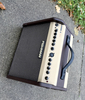
them through my Fishman Loudbox Mini, and they both sound great with that little
amp. I cain't wait to get my VT-30 out and crank it up.
Fishman Loudbox@100.jpg
Acoustics need more TLC than electrics do. All that bare wood inside the box. The Epiphone above also
has bare wood inside, but it's laminated, so it's much more stable. And this MIM Fender Tele and this
MIC Epiphone ES guitar are both finished in polyurethane. So they thumb their electric noses at all
traditionalists who insist that traddie lacquer is superior in some way. I don't believe that at all. I believe
it's simply traditional. ...and more expensive.

Acoustic guitars probably benefit from being finished in lacquer, because an acoustic guitar is all about
tone wood. ...and how it vibrates to create tone. Acoustics need a bit more TLC and protection from extremes.
Electrics are all about magnetism, so I don't think tone wood or lacquer are an issue with them.
 
Last edited:
This whole experience led me to setup all my acoustics. I lowered the string gauge to 11-52 and detuned 1/2 step when I cased them. I will likely leave them tuned to pitch in the summer months.

BTW, all my guitars share a humidity controlled room that stays aound 42% RH on average year round.

"Our factory is climate-controlled to maintain a temperature of 74 degrees and a relative humidity of 47 percent. This consistency causes the wood to equalize at a specified moisture content ideal for building guitars. As the wood’s moisture content changes, so does the size of the wood. Spruce, in particular, shrinks and expands a tremendous amount as it gains and loses moisture. For example, let’s say we condition a spruce top in a room that is 47 percent RH, and then cut that spruce to a width of 16 inches. If we then were to lower the room’s RH to 30 percent, that same piece of spruce would shrink to 15.9 inches in width — shrinkage of almost 1/8 of an inch! If, instead, we were to raise the room’s RH to 60 percent, the spruce would swell to 16.06 inches, an expansion of almost 1/16 of an inch. While our wood drying and conditioning methods minimize this movement, wood is still wood, so even after it becomes a guitar, significant fluctuations in humidity will cause the wood to shrink or grow.


The reason we prefer 47 percent RH is because it is a very “normal” or “median” humidity. When built at that RH level, a guitar can be exposed to more or less humidity and still perform well. The more extreme the temperature and/or humidity fluctuations, the sooner the guitar will be adversely affected."

Taylor Guitars Support site link - Symptoms of a Dry Guitar
 
Well, for what it’s worth, just detuned my acoustic guitar. I had been playing around with it tuned a full step lower. But, I’ve put it back in my closet for a bit, so I loosened all the strings. I also made sure to remove the batteries.

I realize modern bracing makes for a stronger top than in centuries past, but an acoustic guitar is still a delicate thing. I would rather have a thinner, more resonant top than a thicker, less responsive top, even if it means a more fragile instrument.
 
Back
Top