
ninjaking67
Ambassador of Good Will


I think that's why in a three single coil pickup setup, the middle pickup's coil is reversed wound and the pole magnets are flipped: RW/RP. So, with a 5-way selector, positions 2 and 4 will not only give the guitar some serious quack, but it will have hum cancelling properties.Now, I have been asked if I can dupe the same out of phase tone on a single coil. That would require me to push out all the pole pieces and reverse their positions, No??? And if it can be accomplished with just reversing the wiring polarities, where would the effect be present in terms of switch positions????

I think that's why in a three single coil pickup setup, the middle pickup's coil is reversed wound and the pole magnets are flipped: RW/RP. So, with a 5-way selector, positions 2 and 4 will not only give the guitar some serious quack, but it will have hum cancelling properties.

I think that's why in a three single coil pickup setup, the middle pickup's coil is reversed wound and the pole magnets are flipped: RW/RP. So, with a 5-way selector, positions 2 and 4 will not only give the guitar some serious quack, but it will have hum cancelling properties.

I think that's why in a three single coil pickup setup, the middle pickup's coil is reversed wound and the pole magnets are flipped: RW/RP. So, with a 5-way selector, positions 2 and 4 will not only give the guitar some serious quack, but it will have hum cancelling properties.
Hmmmmmmmm.....
Excellent explanation and thanks, El Smitro…Just a clarifying point...Reverse Wound/Reverse Polarity (RW/RP) is not done to put wanted signals out of phase. It is done to achieve Common Mode Rejection of induced hum. Now, of course, CMR is a phase-cancellation. But, the hum cancellation occurs because the hum is 180 degrees out of phase, thus the cancellation. However, the wanted signal is not placed out of phase by means of the RW/RP middle pickup.
The quack effect in a Strat that is achieved in positions 2 and 4 is a result of the summing of the signals from two pickups that are sensing vibrations at significantly different portions of the string, not because of the RW/RP setup.
Long before Fender began using the RW/RP middle pickup and when they were still using just a 3-Way switch, Strat players were nudging the switch into the “in-between” positions to create the bridge/middle and neck/middle combinations. They did this to get the quack from those positions. At that time, they would still have hum because the RW/RP middle pickup hadn’t been developed yet, but they still got the quack.

They called those in between positions “tweener” switch positions back in the day.Just a clarifying point...Reverse Wound/Reverse Polarity (RW/RP) is not done to put wanted signals out of phase. It is done to achieve Common Mode Rejection of induced hum. Now, of course, CMR is a phase-cancellation. But, the hum cancellation occurs because the hum is 180 degrees out of phase, thus the cancellation. However, the wanted signal is not placed out of phase by means of the RW/RP middle pickup.
The quack effect in a Strat that is achieved in positions 2 and 4 is a result of the summing of the signals from two pickups that are sensing vibrations at significantly different portions of the string, not because of the RW/RP setup.
Long before Fender began using the RW/RP middle pickup and when they were still using just a 3-Way switch, Strat players were nudging the switch into the “in-between” positions to create the bridge/middle and neck/middle combinations. They did this to get the quack from those positions. At that time, they would still have hum because the RW/RP middle pickup hadn’t been developed yet, but they still got the quack.
Excellent explanation and thanks, El Smitro…
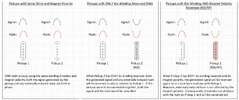

AND THAT is why he IS the AMBASSADOR OF GEAROLOGY!Here's a drawing I made depicting what I was trying to say.
Essentially, RW/RP works to cancel hum because the hum is induced externally and is not dependent on the magnetic polarity.
View attachment 18197




Adrian, you must be purged of your anti-soldering bias, and then "reeducated".
Molten metal is even more fun than a Bag 'O Glass.


