
You are using an out of date browser. It may not display this or other websites correctly.
You should upgrade or use an alternative browser.
You should upgrade or use an alternative browser.
Ceriatone British Style Plexi 20
- Thread starter DirtySteve
- Start date

OP

DirtySteve
Ambassador of Hold My Beer

Did you ask Nik about putting in an input that is jumper'd already? I forgot to ask you before, but that would be handy.
With a good buzz last night I emailed Nik and asked him about it. He said, "why would you want to limit yourself like that?". I have to agree, I don't think that's something I want.

Ampeq
Well-Known Member
Don’t know what he means by “limit”, I have seen them on other 4 holer’s. They just put in another input that IS already jumper’d, a 5th hole. I think you can also still use those mini cords to jump as well. Should be just a cleaner way of doing it.With a good buzz last night I emailed Nik and asked him about it. He said, "why would you want to limit yourself like that?". I have to agree, I don't think that's something I want.

XTRXTR
Well-Known Member
Input resistance, the grid leaks parallel, likely guess. Because you can jumper Bright to Normal the actual guitar input you use will make a difference.Don’t know what he means by “limit”
Jumpered: Then the guitar sees half the impedance and the channel it is plugged into (Bright v Normal) varies its output to the corresponding Volume thus I would think one channel becomes more dominant and the volumes vary the tone in a different way than the other config.
In other words you have four possibilities: Jumpered Bright, Jumpered Normal, Not-Jumpered Bright and Not-Jumpered Normal
Five: You can also have another person plug into the amp or add a looping song you want to practice with on one input while you use the other
Six: With another person playing in the other channel you can still add a looper.
Seven: two other mates playing with you and a looper using all four input jacks.
The pwner rules!!! lol
I actually did the classic fat finger! OMG
Perhaps Nik was thinking similarly. Doing an internal jumper only saves a patch cable, and if switched ON (assuming after the grid leaks) you parallel all inputs so it limits to all input parallel impedance. There may be other internal switch configs too but it still boils down to limiting the designed inputs from what they are to something less.

syscokid
Ambassador of War & Peace
This must have something to do with being in an orgy…Seven: two other mates playing with you and a looper using all four input jacks.

Ampeq
Well-Known Member
Man I hope so.This must have something to do with being in an orgy…
Ampeq
Well-Known Member
OK, so yeah.... I can see.... aaaa ......if you ...., huh?Input resistance, the grid leaks parallel, likely guess. Because you can jumper Bright to Normal the actual guitar input you use will make a difference.
Jumpered: Then the guitar sees half the impedance and the channel it is plugged into (Bright v Normal) varies its output to the corresponding Volume thus I would think one channel becomes more dominant and the volumes vary the tone in a different way than the other config.
In other words you have four possibilities: Jumpered Bright, Jumpered Normal, Not-Jumpered Bright and Not-Jumpered Normal
Five: You can also have another person plug into the amp or add a looping song you want to practice with on one input while you use the other
Six: With another person playing in the other channel you can still add a looper.
Seven: two other mates playing with you and a looper using all four input jacks.
The pwner rules!!! lol
I actually did the classic fat finger! OMG
Perhaps Nik was thinking similarly. Doing an internal jumper only saves a patch cable, and if switched ON (assuming after the grid leaks) you parallel all inputs so it limits to all input parallel impedance. There may be other internal switch configs too but it still boils down to limiting the designed inputs from what they are to something less.
Ampeq
Well-Known Member
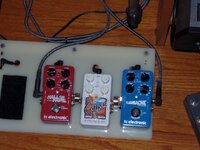
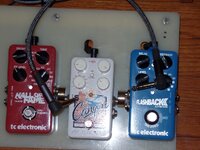
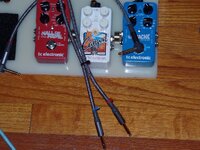
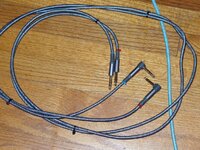
This is what I was talking about for the loop. Simple and works great.That's a good idea. I've never really used an effects loop partly because of all the extra cables. I almost told him to leave it off, but I didn't because I might use it someday. I figured it would be better to have it and not need it, than to someday need it and not have it.
Attachments

T-Rex
Well-Known Member
A retired truck driver’s version:
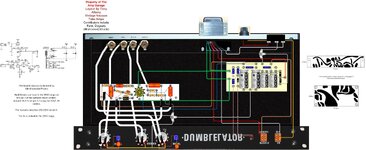
Looking at the layout, this Fat switch adds a .68 cap that parallels V2A’s 820 ohm cathode resistor. IMO, a .68 cap at this location adds a bunch of gain to the mids and highs, and barely any increase to the lows. I’m actually surprised it’s labeled as a Fat switch instead of a Gain switch.
Split/Shared V1 Cathode switch: I think that when V1 shares its cathode circuit with both inputs, that both volume controls are interactive with each other even with only a single input being plugged into. When V1’s cathode circuit is split, that interactivity is eliminated unless jumper cables are used.
3-way NFB switch: The higher the resistance value is, the less negative feedback is in the output circuit. The three selectable values accordingly to the layout is 49K, 95K, and 127K. More NFB makes the amp sound smoother, cleaner, quieter, and tamer. Less NFB makes the amp more aggressive, gainier, and wilder. Plexi’s generally are loaded up with 47K’s, which is like middle-of-the-road for NFB control. JCM800 2204’s use a 100k NFB resistor. Some amps have no NFB, like some Fender Tweeds and Vox AC’s.
Well Put !