caring for a polyurethane coated guitar

So much fuss is made over lacquer...

Who can tell me a REAL advantage? I do appreciate the elegance of lacquer on my Gibson
acoustic, and on my Gibson SGs. I've heard all the theories about how it lets the wood
breathe, but I don't understand how this could affect tone (except maybe on Acoustic instruments).
I have posed that question at least 2x in this forum without response. In other places, the 2 most common responses are
- as you mentioned, laquer allows the wood to breath, which allows for natural wood aging, which contributes to tone
- finish checking, which occurs with aging laquer, is beautiful

I disagree with the first justificaton on a scientific basis and the second one on the basis of personal opinion
 
So much fuss is made over lacquer...

Who can tell me a REAL advantage? I do appreciate the elegance of lacquer on my Gibson
acoustic, and on my Gibson SGs. I've heard all the theories about how it lets the wood
breathe, but I don't understand how this could affect tone (except maybe on Acoustic instruments).

oh no you didnt make this a TONEWOOD issue did you?!?!?!?

lol

Great Dog Col.

Ivan --I am not certain how things function with one dog and bitches--- we have a pack -- males and females ranging from 4 lbs to 120 lbs...they all learn the pecking order--and fit in where they are able/needed--its actuially quite fun to watch the personalities--interactions and and different "jobs" and places in the Hierarchy they each take the biggest male Murphy is top dog of course--- but Ive seen the 4 lb FEMALE Chihuahua give him "what for" and he take it....(he knows if he didnt -- the true alpha dog would beat his arse) -- though Ive never had to -- I have had to break up several "spats" over the years--

Leading with a swift foot --over a hand-- is typically best.....a broom is better ;) but again the incidents are rare-- they all get along. and the trrue master is the LARGE (15lb) orange Main Coon Cat -- he calls the shots the dogs do the heavy lifting ;)
 
- finish checking, which occurs with aging laquer, is beautiful
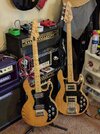
breathing wood ---- again I present exhibit "A"
er and "B:"
Tseries2.jpg

light clear -- was at some point I assume applied at the factory--- the interwebs and the man himself say to use FURNITURE polish on them ......whatever was there originally is gone now------

this has checking--- on top of checking
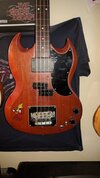
EBO New.jpg

they all sound and play awesome---- and I will bet at least my left eye tooth NONE of them -- received ANY polish-- milly coddling-- wiping down or CARE for decades----- ---but -- again they are still here and still sound fabulous --- nitro-- lacquer -- polypropylene-- vodka -- what ever they are coated with ---
 
Poly impervious to anything but hammer blows & bullet hits is pretty well spot on. The only "all poly" guitar I have is my (maple fretboard) Tele. It gets wiped down after use with a Fender microfiber cloth & that's all it seems to need.
Damn, a dog in the music room. I wont even have one in the house. Cheers

You and I agree on all points, Mate
 
So much fuss is made over lacquer...

Who can tell me a REAL advantage? I do appreciate the elegance of lacquer on my Gibson
acoustic, and on my Gibson SGs. I've heard all the theories about how it lets the wood
breathe, but I don't understand how this could affect tone (except maybe on Acoustic instruments).

It is largely traditional I believe.
 
For me it’s the way nitro feels in your hand. And how it ages.

For poly- coated guitars, I’ve really never done much of anything to them other than the occasional wipedown. I do polish my Gibsons (nitro) at least once a year.
 
So much fuss is made over lacquer...

Who can tell me a REAL advantage? I do appreciate the elegance of lacquer on my Gibson
acoustic, and on my Gibson SGs. I've heard all the theories about how it lets the wood
breathe, but I don't understand how this could affect tone (except maybe on Acoustic instruments).

Lacquer guitars breath better because the finish peels off easier than poly. That's how a guitar breathes.:wink:


;>)/
 
I have posed that question at least 2x in this forum without response. In other places, the 2 most common responses are
- as you mentioned, laquer allows the wood to breath, which allows for natural wood aging, which contributes to tone
- finish checking, which occurs with aging laquer, is beautiful

I disagree with the first justificaton on a scientific basis and the second one on the basis of personal opinion

Kernel says:
Many of us on this forum, and over on ETSG... well, we've kind of burned out on "tone wood" discussions.
To the point where we make jokes about it, and ignore the responses that don't have a sense of humor.

I would chalk up your lack of responses on this topic to that "burnout" factor. I've seen things get ugly over on
ETSG, to the point where I left the discussion and went and played my guitar, and came back to find the thread
was locked and guys had been expunged from the forum, and feelings were still ruffled and sensitive.

Not mine. It's not much of an issue for me. I'm for making music, not fussing too much about whether a one piece
body gives better tone than a glued together body. I appreciate elegance in guitars certainly, but I've been playing my
durn Epiphone Wilshire a lot in the last week, and that baby sounds GREAT.
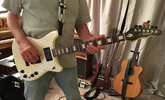
Epi 0917@100.jpg
I bought this baby maybe 7 years ago, and have modded it extensively. Which is why it sounds good, of course.
Nothing to do with whatever wood the Chinese manufacturer used to build it, and nothing to do with the polyurethane
finish it's painted with. Those features are unimportant IMHO. I bought this guitar because of it's "cool factor..."
And then I modded it with excellent parts, and had my luthier go over it when I finished my ham-handed work.

I feel the tone of this guitar is inspiring. It's got a Gibson 490R in the neck,
and a "Golden Age" overwound hum bucker in the bridge position. Great combination...
...lots of versatility in the tone. The neck 490 has a round and full tone, lots of presence, like a great jazz tone. The bridge p'up is pure rock an roll, and the middle position blends them both, which I like best. This one's got a perfect
"Sixties slim' neck... of course it does, it's a replica of a 1962 Kalamazoo made Epi.

I bought a TonePros bridge and tail, which fits perfectly and contributes to tone IMHO.
Tusq nut, and really excellent action. The neck is fine to play. It's surely the "slimmest" of all my instruments. But I don't care. And I don't care what kind of wood it's made of. It sounds and feels great, and it's been durable and dependable for about 7 years.

Polyurethane doesn't seem to check (much). Or else this guitar is too young.
But I haven't pampered it, except for buying this guitar a fine SKB-61 case, which
protects it from the slings and arrows of outrageous fortune.

I'll never sound like Steve Vai (or Wayne Kramer) on it... but I don't care about that either. It's
not the guitar's fault... prolly the lack of a monkey grip.
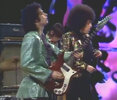
epiphone_wilshire_1966__mc5_wayne_kramer-1.jpg
 
Last edited:
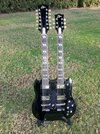
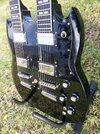
Polyurethane is much more wear resistant. For a working guitar, I think it's a longer lasting finish. I have no opinion on tone vs. a particular finish...I just like black and shiny black at that...

DoubleNeck Body April 2018.jpg
 
One advantage to lacquer which I’ve read is that it’s easier to fix a chip, or something similar.

Lacquer is its own solvent, so say you get a chip in a clear coat, you could drop a bit of clear lacquer in the chipped area and it would melt into the edges of the surrounding lacquer. This would make for a more seamless repair, especially after a bit of wet sanding and buffing.

Supposedly Poly, on the other hand, is not as friendly when it comes to finish repairs.

Whereas I have done some lacquer repairs on one of my guitars and it works pretty well, I’ve never attempted any poly repairs, so I can neither confirm nor deny any difficulties with repairing a poly finish.
 
Last edited:
Back
Top