Capos

Very creative, Colonel...

I own a Shubb capo, that i use on my 12 string double neck, but its only used for certain music projects.

My current music project, with Outfall band, has all guitars tuned to D standard, but i solo with a guitar tuned to standard, so re-adjusting a Floyd Rose guitar is not required.

I also play some rhythm phrases alternately, using one guitar tuned D standard and the other track recorded with a guitar tuned to standard, which gives a very unique tone to the guitar tracks.
 
What a strange planet you must inhabit, if you never use a capo.
I read all of the entries in this thread, except the mafia ones.
I found them difficult to believe, but I believed them.

Maybe I'm from some other planet, where guitarists and banjo players and
mandolin players ALL use capos, and play happily together with no problems
and we make excellent music. A capo is just a tool for a musician. It makes your
job easier, so you can concentrate on your performance. It's no big deal if you
use one or if you don't. It's a style thing. To me, it's a weird mentality that would
call a capo a "cheater..." like maybe they think a stomp tuner is a cheater too.
And maybe it is, the tuner allows those of us who don't have perfect pitch to be
musicians.

Anyway, I use capos all the time. I like what they do.
I also play in alternate tunings such as DADF#AD or DADF#CD
where I don't need a capo.
I also play bass with other players who use capos, with no problems.
I don't need a capo for my bass, just tell me what key we're in, or if you
don't I'll figure it out. My mind sees chord shapes and counts frets and
then I know.

So... because I haven't seen anybody mention this yet, and only a few of my colleagues
on this forum seem to use capos, I'll boast a bit about my use of PARTIAL CAPOS so I can
play alternate styles without re-tuning the whole guitar.

Dig this:
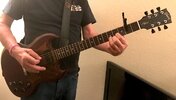
View attachment 35322

*laughs... How d'ya like them apples? I'm playing in the key of Bb using the
G pattern. I've got a full capo on the first fret to raise the pitch one half step, and
I'm using a partial capo on the third fret to change the tuning to an open Bb chord,
and then I'm picking higher up the neck using the G pattern... C and D, Em and Am are
all their normal shapes, just raised a step and a half and with some modal notes
thrown in.

Got that? One of the reason for me to do this is my music partner David's preference to play
down-tuned a whole step. So his guitar is a full step low. When he plays in the C pattern, he's
in Bb, and I can play using different chord shapes and a different tonality but still in the same
key. It makes a very interesting guitar duet.

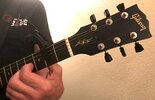
Here's a closer look at the partial capo. Here I have it on the second fret, so I'm playing in
the key of A using the G pattern. You can see that the capo presses down three strings.
In this case giving me an open A chord: EAEAC#E
View attachment 35324
One of the other cool things I do with the partial capo is to flip it over and press down the A,D, and G
strings on the second fret. Then I can play in the key of E using the D pattern, and I get a great low E
note without any problems. Using combination of full and partial capos, a player can create a lot
of exotic sounding music, without re-tuning his guitar all the time. You have to correct the tuning
after you put the capos on of course, and after you take them off... Capos are like that.

But it's only tweaking the tuning, not cranking the strings around and freaking the guitar out
while you're onstage. I find these things quite useful.
Damn Colonel, that's a mighty fine idea right there. Never seen (or heard of) a partial capo before, but I gotta get me one. Thanks for posting. Cheers
 
Damn Colonel, that's a mighty fine idea right there. Never seen (or heard of) a partial capo before, but I gotta get me one. Thanks for posting. Cheers

The Colonel may have some better information, but I don’t think you can buy a cut capo (partial capo). I think you actually have to cut a regular capo down.
 
glad you guys got the idea...
Capos work fine on any guitar, acoustic or electric.
IMG_1257.jpg
it's actually a very interesting new avenue in the endless
quest for tone. Remember:

THE QUEST FOR TONE HAS NO FINISH LINE
SO IT'S TECHNICALLY A DEATH MARCH...

Here's a closer look at the partial capo pressing down the A, D and G strings
so I'm playing in the key of E using the D pattern, and with a fine bottom E
note that you can't get in standard unless you drop your E string a step.
(which plenty of players do).
IMG_1253.jpg
The capo just makes it easier onstage, with only minimal tuning tweaks when you put
the capo(s) on or take them off.

I'm a little fuzzy on the theory part which would explain the "modal" notes that are
added to the other chord patterns or the solos up and down. It has to do with
"sus" chords and their associated intervals, I believe.
But I'll testify that they are useful and interesting. No discord. *grins

You can order partial capos from Musician's Friend, or from www.elderly.com
or what. You can also google "partial capo" and find chordal theory explanations
and videos and suggestions for other uses up the neck. If any of you finds this
useful, let me know.

on an electric, it sounds like this:
 
...I have been playing guitar for 42 years and I have never owned a capo. I am honestly not even sure what they are for - every time I have ever played with someone that used one I was able to play the same thing somewhere else on the fretboard without it.

Bingo!
We don't think less of you... you just nailed it, right there.
 
glad you guys got the idea...
Capos work fine on any guitar, acoustic or electric.
View attachment 35365
it's actually a very interesting new avenue in the endless
quest for tone. Remember:

THE QUEST FOR TONE HAS NO FINISH LINE
SO IT'S TECHNICALLY A DEATH MARCH...

Here's a closer look at the partial capo pressing down the A, D and G strings
so I'm playing in the key of E using the D pattern, and with a fine bottom E
note that you can't get in standard unless you drop your E string a step.
(which plenty of players do).
View attachment 35366
The capo just makes it easier onstage, with only minimal tuning tweaks when you put
the capo(s) on or take them off.

I'm a little fuzzy on the theory part which would explain the "modal" notes that are
added to the other chord patterns or the solos up and down. It has to do with
"sus" chords and their associated intervals, I believe.
But I'll testify that they are useful and interesting. No discord. *grins

You can order partial capos from Musician's Friend, or from www.elderly.com
or what. You can also google "partial capo" and find chordal theory explanations
and videos and suggestions for other uses up the neck. If any of you finds this
useful, let me know.

on an electric, it sounds like this:

I enjoyed your song!

Really glad you shared about the partial capos! :dood:

As a fellow songwriter, I love the world you have opened me up to by using a partial capo!

Thank You!

John
 
glad you guys got the idea...
Capos work fine on any guitar, acoustic or electric.
View attachment 35365
it's actually a very interesting new avenue in the endless
quest for tone. Remember:

THE QUEST FOR TONE HAS NO FINISH LINE
SO IT'S TECHNICALLY A DEATH MARCH...

Here's a closer look at the partial capo pressing down the A, D and G strings
so I'm playing in the key of E using the D pattern, and with a fine bottom E
note that you can't get in standard unless you drop your E string a step.
(which plenty of players do).
View attachment 35366
The capo just makes it easier onstage, with only minimal tuning tweaks when you put
the capo(s) on or take them off.

I'm a little fuzzy on the theory part which would explain the "modal" notes that are
added to the other chord patterns or the solos up and down. It has to do with
"sus" chords and their associated intervals, I believe.
But I'll testify that they are useful and interesting. No discord. *grins

You can order partial capos from Musician's Friend, or from www.elderly.com
or what. You can also google "partial capo" and find chordal theory explanations
and videos and suggestions for other uses up the neck. If any of you finds this
useful, let me know.

on an electric, it sounds like this:
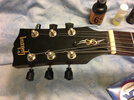
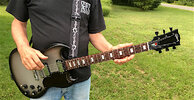
Your truss rod cover looks like it has the Slipknot logo on it...
 
the maker called that the "Tribal Blades" inlay...
IMG_1109@100.jpg
He made the TRC out of ebony, and the inlay with abalone and MOP.
I think it looks great on a plain guitar like my faded special... which has no other
inlays or decorations besides the dots.
here's a link to his other work:

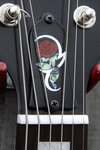
He made one called "Tribal Rose" for my other SG special
which looks like this:
Rose6b@100.jpg
a fine splash of color for a silver burst guitar
April 2017@100.jpg
 
Last edited:
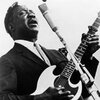
that's cool... now add some thinking' about Muddy Waters
the original Hootchie Kootchie man
muddy waters SG.jpg
I never liked those rubber strap type capos... I used them of course, because that's what
was available in the music store, along with the coil cord and the shitty guitar stand with
the seeping Plastic-sizers in the rubber padding. Muddy Waters used them too, and figured
out how to play in tune anyway. Like we all did.

Those old strap type capos were TOO TIGHT...
better suited for a badly setup 12 string owned by Huddle Ledbetter... they would throw the
guitar out of tune as soon as they were applied. The Shubb capos were the first ones that you
could adjust to the action of your guitar, so they applied enough pressure to fret the strings,
but not so much that the whole shebang went haywire.

I like the Keyser capos now, but use the Shubb products also.
Muddy, he'd prolly say the same, from Heaven.


Back
Top