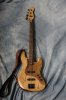
Building a Warmoth Fretless Jazz Bass

Col Mustard

Ambassador of Perseverance
Country flag
This story begins in like 2009, when I realized that I was capable of doing a lot of
guitar-tech kind of work. I had been studying the art, and had used a couple of inexpensive
guitars as learning platforms. So I decided to tackle something more ambitious, and to
assemble my dream bass out of parts I could order online.

Cain't call myself a custom woodworker, but within my own limitations there are things I
can do. So I ordered a Warmoth Fretless neck, (It was almost three hundred dollars) and
installed that on a MIM Fender J-Bass that I had bought from a friend on a whim.

That answered some immediate questions:
1. Could I successfully switch to fretless and not have to begin all over?
2. If I ordered a Warmoth neck, would it fit into a MIM Fender J-bass body?
3. Could I order tuners based on dimensions given online, and then put the parts
together and have them fit properly?

The answers to the above questions were a resounding chorus of YES!
Warmoth gets applause for excellent neck making. I only had to sand the neck a small amount
for it to fit right into the MIM body. And when I inserted the neck screws through the body,
I felt them go right in the holes in the neck. *thunderous applause! I was delighted.

I ended up modding the Mexican made Bass, removing the active pickups and installing a set of
inexpensive EMG bass p'ups, making a new simplified wiring harness and installing the Warmoth
Fretless neck. Then I played it for a while, congratulating myself on obtaining a fine custom fretless
bass for about six hundred dollars, including an excellent hard shell case.
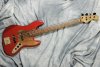
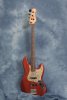
09-17-09 Scarlett_5x@100.jpg
Those are not frets... those are maple inlays. "Sissy Lines" as other bass players might say.
But for me, essential. I love the look of an undecorated fingerboard, but where we play, we don't always get good sound. So I have to be able to see where to put my fingers, in case I can't hear it.
I'd rather have good intonation than the ultra cool factor of that clean unmarked rosewood.

Oh and that's another walnut pick guard that I made, out of the same board that I used for my SG.
So this preliminary attempt has a MIM Fender body, with the stock bridge and control cover, a pair of
EMG passive J-Bass p'ups, a hand made wiring harness from a Stew Mac kit and my $300 Warmoth
fretless neck and $80.00 Schaller tuners.

Scarlet@Thmpfst@100.jpg
...to be continued
 
I just got that feeling I used to get while watching Bob Ross paint - "Leave it alone, it is good the way it is!!" But he would not listen to me and successfully add to the painting anyway. I look forward to the rest of the story!
 
yah... I got the Build-yer-own-bass bug while playing "Scarlet" as I named the MIM red bass.
Scarlet had a pair of EMG active pickups when I got her... I don't know if those were
factory installed or if someone modded the instrument. I didn't think much of the active pickups
and neither did the guy I bought the bass from, which is why I didn't have to pay much for it.

Also, a good friend of mine owns a Strat made out of various Fender components,
and he plays this instrument to great effect. So the idea of a pristine Fender guitar or bass seems
like unnecessary to me. Oh yeah, there's a place in the world for cool Fender guitars played just
the way they were designed and built... I own one. But Fender spawned this whole underground
of 'PartsCasters' made of pieces of stolen guitars or pawn shop derelicts. And in spite of my high
moral character, I find this fascinating.

So once I got Scarlet up to standard, and played her onstage a few times, I became obsessed with the idea
of creating my own Jazz Bass, with all my preferred features and nothing to inject a sour note (but me, and I
can work on that). I would NOT patronize the stolen guitar underground. Having been a victim, I don't wish
to fraternize with the perps. Git a Rope... and then pass me the Warmoth Catalog.

Getting rid of the EMG active pickups was an immediate improvement (to my ear). Bassists who have to
stand next to an insane drummer might like the enhanced output of the active p'ups. But not me...
Because of the venues I play and the sound levels that are appropriate, I don't need high output or gain.
I need subtlety of tone, and individual note mojo, I need growl and rumble, as well as a cello-like upper
range. How to achieve that, my friends... that is the question. The EMG 'Select" pickups
seemed like a good compromise... lower output, cleaner tone, more of everything.

Well... of course, step one (to get proper tone) is the proper pick guard! When I bought Scarlet, the "Fiesta Red" Jazz Bass,
she was saddled with a white plastic pick guard. I did not like the Red/White motif, because it reminded me of a fishing
lure... and I hated the thought of a fish big enough to see a Fender Bass and its owner as bait... *Chomp!

So I gave my step daughter a sponge and some craft paint, and asked her to create her masterpiece on my white
plastic pick guard.
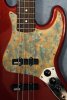
Fretless_painted@100.jpg
Frets:Painted closeup@100.jpg
and yes, you sharp eye'd devils, that (in the closeup) is the original fretted neck in the lower photo.
I didn't do all these steps in logical order, as you may have guessed.
 
Last edited:
Looks brilliant, Michael, and I bet she sounds awesome too.
I did the same with the pups on my bass - converted it from active to passive. Best thing I did.
Oh, and just recently I took out the kill switch and pup selector and swapped the 500k Alpha mini-pots with 250k Bournes pots.
Now it acts and sounds exactly like a bass should...
Now I just gotta learn how to play the thang... ;)
 
Well, the craft paint on the plastic pick guard was lovely and original and artistic,
and packed with girl magic by someone who loves me... but it wouldn't
stick too well. She was trying to make it look like an old piece of copper sheet metal that she
found in some alley, and did pretty well I thought. But paint began to come off when things got
hot and sweaty under stage lights.

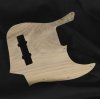
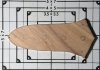
So here's a closeup of the wooden pick guard. It's made out of a plank of walnut given to me
by a cabinet maker. I think he couldn't use it because of the burl that you can see near the
upper bout. But I could. I actually love that burl. I traced the plastic pick guard on the walnut,
and marked all the holes and cutouts, and then carefully cut it out with a jig saw and beveled the
edges with a dremel tool and hand files. The wood was too thick, so I took it down to about 3 mm
with a belt sander.
02 Walnut pickguard.jpg
I know, I know... most bass players don't even use picks. Some do, and I will on certain songs, especially if I'm
jamming with a band that has a drummer. I thought of just taking the plastic piece off, but the MIM bass body
was routed from the front, so there is a channel that needs to be covered. This is an elegant solution to that
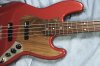
problem. Here's what it looked like on the red body.
09-17-09 Scarlett close_5x7@100.jpg
Pretty cool. Those EMG "Select" pickups actually sound punchy and good... and they were not expensive. Because I was
not trying to build a bass from the ground up (yet), I was only messing around with this inexpensive J-bass, enjoying the
process as much as the varying results.

I already owned my dream bass... many of you know that I bought a 1966 Fender Jazz Bass in 1972 for $100...
somebody's under-the-bed special. I've been playing that one bass for all these years, happily uninterested in anything
else. "Why go out for a hamburger when you've got steak at home?" --Paul Newman
Sluggo-BFG@100.jpg
But I remember seeing a bass similar to this old warhorse offered for sale at Elderly Instruments
in Lansing, and they were asking $18,000 for it. I was like, ...REALLY?
Now mine's not worth that much of course, because I stripped the old sunburst off it and replaced
the pots. But the idea made me paranoid slightly, because even if my bass was only worth half
that, I could get targeted by guitar rustlers. So I bought a cheaper bass to take into dodgy areas
and unknown territory.

Also, in 2009 I was very worried that I might get in trouble financially and
not be able to sell my house. The country and the economy were in a deep hole by 2008, and the
recovery was only just beginning. I was worried, and thought that if I could replace my old fender
with something more modern but just as good, I could turn the old beast into cash to make my
mortgage payments. I had never considered selling it before, but had given up my health care trying
to keep my Photo Shop afloat in the hard times. Hard times require hard choices.

So if I had to sell my old bass because it was stupid to be driving around with a bass that was worth more
than my car, and stupid to cling to an instrument while losing my house, then I would need some comfort eh?
What kind of comfort did I need? I had lost my lady too, and was living all by myself in a house I couldn't
put on the market because the market had tanked.

How about building my dream bass from the keel to the masthead?
...to be continued.
 
Loving this thread, Michael.
Even though I seriously dislike active electronics, I still wonder if I should put my bass back to original condition - I still have all the original components in a box...
 
yes... I liked the EMG passive Selects I put in that red Fender. Much better to my ear
than the active EMGs that were in it when I bought it. The red bass gave good service
but didn't have much soul or something. A decent but normal instrument.
And I needed some comfort, as I was saying above.
And maybe building my dream bass provided it.
Nothin' like an NBD to cheer a man up.

The following project was actually a pleasure.

I decided that I would go back to the beginning and begin here:
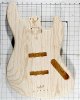
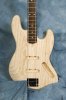
01 Warmoth Swamp Ash body.jpg
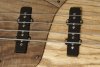
This is a Swamp Ash body from Warmoth, as you can see by the logo inside the neck pocket.
I picked this individual instrument body off the Warmoth site, because I liked the grain of the
Ash. AND also because it was one of the least expensive bodies they had.

And in spite of how good the EMG 'Select' pickups might sound, I decided they were staying in
the red body. If I were going to build my dream bass, I would also go back to the beginning and
begin here:
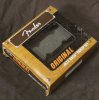
06c1 Fender Pickups pkg.jpg
The best tone and sustain in any bass I've ever played comes from my old Fender '66. So my dream bass has
to try and reconstruct that sound, especially if I was considering selling the old one. Such loyalty must sound
boring I suppose, but I played that one bass for decades and never seriously considered getting another one
because the old J-bass did everything I asked it to do. That says worlds.

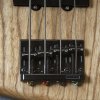
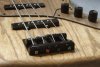
I decided to go with a black "High Mass" bridge, which sounds satanic or something... but isn't.
My dream bass was getting black hardware. The best tone and sustain comes from my old Fender bass bridge,
which is a simple piece of bent steel. Something Ol' Leo got right the first time. But I wanted black, and
I was curious about the "high mass" concept, having read that it was an improvement. So I bought one made by
Gotoh.
06c Gotoh bridge 2.jpg
Then I took the Warmoth Fretless neck off the Red Fender, and re-installed the old MIM regular neck on that. I gave the Red Fender bass to my daughter, who plays a mean standup bass in various classical and jazz groups, just for fun. My grandson also plays standup bass, and I thought that since I didn't need the red one, maybe it should be in their family... as an alternative.

I inserted the fretless neck into the pocket on the Warmoth body, and it slid right in... reminding me of something from
my wilder days. I inserted the new black screws through the new black neck plate and through the ash body
and felt them bite right into the holes in the neck. No problem. I absolutely loved this moment. Hand it to Warmoth for
precision cutting and mill work. This paragraph also says worlds.

Then it was time to check alignment, to make sure the neck was straight with the bridge and the strings weren't too far
to one side or another. This is just household twine, knotted in the bridge and wound around the tuner posts. But
the alignment is good.
05a Checking alignment.jpg
...to be continued
 
Last edited:
I had enough walnut left after making the bass pick guard and one for my favorite SG
so I could think about having a walnut control cover on this beast. I looked carefully at the
grain of the pick guard and figured I could make a pleasing combination.

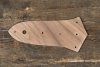
So I traced around the stock part, and cut out my walnut cover, like this:
03 Walnut control plate 1.jpg
you can see it's too thick, so I screwed it to a piece of plywood with a screw countersunk through
one of the pot holes and took it down to about 1/8" thick using my belt sander.
04 Walnut control plate 2.jpg
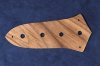
then I did the final work with hand tools and realized that I'd taken it down too thin with the
belt sander. I was worried that it was too fragile. Fender bass is supposed to be built like
a tank, eh? But I went ahead and sanded it down to 600 grit, because this piece had the
right grain pattern, I would have to strengthen it somehow.
05 Walnut control plate 3.jpg
I stained the Ash body, sanded it pretty smooth (down to 600 grit) and applied tung oil finish
I applied tung oil finish to the walnut parts too, and they didn't need any stain. I like tung oil, it seems
very practical to me. It's easy to apply, you can sand it when it's dry, and if I scratch it, I can just apply
more tung oil and the scratch can be repaired easily. I first used it on a gunstock which has
given good service in harsh conditions... And I believe it works well for guitars.
I'm apparently not a Lacquer Guy...
06d Fender Original J-Bass pickups.jpg
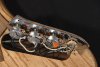
Pickups in place... now for the wiring harness:
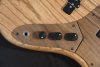
AND you can see that I've employed a standard J-Bass chrome cover under the walnut... for strength.
08 wiring.jpg
This is why I didn't want to simply make another control cover, even though this one's too
thin... it lines up so well with the grain of the body and the pick guard, that it's the only
cover for this guitar's control cavity. Plus it's still obviously hand made. I like something where
the closer you get, the cooler it looks.
09 Control Plate finished.jpg
Here's a stern view, giving a glimpse of my dream bass taking shape.
06b Gotoh Bridge.jpg

This project was a real pleasure to execute, because all the parts fit together properly. So it was easy to do.
I'm not a professional wood worker, and I did no precision cutting or mill work. I was careful when making the pick guard
and control cover, and I'm proud of that work. But this was just screwing things together mostly. I built the wiring harness
from a kit, and did all the soldering. The cool thing about tung oil is that you can keep adding coats until your patience
fails. The pictures above show the instrument with only a few coats of tung oil on, so she still looks VERY satin, almost
unfinished.
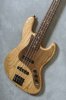
10b Body_finished 4.jpg
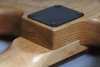
09d Neck joint.jpg
But with tung oil, maybe you're never finished. I've taken this darling beauty apart three times and added more coats of
tung oil, and she keeps getting a deeper varnish look.
Done xtra coats 5x@100.jpg
 
So does the action need to be a little higher on a fretless Bass ???

I took a ruler and measured the action on the 12th fret (or sissy line) with both my ex-Squire P-Bass and this lovely
Fretless Warmoth J-Bass... You are right, the action on the fretless is slightly higher.

And on the fretted P-bass (with my finger on the first fret) the action on the Low E string
at the 12th fret is less than 1/16 of an inch (which is just about perfect IMHO)... this plays well all the way up and down
the neck and gets no buzz, and intonates fine. This No-Longer-A-Squier instrument has a story all it's own, but that's
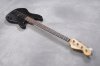
another thread. Her name is Raven, and she's my 'rescue bass." I have come to love this misbegotten black beauty.
17. Whole bass 4@100.jpg
Then I measured Luretta, the subject of this thread. With my finger on the first 'sissy line" the action at the 12th 'sissy line'
is about 3/32, so it's less than 1/8 of an inch. I didn't have my metric ruler with me here... so citizens of other nations
will have to do the conversions in their heads. I'll make it easy by saying that the difference between the action of the
fretted P-bass and the Fretless J-bass is about 1 mm. Not a lot, but there it is.
13 Onstage close.jpg
 
Last edited:
thanks for the good word. Maybe one more post goes on this epic...
on the subject of Headstock ornaments.

For Luretta, I knew what I wanted to do before the project even began:
I had seen an oak tree that had been blown to smithereens by a stroke of lightning.
The sight was so amazing that I walked close up, in wonder. It was in a public park,
and I must have arrived soon after the storm was over, because the tree was still
standing, but split wide open and weaving in the wind.

All about the tree were pieces of oak, large and small. Some pieces were 2-3 meters long
others were splinters like toothpicks. I was fascinated, and I gathered up as many fragments
as I could carry away. I knew I could make something cool out of those.

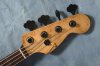
So when I looked at Luretta's headstock, it seemed a bit empty where the Fender logo would usually go.
Warmoth gave me a decal with their happy-ass turtle on it, but I was NOT putting that on my dream bass. NO.
What Luretta needed was the hammer of Thor, carved from a piece of a lightning riven oak.
How about that for witchy magic?
Headstock 5x@100.jpg
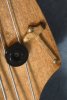
Thor Hammer detail_5x@100.jpg
My step daughter tells me that having a piece of a lightning blasted oak tree attached to
an electric guitar with brass tacks seems like not just asking for it, but BEGGING FOR IT...
like ZAPPO!

And yes, we bass players do have the elemental forces of the universe at our very fingertips
but my answer to my step daughter's very appropriate concern is:
"Lightning never strikes the same place twice..." *grins

Now, what about Raven, my black beauty? If this long winded post is well received, I could re-tell
the Raven story, but for now I'll just quickly say that Raven was a 1997 Squier bass given to me in bad condition.
I spent some time and effort turning her into a playable instrument up to professional standards
and succeeded. I used my experience with Luretta above, and ended up with a fine playing and sounding
P-bass. Since I had removed everything I could easily get to, and had rebuilt the instrument with high quality
parts (all black) and named her Raven, she was no longer a Squier bass.

I sanded off the Chinese decal. I threw away the rusty neck plate with the serial number.
And once again, the headstock seemed blank and empty. See Raven's picture above.
I bought some doll eyes at a craft store, and briefly considered gluing one of them to the headstock in Drogon fashion, but... nah.
So I ended up carving a Raven out of some leftover Ebony headstock veneer. I made a couple of prototypes, the first one out
of balsa just to see how I would like it
Raven Headstock 2@100.jpg
He likes it! Hey Mikey!
So I made another one out of the real Ebony and was immediately unhappy with it.
Raven Headstock 6@100.jpg
Too big, too coarse looking, ...when you work hard and carefully on something, you want to like it
but I could not like this one and pried it off after one day. Let's start over.
raven headstock 2016.jpg
So this is Raven's third bird, and I'm sticking with this one. I learned a lot
during this, and ended up with two fine custom basses, one by design and one
by accident. I am very fond of Raven, but Luretta has that fretless mwah sound
that I don't think can be modeled or obtained any other way but the right way.

Here's what Luretta sounds like:
https://soundcloud.com/michael-hough-5/shadows-on-the-shore
and there it is.
 
Last edited:
Back
Top