Bridge pins and acoustic guitar tone

Col Mustard

Ambassador of Perseverance
Country flag
I was reading posts on the "unofficial Martin Guitar forum" again, and guys
were discussing the effect that changing out bridge pins has on guitar tone.

Remember now, we're in the room that Dylan built, along with Andres Segovia and Hank Williams
and Bert Jansch, Doc Watson, Merle Travis, Robert Johnson, Taj Mahal, and a host of others...

In THIS forum, tone wood is crucial. For an acoustic guitar, it's all you have to work with, besides
pick material, pick attack, fretting hand technique, picking hand technique, rhythm and the
signal chain of yer pedal board (which is another thread, below).

WHAT'S THE BEST MATERIAL TO USE FOR BRIDGE PINS, AND WHY?
Bridge 2@100.jpg
So who's got experience, which can form an opinion?

Who's got an opinion based on nothing but prejudice and testosterone?

Who's got an opinion based on rich imagination, or conversely on rigorous
Scientific knowledge?

I'm okay with all that, you know this by now.

I've tried lots of different ones... Bone, Ebony, stock cheapo plastic...
In the '70s I could walk into a music store and buy a set of Ivory bridge pins
and I did. (I removed those years later when planning to cross borders with
the guitar, and never put them back)
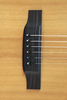
Bridge@100.jpg
Also in the '70s, when mod fever was sweeping country, I tried Brass. *grins
I know, I know... but it was the times, man. We tried all kinds of weird stuff.
I made myself a bridge saddle out of brass too.... somebody said it would give the
guitar more sustain. *laughs

It did, but the instrument sounded like the brassy bells of Hades, and I took it out
very soon, and made a new saddle out of bone, and was much happier.
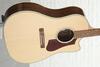
10128031-angle-xlarge.jpg
My new Gibson came with bridge pins (and saddle) made of Tusq... Those are new to me.
So I might try Ebony and see if it makes a difference. Bone pins are pricey now, man.
But they might be the best. I like Ebony, and I have a set, so I'll have to sand them a bit
and install them next string change. I already know I like Tusq.

Stew Mac offers bridge pins made of 'Snake Wood"
which sounds a bit kinky maybe, but also might be carved out of recycled pallets,
soaked in Snake oil. They offer a set made of 'tortoise" .....
... would that be courtesy of Arizona Highways, maybe?

What if it makes NO DIFFERENCE!!!!!??????
Should I save up for a set of Fossil Mammoth Ivory bridge pins...
Will I get more sustain? Longevity...? A woollier sound? Heavy music...

Then we'll see... oh yes Precious... we'll see indeed. Wooly Bully... Watch it now.
 
Last edited:
Personally, I’d think the bridge pin material would have less of an effect on tone than the saddle and bridge material.

Did you notice a difference in the past when you’ve tried bone, ebony, plastic, and ivory?

To be honest, I have to admit that I’ve never thought about the influence of the bridge pins on tone. I never knew it was a thing! I’ve just kept the stock pins.
 
Last edited:
Interesting topic; seems there could be legitimate differences.
Maybe help brighten or subdue brightness based on the host guitar's character.
Sounds like a whole 'nother arena for lots of snake oil too.
 
BEHOLD BOYS --- the
power pins!!!!!!
powerpins.jpg


Review here
Gear Review: Power Pins 2.0 Replacement Bridge Pins
 
No scientific answers from me, but I'm also curious as to what effect that those little pins have on the overall tone & performance from an acoustic.
Most seem to be ebony in better guitars and white or black plastic in cheaper ones.
Some plastic pins even have little rhinestones in them, they must be there to enhance tone. :confused:
The aftermarket is flooded with "alternatives" bone, brass, Tusk etc...

So are some better than others?
Obviously plastic is a poor choice, but prevalent in many many acoustics . No doubt used due to low cost and ease of manufacturing.
It works but I've extracted & replaced many broken plastic pins that people jam into the pin holes incorrectly.
Brass? I've never seen them stock on any guitar.
I'm sure elephant ivory had it's place in pre war guitars but it's unobtanium now, replaced by mammoth & walrus ivory which is quite pricey @ about $100 per set.
Ebony seems to be pretty widely used and is my go to choice due to availability. Also my choice for replacing plastic pins.
The Tusq pins may well be a good choice, but I've never tried them.
 
I've never thought much about the bridge pins affecting tone. It seems like the bridge would affect it more. I've used ivory and plastic through the years.
 
My music partner's '67 Martin D-35 is a beautiful instrument...
Well sonically it is. He's been playing that one instrument since 1976, and has
worn the finish off in many places with nothing but his own skin and fingernails.
Personally, I think that's beautiful too.

Anyway, its tone is magical IMHO. David's dreadnought has a wonderful deep
bottom to it, and when we do a house concert or other unamplified performance,
it turns heads. It also rings with fine clarity and grace all the way up the neck.
So it's a real prize.

But that legendary Martin boominess has been difficult for some sound men to
deal with. He uses medium gauge strings (013s) and tunes it a full step low.
Which makes it even deeper... When given a sound man who knows how to mike
that guitar, it sounds remarkable. When we have the sound man's brother in law
on the board, or a well meaning volunteer with a wonky hearing aid, it can be
obnoxious.
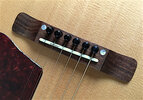
D-35@100.jpg
So he uses three brass bridge pins, on the lower three strings, and that brightens
up the bottom and makes the guitar easier to mix. I noticed it right away when he
installed those, because I'm the one who has to accompany him on bass. If he
doesn't pay attention to where he's standing (in front of his mike), or the sound man
doesn't know how to EQ a Martin guitar, he gets a huge, deep bass roll-off kind of
feedback... and people look at me, thinking it's my bass doing it.

This is what I meant by opinion that comes from experience.

Not my circus, not my monkeys. I tend to favor guitars that don't howl like a
baritone banshee... and I plug in to my illustrated paddle board which gives me
lots of presence and zero feedback. And I tend to play my bass with more treble in
the signal, to avoid us stepping on each other. When Libby accompanies me on her
Hofner bass, our signals compliment each other very well.

And when I play my acoustic alongside David's our two tones seem to meld well
also... His deeper tones complimented by my sweeter & brighter ones. But it's a new
year. I've got a set of Ebony pins in my Martin XC1T, and feel that they rounded the
tones of that smaller-box guitar nicely, which I like. It came with 'regular plastic," which I
replaced immediately. Ebony bridge pins don't cost as much as Mammoth Ivory,
so I might try a set in my Gibson. I'm planning to record some new songs with that
guitar, so I'll likely go into the studio first with the tusq pins, and then swap, and
then listen.

Sometimes a small difference makes a big difference.
 
Last edited:
My snake oil senses are tingling on these...
Completely takes the interaction of the bridge plate and ball end of the string out of the equation.
Also looks as it would affect the break angle over the saddle as well.

Not buying it.

See, that's why I started this thread... Where do you guys get this stuff? *laughs

Sometimes, we pay extra for a guitar that has the world's best designers who designed it
and the world's best craftsmen who build it out of the world's best materials... and then we
buy some dang gizmo that's advertised to take the interaction of the bridge plate and the
ball end of the string out of the equation. It's the quest fer tone, man... fer shure...

I'm not buying it either, unless it's to install in my dad's old Stella. (Oh no, we gave that a
well deserved Viking funeral). When we buy a decent guitar, what we are paying for is
the interaction between the ball end of the string and the bridge plate, which is connected
to da guitar top, which is connected to da guitar bridge, which is connected to da bridge
saddle, and the vibrations of all these components are amplified by the guitar's box shape
to form the music we hear. Held in place FIRMLY by da bridge pins.
Gisele 79*@100.jpg
The "power pins" apparatus might get a signal out of a plywood guitar, and send it to a sound board
where it could be run through a rack of expensive f/x, and someone
might TRY to make it sound like music... but when you've paid a premium for a
guitar made with a rock maple bridge plate, good spruce top, good rosewood or ebony bridge,
bone bridge saddle and pins, you can expect to get good tone. And then tweak it by
swapping pins and listening... but not buy something to uncouple all this goodness.

for goodness sake...
 
Last edited:
So he uses three brass bridge pins, on the lower three strings, and that brightens
up the bottom and makes the guitar easier to mix. I noticed it right away when he
installed those...

Well, slap me with wet noodle...who woulda thought!

I didn't.

Interesting stuff...
 
Are we having fun yet?

Thanks for all the great responses. I couldn't find a clear photo of David and his D-35 with
the three brass bridge pins until today, so i inserted it above. Those really do make a difference
when it came to the bottom tones of that particular Martin.

And it still sounds wonderful. So he hasn't given up anything valuable IMHO... just some
overbearing bass overtones that were difficult to mix properly.

Not only that, but I've just got home from a gig, where I got to play my Gibson J-45 with
a set of Ebony pins installed.

Here's the result as I'm hearing it: The Ebony bridge pins have warmed up the tone of my
new guitar. I installed them yesterday (Saturday 12 Jan 2019). I had new strings on the Gibson
so I only loosened them enough to get the Tusq pins out and insert the Ebony replacements.
I had to sand the Ebony pins just a little, to get them to go down the holes.

I did this yesterday evening after dinner, and tuned her up to pitch and played her for more than
an hour... rehearsing songs I figured I might perform today. I noticed the difference right away.
Up to now, using the stock bridge pins made of Tusq... my Gibson was bright in the beginning and
has slowly gotten warmer and deeper sounding as I played her in practice and on the road.
It's been fascinating to hear the tone modify itself with use... just as we've heard that it does.

Adding the Ebony pins made an audible difference. Some of the high frequency overtones have
become less obvious. I'm trying to figure how to articulate something that I don't have any experience
with, having only played used guitars up to 2018. She doesn't sound quite as bright...
(Since I'm fond of intelligent and empowered women, this sounds weird coming from me!)
But I like the warmer and rounder tones I'm getting now. Not so bright, but still keeping the
native sweetness of this instrument.

There, that's as near as I can get. I don't have the technology to make a video, upload it to
utube and post the link. So I'll have to say it in words, as near as I can. I'll take a picture of the
Gibson with her new black pins and post it when I can.
 
I'd have to get me a spider & web tattoo on me arm, if I were going
to play that. AND a silver Viking arm ring...

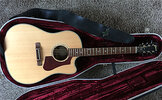
Here's what I have:
Zelda in case@100.jpg
Zelda, in the Hiscox case that used to hold my old Mossman dred that I sold.
Wearing the wide black strap that used to hold up my Fender J-bass that I sold.
AND sporting her new ebony bridge pins. Zelda is about one year old now, having
been made in Montana in January of '18.
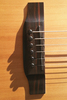
bridge@100.jpg
It's a cold morning light coming in my window... Michigan Ice light, you can see it in the
shadows on the bridge saddle (Tusq). When the guitar was new, I tried to get those ebony pins
in the holes and they wouldn't go. Too snug.

So I bided my time, and played this guitar. The strings seem to have vibrated themselves notches
into the wood of the bridge by now. That always happens. And MAYBE that's part of the mellowing
process that the tone goes through... an interesting thought. When the hole is brand new, how
does that effect the tone, and when the string is deeply embedded in the wood as it turns toward
the saddle, how does that effect the tone?

As a matter of fact, StewMac offers bridge pins "unslotted" ...
for those with old and worn guitars whose bridges are slotted with hard use...
And they offer "oversize" bridge pins if your bridge is getting sloppy from wear.

I know for a fact that if your bridge is so worn that the grooves are very deep, and
the bridge plate is so chewed up from careless (or hurried) re-stringing that the ball
ends are halfway up inside the hole... the twisted part of the string end can be pulled up
on your bridge and choke your tone, AND break strings right there. I learned this
the hard way, of course.
 
Back
Top