Brass vs. Steel Fender Tremolo Block:

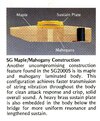
The differences arent massively distinct but it is there. I guess its the concept of heavier metals resonate longer and that is based on density of their cores. I remember the Yamaha SG2000 used a brass block beneath the tail piece studs, embedded within the cap to increase sustain and resonance and it did work pretty well

8a14d1ac650c49a54c251aec26594bae.jpg
 
I was contemplating this swap, the found this video...


It is said that zinc brings deadness...
However the 3 materials steel aluminum and brass can be mixed matched, and there is audio samples of all the materials and combinations to be listened to.

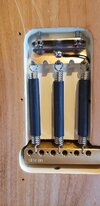
In addition I recommend using a damper to stop the springs inside the guitar from ringing / resonating...like just a piece of foam or whatever to prevent the springs from vibrating while the guitar is played.
The spring noise definitely mixes in with the guitar sound.
 
Cold rolled steel is a lot heavier and denser than zinc/pot metal. It's not surprising that the steel block will make for more sustain. Then there's good quality brass blocks that sustain more than the zinc stuff. Brass probably resonates a little differently than steel but now we are splitting hairs that already been split... :whistle:

Edit: BTW, I love the look of a shiny brass block on a guitar!
 
For me, there are so many variations that getting the "correct" block can be a bit of a challenge.

My MIJ Fender bridge is 52.5mm screw spacing and 10.5mm saddle spacing., which is the "narrow" version.

Next issue is depth of the cavity. Most Import Strats won't accept a block longer than 40mm, with 37mm being the "safe bet."
 
The differences arent massively distinct but it is there. I guess its the concept of heavier metals resonate longer and that is based on density of their cores. I remember the Yamaha SG2000 used a brass block beneath the tail piece studs, embedded within the cap to increase sustain and resonance and it did work pretty well
I see these kind of statements a lot, and it is a bit misleading. Sustain and resonance are polar opposites. If a material resonates, then it does so because it is robbing energy from the vibrating string, thus, sustain is decreased. If sustain is increased, it is because the material resonates less, thus letting the string vibrate for a longer duration.
 
Last edited:
I see these kind of statements a lot, and it is a bit misleading. Sustain and resonance are polar opposites. If a material resonates, then it does so because it is robbing energy from the vibrating string, thus, sustain is decreased. If sustain is increased, it is because the material resonates less, thus letting the string vibrate for a longer duration.

Good observations!!!
 
My 1987 Squire had a zinc block and it broke one day during a dive. I put a steel one in from AllParts.

Didn't really notice a big difference in tone, but it was a rush to get the guitar back in service.
 
  • Like
Reactions: RVA
I'm told the Squier Strats have a shallower body than Fenders. Didn't know other import Strats were thin too but it makes sense.
My only MIJ Strat is a Tokai from '80/'81, maybe before they began making 'em thinner.
Or perhaps it is shallower and I just never noticed... Never really considered changing the block on that guitar.

I do dislike the thin pot metal trem blocks; IMO any full thickness block probably would improve sustain.
Tonewise, steel seems pretty classic and brass definitely was a little rounder in a thin sounding guitar.
Never used an aluminum one. Certainly would shave a few ounces off the weight.
I like light guitars in general; don't recall encountering any Strats that were actually too heavy for comfort though.
I remember one pretty hefty ash-body Strat in the 70s, but I was young and strong back then.
 
Back
Top