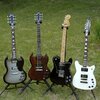
Gretsch was acquired by Fender in 2003.
Filtertrons are Gretsch's own humbuckers. They were said to have been designed by Ray Butts for Chet Atkins. Although the patent on the Filtertrons was granted later, historical evidence shows the prototypes were actually produced well before Gibson's humbuckers were released.
Before Gretsch switched to Filtertrons in 1957, Gretsch guitars mainly used DeArmond's 200 pickup, which known as the "Dynasonic" pickup in Gretsch literature.
There are a number of things to take into consideration when speculating where certain articles are produced and determining what percentage of parts are used from foreign sources.
Hamer had a USA line of pickups, made for them by DiMarzio, and later by Duncan, that carried the Hamer name.
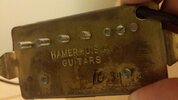
However, it is not clearly known what percentage of foreign parts may be used in the building of domestic pickups.
At a certain percentage of imported parts, a product can still be legally declared "Made In USA. " Beyond a certain percentage of imported parts a product must be labeled "Assembled in USA," and beyond that, a component must be declared made in the country of origin.
Gibson's facility, in Quingdao China, is very near to many other guitar and guitar part manufacturers. Two of the largest in this area are SSMII and Huyuan.
I have approached both and obtained production samples from both (including Swing Inc. and WMI in Korea) when my oldest son suggested we start offering an import line of guitars - an idea I later rejected in favor of keeping everything USA Made.
Step one in these discussions were signed non-disclosure agreements, which is SOP when dealing with intellectual property.

Since Gibson China is very secretive about what they do, and with good reason, you may be only able to speculate as to what parts are actually made in their facility. Gibson China likely has similar non disclosure agreements in place also, as one would expect.
I have been told, in my recent conversations with my contacts in China, that cargo trucks are in constant motion between the Gibson China facility and other nearby musical instrument builders, so one could speculate that some level of sub-contracting is in place with their Chinese plant.
Artec is one very large producer of guitar pickup raw components and they produce completed pickups for a number of OEM's. They also produce the GFS line as well.
One can easily examine the shipping manifests of various companies online and see what raw materials are being imported by a given manufacturer. That data is widely available.
When we were in talks with pickup winders recently about building pickups, before we went with a California company, we obtained some pickups from an Asian maker. To my surprise, one had a base plate clearly embossed "Gibson." When I emailed my contact the photo, he called me immediately.
I was asked not to post or retain any photos of the pickup in question. My contact immediately issued a call tag and told me the base plate was a "controlled article" protected by confidentiality agreements which had been accidentally released.
The question is, does it really make a difference where the baseplates, bobbins and magnets are made, or where the wire is sourced??? For that matter, does it really matter where or by whom the pickups are wound as long as the end user likes the sound???
If winder A uses the same gauge of wire, same number of turns, same impedance, same materials and same magnet composition as winder B, you will have an identical product.
Everyone is going to hear something different in the sound and many things will influence what the ear ultimately hears, and many factors that people attribute to the pickup sometimes have little to do with the pickups themselves.
So in the end, a good pickup or a bad pickup is just a matter of opinion...