Bad tube?

I had no sound from user error at a gig once first song in. Everything was on. Guitar was up. Wireless on but no signal.
Then I saw it.
Dangling from the strap.
The shiny 1/4 inch plug swaying in a beckoning yet taunting fashion.
I plugged the cable from wireless into guitar and oddly, it worked...:rolleyes:

I also had the same thing happen during first song. NO time to troubleshoot, guitar was plugged in that time. So I grabbed a cable and went with that. When I went to change guitars I realized by jumping around I unplugged the cable from the wireless pack end attached to strap! It was obviously pulled too tight.
Sigh..
Now I leave a loop of slack in the cable.
 
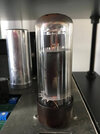
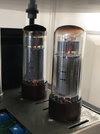
I just turned the amp on and this time I turned out the lights and can now see that one of the 6v6s is blowing blue. I couldn't see it until I shut off the lights.
Glowing blue is OK normal.
Older style tubes:
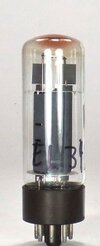
You can tell a lot by the silver inside the glass. If it's turned mostly black then it's time to replace the output tubes.
Newer style tubes:
Have no mercury, and the inside of the tube is black even when it's new.

One trick is to swap the output tubes around and see if the problem follows the tube or stays in the same socket same place.

Another cause of a problem like this is a blown speaker.
Try a different speaker to make sure that's not the cause.
 
Unfortunately not too specific information ... but a probabilistic argument: preamp tube tend to last "forever" - power tubes need to be changed more often. In Your case i would by a new pair of 6V6 and keep the old ones as backups.

BTW are there visible sign of tube aging in the glass?
Preamp tubes do not last forever, preamp tubes go stale and it's really common.
I change a preamp tube or 2 almost every time I work on an amp because they can get weak or noisy.
They do become microphonic and sometimes distorted...
If you have one good new 12AX7 swap it out with the old ones, one at a time.
Retest each time you swap an old tube out.
By process of elimination you can find a bad preamp tube.
No you do not really need a whole set of new tubes. Just one new one will help you find the bad one by swapping them and retesting.
But it is great to have spares if you can afford to buy them...swapping is the poor man's method and it does work for sure.
 
Preamp tubes do not last forever, preamp tubes go stale and it's really common.
I change a preamp tube or 2 almost every time I work on an amp because they can get weak or noisy.
They do become microphonic and sometimes distorted...
If you have one good new 12AX7 swap it out with the old ones, one at a time.
Retest each time you swap an old tube out.
By process of elimination you can find a bad preamp tube.
No you do not really need a whole set of new tubes. Just one new one will help you find the bad one by swapping them and retesting.
But it is great to have spares if you can afford to buy them...swapping is the poor man's method and it does work for sure.

Greg shared with me a nearly new tube that read "worn" the tester, then "good" and shortly thereafter went microphonic...
 
This is what it was. I have to play at really low volume most of the time where I live. I usually don't touch the volume but I must have bumped it or something and didn't realize it. It was turned just a hair too low so it started to cut out, but not enough to notice a difference in the volume. I turned it up a little and everything was back to normal. Stupid of me not to check that first, it's not the first time that's happened, but when it happened before I knew why because I had messed with the volume.
 
Last edited:
Greg shared with me a nearly new tube that read "worn" the tester, then "good" and shortly thereafter went microphonic...
Tube testers are not entirely accurate.
A normal consumer tester tells you about 40% of what you need to know.
The only real test is to run it in the circuit.
The consumer tester misses microphonics, noise, hum, distortion entirely.

Well, this is why there are so many crap tubes that "test good."
Don't rely on consumer tube testers.

The lab test is different.
It is far more accurate and expensive.
This will often include a spectrum analyzer, and several listening tests that detect microphonics and noises.

The best tubes were Bugle Boy, they were tested better than any others in a lab. And they became so impractical and expensive because 90% of the tubes tested were rejected.

The best tubes around today are actually made by JJ.
These tubes are lab selected and labeled "Telefunken" or "Black Diamond."
These tubes are considered to be the world broadcast standard.
Used in Hi Fi, and other studio equipment.
However, these tubes are "clean," and may not be the best sound for guitar amplifiers.

The final sound is a matter of taste, and is subjective for a guitar amp.

1633812712532.png

Sorry there are no more Bugle Boy tubes left.
We bought them all. :pound-hand: too bad for you.
 
Last edited:
Older style tubes:
You can tell a lot by the silver inside the glass. If it's turned mostly black then it's time to replace the output tubes.
Newer style tubes:
Have no mercury, and the inside of the tube is black even when it's new.
While mercury has been used in rectifiers (like the type 83 or 866) & thyratons etc, it has not been used in audio valves. When used in rectifiers, thyratons etc, it was not used for "gettering" purposes, rather, to aid current flow from cathode to anode.
The "getter flashing", while most usually silver in color, can actually vary from grey, brown, silver or black when the valve is new, the color being dependant on the exact reactive "getter" metal(s) used & the speed/temperature of getter firing.
The getter flashing gets slowly "used up" by "gettering" the valve during use. It takes on an opaque appearance where it has been consumed.
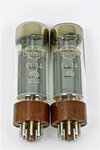
Below is a pic of two vary rare & desirable 1950's era Mullard xf1 EL34's with perfect getter flashing.16338276017362776590015199660894.jpg
Here are the same types showing getter flashing that has been "consumed".16338257242541406833652276057006.jpg
16338260225107598697004409049849.jpg
And a couple side-by-side. The one on the left appears to have less hours on it than the one on the right16338277494054303379907611608184.jpg
Notice the difference in the getter flashing on these two valves. The getter flashing can change colour over time during the gettering process, as it is reacting with impurities, gasses etc that evolve from the metal elements inside the valve ("getting" them out of the vacuum). Cheers
 
Ha ha... I absolutely hate JJ 12AX7's and JJ 12AT7's. I've had a lot of bad luck with them through the last 15 to 20 years. They're the only preamp tubes that ever pooped-out on me in a hurry!
Although some do not like JJ for guitar amps, they are still very widely used.

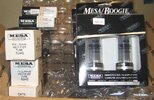
Mesa Boogie tubes are JJ, just double the price.
They pay for the label.
Of course Mesa is not superior as claimed, but just average.
If Fender and Marshall was not copied by Mesa, Mesa wouldn't exist.

I have used JJ for decades. The defects are pretty rare.
Although I admit that the Tesla JJ probably sounded better.

But I have seen Groove Tubes crap out just as often as JJ. Still not frequently.
Some of this is probably shipping damage.

I think JJ has taken some unfair criticism, based on internet rumors.
 
Although some do not like JJ for guitar amps, they are still very widely used.

Mesa Boogie tubes are JJ, just double the price.
They pay for the label.
Of course Mesa is not superior as claimed, but just average.
If Fender and Marshall was not copied by Mesa, Mesa wouldn't exist.

I have used JJ for decades. The defects are pretty rare.
Although I admit that the Tesla JJ probably sounded better.

But I have seen Groove Tubes crap out just as often as JJ. Still not frequently.
Some of this is probably shipping damage.

I think JJ has taken some unfair criticism, based on internet rumors.
Except Mesa does test them in amps and selects extra low microphonic ones as the SP tubes. Nice that they sort em and select matched pairs etc for you ahead of time. Rather than the crap shoog that is simply buying a bunch of CP tubes.
Groove Tubes does the same in some ways.
 
Except Mesa does test them in amps and selects extra low microphonic ones as the SP tubes. Nice that they sort em and select matched pairs etc for you ahead of time. Rather than the crap shoog that is simply buying a bunch of CP tubes.
Yes most good tubes are selected and tested for microphonics and noises... I know eurotubes tests them all before shipping.
JJ tubes do have a more flat kind of response and are not like others.
Some tubes are just wild with extra sensitivity, like Sino.
Sino might be good in a guitar amp but not in a Hi Fi amp.

But people who have said JJ is unreliable: I really haven't seen that. I have seen a few defects but not a whole lot.

There are those who think that all output tubes are exactly the same, or should be.
They think the bias range will always be uniform.

But there is really a wide variation and expecting all tubes to be the same bias, etc...is really unrealistic.
There is plenty of times that I adjust the bias range, and that is expected depending on which tubes.
I expect variations and it's not so unusual. After 40 years of working on tube amps I have seen lot of variety it doesn't surprise me.

Then you have Electro Harmonix which is selling EL34 / 6CA7, which is not a EL34 at all.
But it's labeled as such....using a tetrode and calling it the same number as a pentode.
This is really causing confusion. And the bias range is wayyyy different from a real EL34. It's closer to 6L6 than it is EL34.
 
Yes most good tubes are selected and tested for microphonics and noises... I know eurotubes tests them all before shipping.
JJ tubes do have a more flat kind of response and are not like others.
Some tubes are just wild with extra sensitivity, like Sino.
Sino might be good in a guitar amp but not in a Hi Fi amp.

But people who have said JJ is unreliable: I really haven't seen that. I have seen a few defects but not a whole lot.

There are those who think that all output tubes are exactly the same, or should be.
They think the bias range will always be uniform.

But there is really a wide variation and expecting all tubes to be the same bias, etc...is really unrealistic.
There is plenty of times that I adjust the bias range, and that is expected depending on which tubes.
I expect variations and it's not so unusual. After 40 years of working on tube amps I have seen lot of variety it doesn't surprise me.

Then you have Electro Harmonix which is selling EL34 / 6CA7, which is not a EL34 at all.
But it's labeled as such....using a tetrode and calling it the same number as a pentode.
This is really causing confusion. And the bias range is wayyyy different from a real EL34. It's closer to 6L6 than it is EL34.
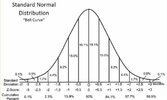
Yes, valves, or tubes of the same type can vary quite a bit characteristically. Typically, they are roughly graded at the manufacturers plant using the "bell curve" system to find which do not make the grade & which go on for further testing/grading etc. This is your typical bell curve16341575445336425468875640691499.jpg
The tubes that test in the center of this bell curve are testing close to ideal. As we move outward from the centre of the bell curve the tubes are testing further from ideal, until we get to where they don't make the grade.

The Shuguang EL34B is another "beam tetrode" type & so not really an EL34. Cheers
 
I think JJ has taken some unfair criticism, based on internet rumors.
JJ once had problems with pins slightly too thin (measured) with ECC83 and EL34 which sometimes lead to contact problems and also reliability problems with their standard EL34 (which i am using in an old Dynacord amp, but at average voltages, not at 750V). Good sound, up to now no problems.

All tubes except the EL34 appear to behave quite well, and, for example their KT88 is said to be more reliable under rugged electrical conditions than many others.

The warnings on the EL34 mostly regard the operation close to the voltage limit which i actually do not really understand, because that means relatively small currents in the tube. One of the major vendors in Germany told me to reduce the grid leak resistors. These are often too large because the designers of those days did not take into account the internal resistance of the bias circuit which is in series with the grid leak and therefore contributes to it. But that vendor still sells RCF tubes (for twice the price of the standard JJ EL34).
 
Back
Top